Wei Collection, Lower Volume
Radical: Meat (ròu)
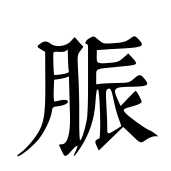
Shèn
Kangxi Stroke Count: 13
Page 983, Entry 25
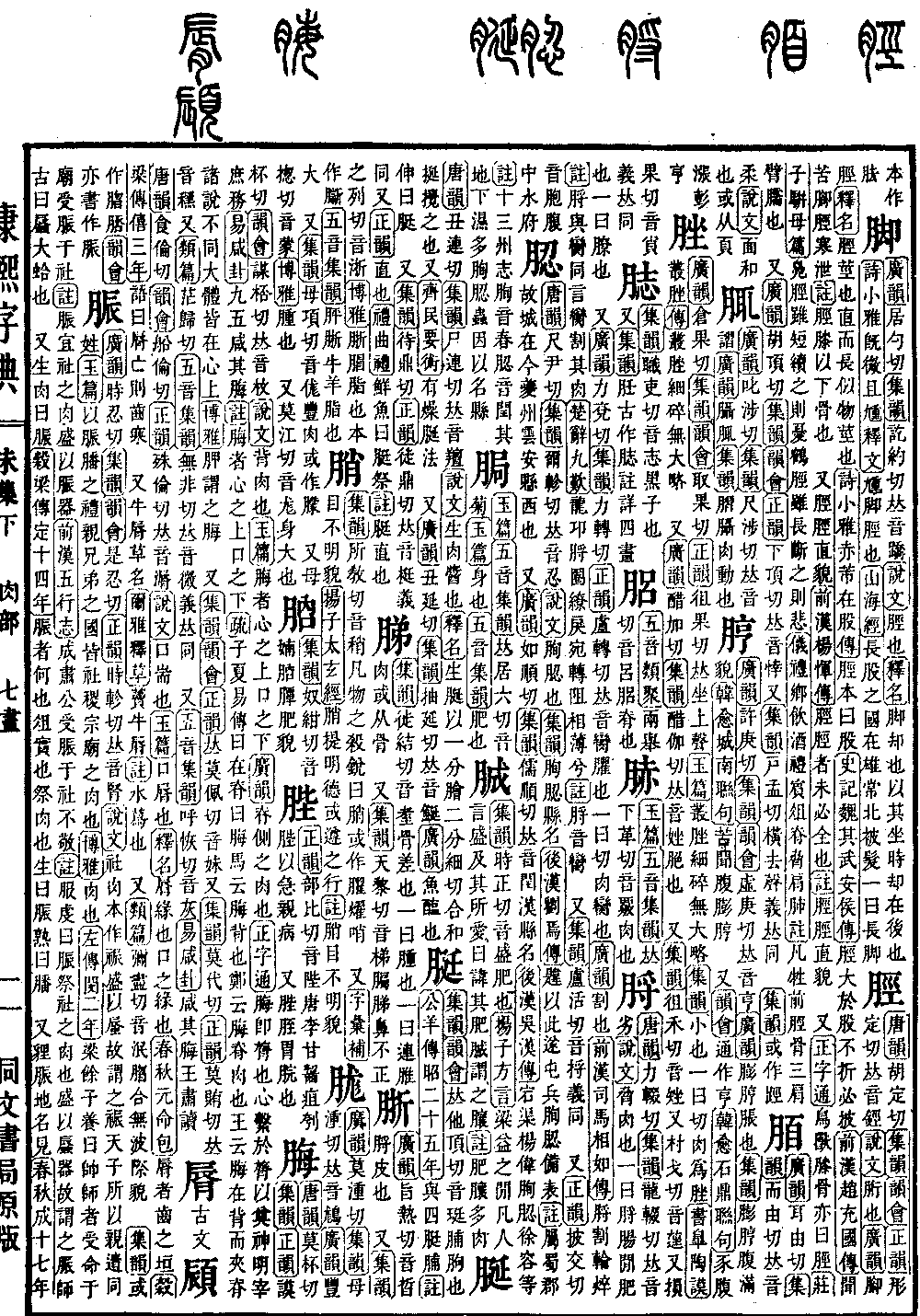
According to the Guangyun (Guangyun), the Jiyun (Jiyun), and the Yunhui (Yunhui), the pronunciation is shèn. According to the Zhengyun (Zhengyun), the pronunciation is shěn.
According to the Shuowen Jiezi (Shuowen), it refers to the sacrificial meat of the earth god. Originally written as a variant form (shèn). It was contained in a clam shell, hence the name, representing the meat the Son of Heaven would send to his kinsmen.
According to the Yupian (Yupian), the ritual of distributing sacrificial meat was used to show affection toward the states of one’s brothers, referring to the meat from the altars of the soil and grain or the ancestral temple.
According to the Boya (Boya), it means meat.
In the Zuo Commentary (Zuozhuan), during the second year of Duke Min, it is said: Liang Yuzi Yang stated that those who lead armies receive their orders at the temple and receive the sacrificial meat at the altar of the soil. The commentary notes that this refers to the sacrificial meat for the soil god, contained in a sacrificial vessel.
In the History of the Former Han (Qianhan Shu), in the Treatise on the Five Elements, it is recorded that Duke Chengsu received the sacrificial meat at the altar of the soil but was not respectful. The commentary by Fu Qian states that this refers to the sacrificial meat for the soil god, contained in a clam shell vessel, hence the name. Yan Shigu notes that it refers to a large clam.
Also, raw meat is called shèn.
In the Guliang Commentary (Guliang Zhuan), during the fourteenth year of Duke Ding, it asks what shèn is, defining it as the meat placed on the sacrificial stand, the sacrificial meat. Raw meat is called shèn, cooked meat is called fán.
Also, Lishèn is a place name, appearing in the Spring and Autumn Annals (Chunqiu), seventeenth year of Duke Cheng.
Also, Wushèn is a person's name. In the Zhuangzi (Zhuangzi), in the chapter on the fullness of virtue, it is mentioned that Wushèn spoke to Duke Ling of Wei, and Duke Ling was pleased with him. The commentary notes that Wushèn is a name.
In the Jiyun (Jiyun), it is also written as a variant form.