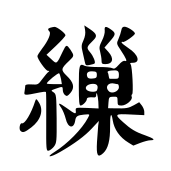
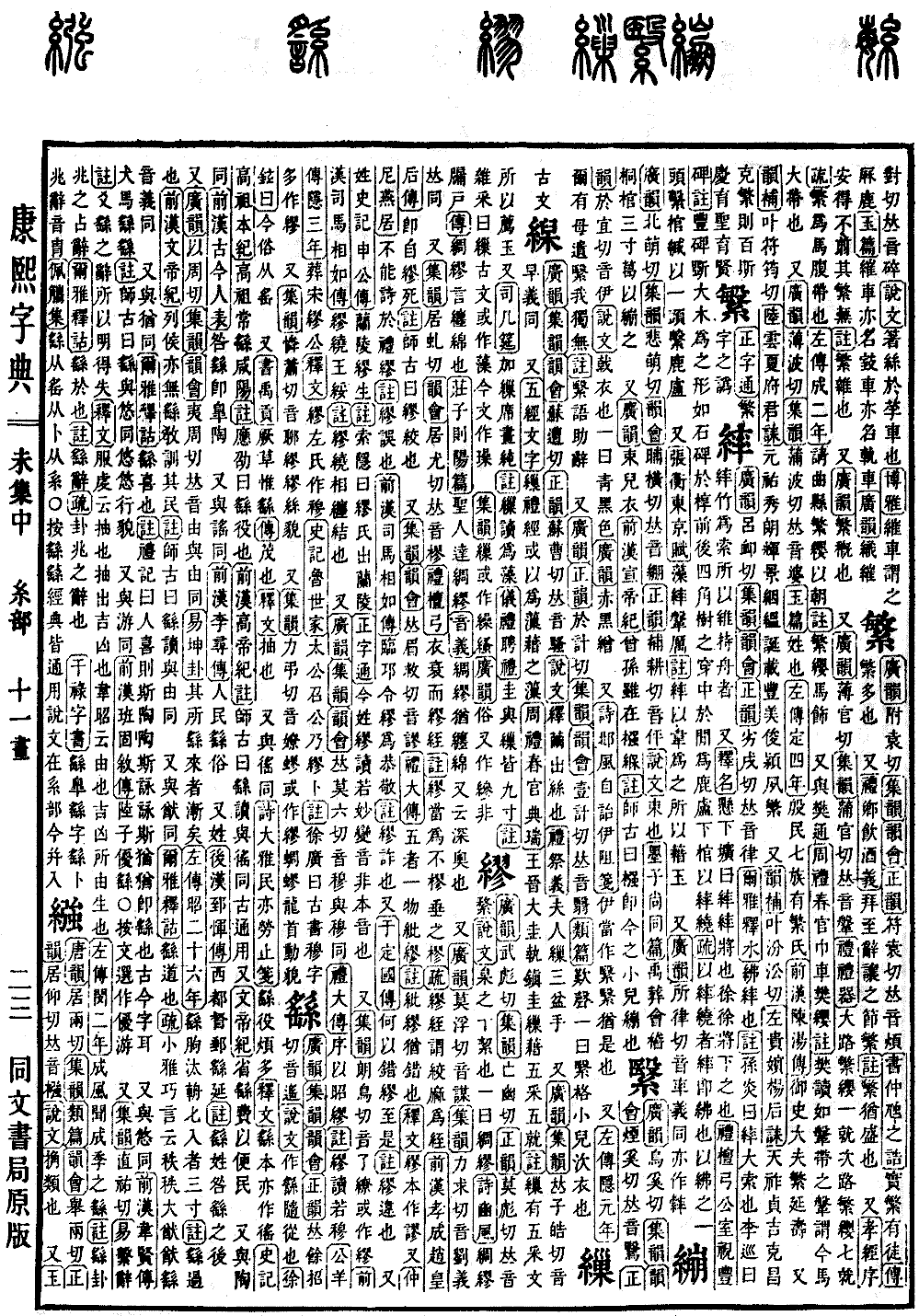
Wei Collection, Middle Volume. Radical: Silk (mì). Kangxi stroke count: 17. Page 937, Entry 06.
Ancient form. Pronounced sao. Pronounced sao.
According to the Explaining and Analyzing Characters (Shuowen Jiezi), it refers to the process of reeling silk from cocoons. According to the Book of Rites (Liji), specifically the section on Ritual Observances, the wife of the sovereign immerses her hands into the basin three times while reeling silk.
Also pronounced zao. The meaning is the same.
According to the Five Classics Characters (Wujing Wenzi), this character is sometimes used for the term zao in the phrase zaojie. In the Rites of Zhou (Zhouli), section on the Ministry of Spring, under the Office of Auspicious Objects, it is stated that the king holds the great jade scepter and the stabilizing jade scepter using a silk pad embroidered in five colors, with each color appearing five times. The commentary states that this silk pad features five-colored patterns and is used to cushion jade objects. In the section on the Office of Mats, it refers to the layered mats with colored ornamental edges. The commentary notes that this is pronounced zao. In the Ceremonial Rites (Yili), section on the Appointment Rites, the jade scepter and the silk pad are both nine inches in length. The commentary states that multicolored ornaments are referred to as sao. In ancient texts, it is sometimes written as zao. Modern texts write it as zao.
According to the Collection of Rhymes (Jiyun), it is also written as cao. According to the Broad Rhymes (Guangyun), the common form is written as shan, which is incorrect. According to the Explaining and Analyzing Characters (Shuowen Jiezi), it is written as sao. Detailed notes provided under the entry for sao. The character was originally written with the element for mortar.