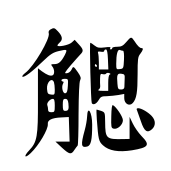
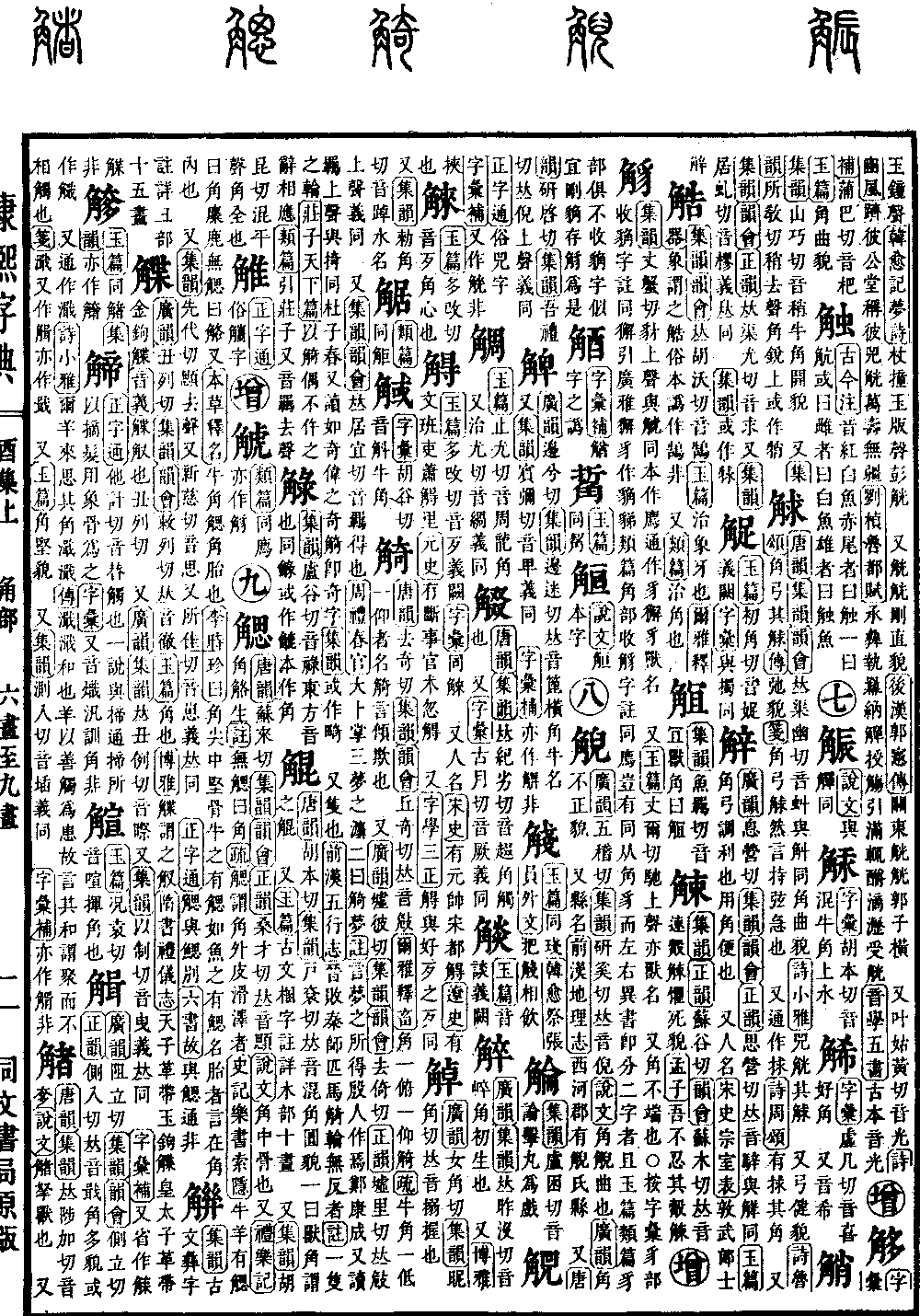
Zi Collection, Page Position: Upper, Radical: Horn (jiǎo), Page 241, Entry 03
Pronounced sai (falling tone).
"The hard bone in the middle of a horn." — Shuowen Jiezi (Shuowen)
Also, "horns and antlers grow." — Book of Rites (Liji), "That which is without a sheath is called a horn." — (Note) "Sheath refers to the smooth outer skin of a horn." — (Commentary) "Cattle and sheep have sheaths, called horns; elk and deer do not have sheaths, called antlers." — Historical Records (Shiji), "Book of Music" (Yueshu), "Subtle Meaning" (Suoyin)
Also, "Horn sheaths are horns, which are the fetus." — Herbal Classic (Bencao), "The tip of the horn is the central hard bone. Cattle have sheaths like fish have gills. It is called fetus because it is inside the horn." — Li Shizhen
Also, pronounced sai (falling tone). Also pronounced si. Also pronounced zai. Same meaning. — Jiyun (Jiyun)
"Sheath and gill are different." — Zhengzitong (Zhengzitong)
"Interchangeable with gill." — Liushu Gu (Liushu Gu)
Incorrect.