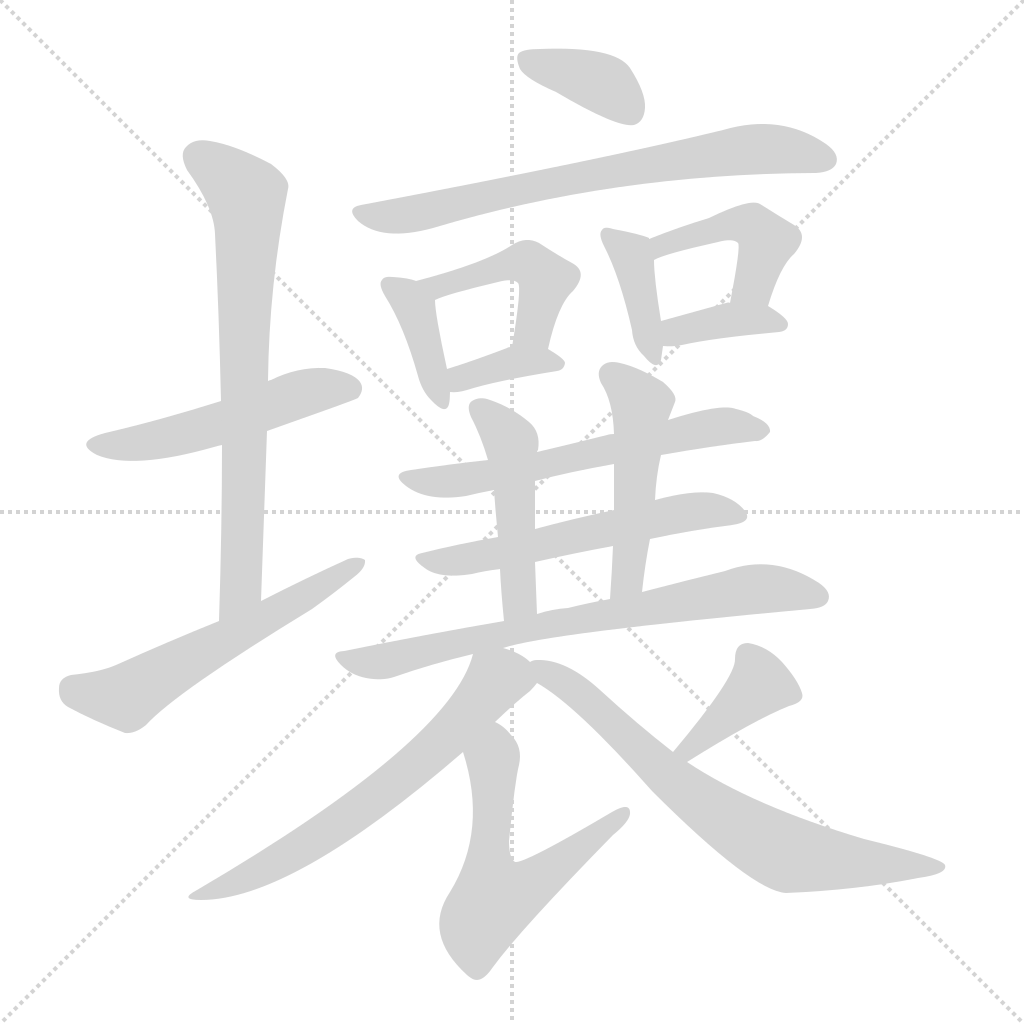
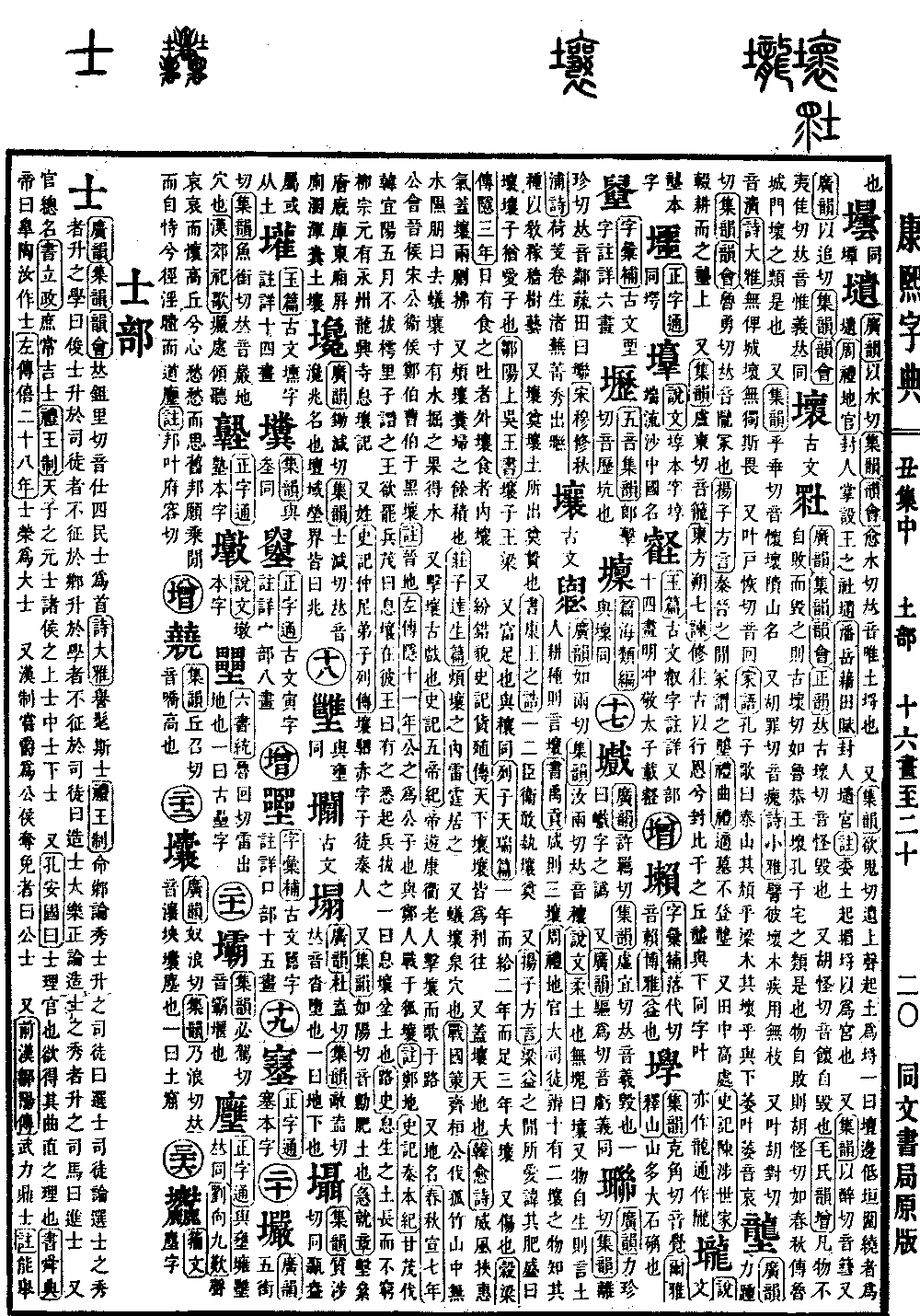
Chou Collection, Middle Volume. Radical: Earth (tǔ); Kangxi strokes: 20; Page 242, Entry 17.
In ancient scripts. Guangyun (Broad Rhymes) and Jiyun (Collected Rhymes) both state it is pronounced rang. According to the Shuowen Jiezi (Explanation of Simple and Compound Characters), it refers to soft soil; soil without clods is called rang. Furthermore, when things grow naturally it is called soil, but when cultivated by man it is called rang. In the Book of Documents (Shujing), Chapter Yu Gong (Tribute of Yu), it states: All followed the three grades of soil. In the Rites of Zhou (Zhouli), Section Earth Offices, Grand Minister of Instruction, it states: Distinguish the products of the twelve types of soil, understand their seeds, and teach the cultivation of crops and trees. Also, rangdian refers to the tribute offerings produced from the soil. In the Book of Documents, Chapter Kang Wang Zhi Gao (Announcement of King Kang), it states: The various ministers and guards dare to hold their offerings of the soil. According to the Yangzi Fangyan (Regional Dialects), in the regions of Liang and Yi, when people cherish someone for their abundance, they call them rang; rangzi is like saying beloved child. In Zou Yang’s Memorial to the King of Wu, it says: Cherishing the king as a son is like Liang. Also, it means wealthy or sufficient. It is the same as the character rang (abundance). In the Liezi, Chapter Tian Rui (Heavenly Portents), it says: In one year there is sufficiency, in two years there is abundance, in three years there is great prosperity. Also, to injure. In the Guliang Zhuan (Guliang Commentary), third year of Duke Yin, it says: When the sun is eclipsed, that which is cast out is outer rang, and that which is consumed is inner rang. Also, the appearance of being chaotic and confused. In the Records of the Grand Historian (Shiji), Chapter Biographies of Money-makers, it states: All the people in the world are bustling, all moving for the sake of profit. Also, gairang refers to heaven and earth. In a poem by Han Yu, it says: The majestic wind carries a gracious spirit, brushing against both heaven and earth. Also, fanrang refers to accumulated refuse or waste. In the Zhuangzi, Chapter Da Sheng (Mastery of Life), it says: Within the piles of waste, the thunder dwells. Also, yirang refers to an ant hill, often associated with water sources. In the Strategies of the Warring States (Zhan Guo Ce), it says: Duke Huan of Qi campaigned against Guzhu, and there was no water in the mountains. Xi Peng said: Where there is an ant hill, there is water an inch below. They dug and indeed found water. Also, jirang refers to an ancient game. In the Records of the Grand Historian, Chapter Annals of the Five Emperors, it states: The Emperor traveled to the crossroads, and an old man was playing the game of jirang and singing on the road. Also, a place name. In the Spring and Autumn Annals (Chunqiu), seventh year of Duke Xuan, it says: The Duke met with the Marquis of Jin, the Duke of Song, the Marquis of Wei, the Earl of Zheng, and the Earl of Cao at Heirang. The commentary notes this is a place in Jin. In the Zuo Zhuan (Zuo Commentary), eleventh year of Duke Yin, it says: When the Duke was a prince, he fought with the people of Zheng at Hurang. The commentary notes this is a place in Zheng. In the Records of the Grand Historian, Chapter Annals of Qin, it says: Gan Mao attacked Yiyang of Han, and after five months it was not taken; Chulizi slandered him, and the King wanted to withdraw the troops. Mao said: Xirang (growing soil) is there. The King said: I have it. He raised all his troops and captured it. One version says that Xirang is mound soil. The Lushi (History of the Way) states: It is soil that grows, expanding without end. Liu Zongyuan wrote the Record of the Growing Soil at Longxing Temple in Yongzhou. Also, a surname. In the Records of the Grand Historian, Chapter Biographies of Confucius' Disciples, it mentions Rangsi Chi, courtesy name Zitu, a man of Qin. Also, according to Jiyun, it is pronounced rang. It refers to fertile soil. In the Jijiuzhang (Quick Reference Chapters), it says: Bricks are stacked in the warehouse and stable, east wing, screen, latrine, and the dirt of the soil.