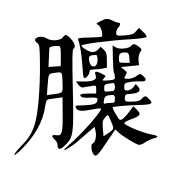
Zi Collection, Page Position: Upper, Radical: Person (rén), Stroke count: 7
Pronounced liǎng (falling tone)
Pronounced rǎng (falling tone)
Pronounced rāng (falling tone)
In the "Guangyun" (Tangyun), the pronunciation is noted as rú liǎng qiè. In the "Jiyun" (Jiyun) and "Yunhui" (Yunhui), it is noted as rǔ liǎng qiè, with a pronunciation similar to "rǎng." The "Shuowen Jiezi" (Shuowen Jiezi) records that in the dialects of the Yizhou region, to describe a person as physically strong and robust, it is taboo to directly say "fat," and instead they are called "nán." The "Boyao" (Boyao) explains that "nán nán" means fat.
Furthermore, the "Yangzi Fangyan" (Yangzi Fangyan) mentions that "nán" means grand or magnificent. This is a dialectal term used from west of the passes to the Qin and Jin regions.
Additionally, in the "Wuyin Jiyun" (Wuyin Jiyun), the pronunciation is noted as rǔ yáng qiè, with a sound similar to "rāng." The meaning is the same.