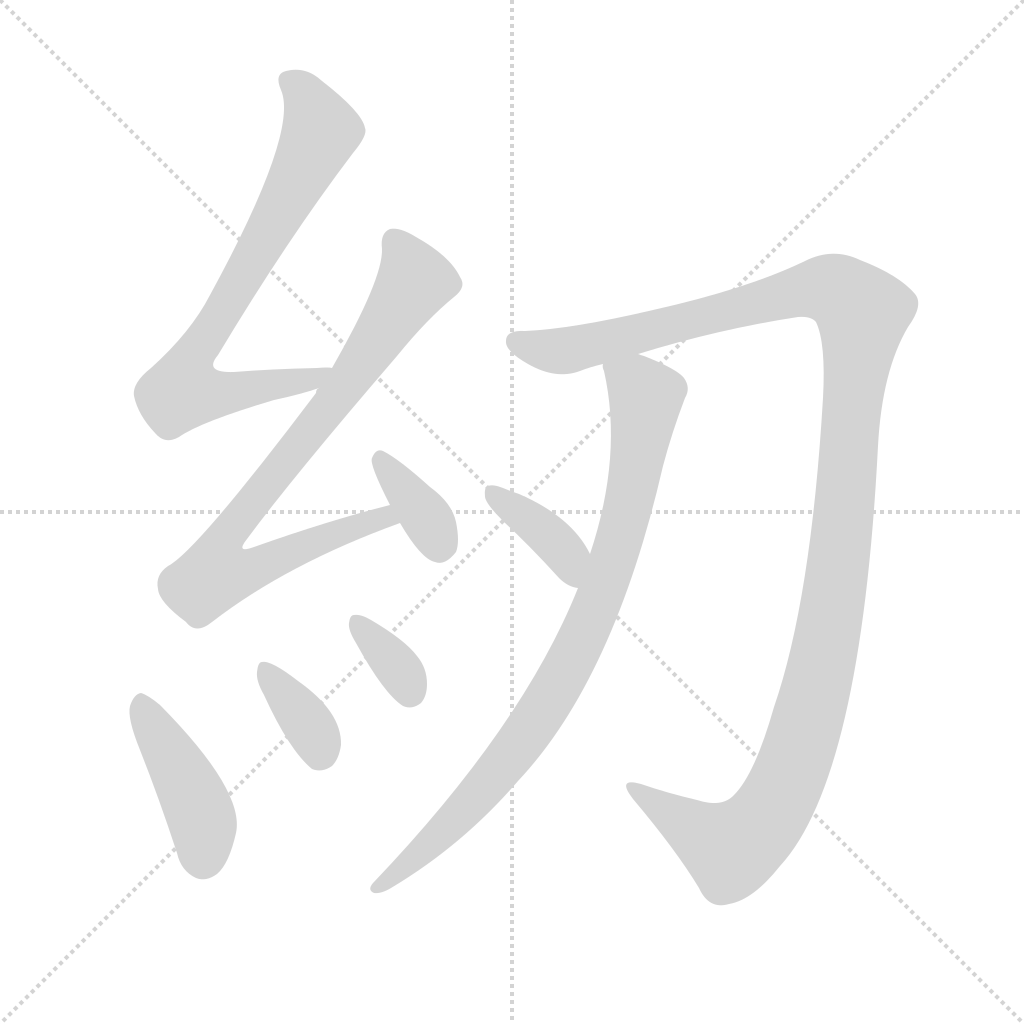
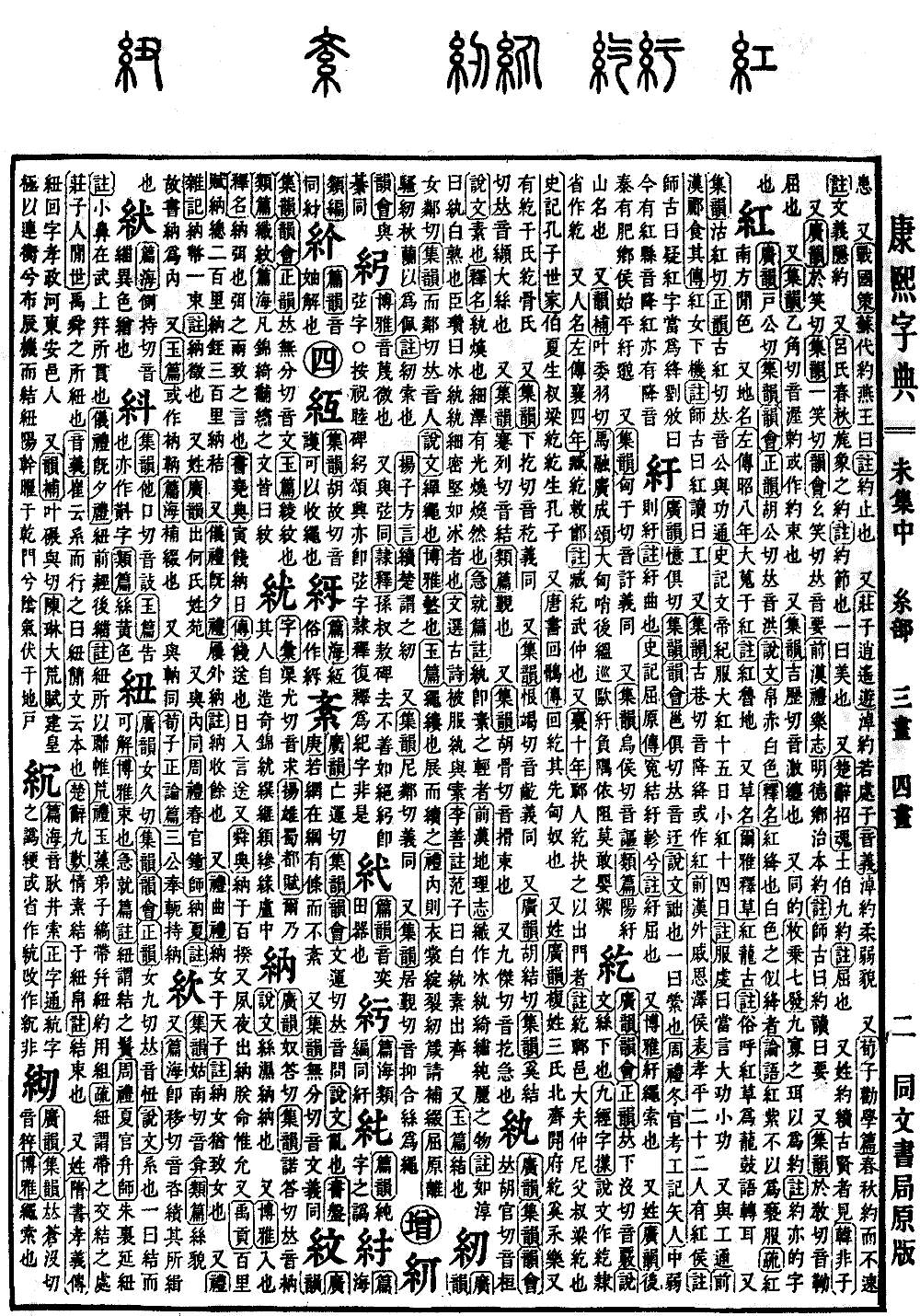
Wei Collection, Middle Volume. Radical: Silk (mì). Kangxi stroke count: 9. Page 916, Entry 05.
Guangyun: Pronounced ni (rising tone). Jiyun: Pronounced ni (rising tone).
Shuowen Jiezi (Explaining and Analyzing Characters): To twist or spin rope.
Boya (Fine Arts): To twist or distort.
Yupian (Jade Chapters): Silk thread; to stretch out and join together.
Book of Rites (Liji), Inner Teachings: When clothing tears, thread a needle to request mending.
Qu Yuan, Li Sao (Encountering Sorrow): Twist autumn orchids to form a string as an ornament. Commentary: To twist into a rope.
Yangzi, Dialect (Fangyan): To tear; in the Chu region, this is called ren.
Also, Jiyun: Pronounced er (rising tone). The meaning is the same.
Also, Jiyun: Pronounced jin (falling tone). Meaning: to combine silk threads to make a rope.
Verification: Guangyun gives the pronunciation as ni (rising tone); Jiyun gives it as er (rising tone), suggesting the pronunciation ren. Scholarly assessment: ni (rising tone) belongs to the niang initial, while er (rising tone) belongs to the ri initial; it cannot be pronounced as ren. Based on the original pronunciation in Jiyun, the pronunciation er (rising tone) should be changed to ni (rising tone), and the pronunciation ren should be corrected to ni (rising tone).
Yangzi, Dialect (Fangyan): To connect or continue; in the Chu region, this is called ren. Scholarly assessment: Based on the original text, the character for continue should be changed to one meaning to tear.
Also, Jiyun: Pronounced ni (rising tone). Scholarly assessment: Based on the original pronunciation of this character in Jiyun, the current entry should be corrected to the pronunciation er (rising tone).
Jiyun: Pronounced jin (falling tone). Scholarly assessment: The pronunciation jin (falling tone) cannot be pronounced as yi (falling tone); it has been corrected according to the first character listed under that pronunciation in Jiyun.