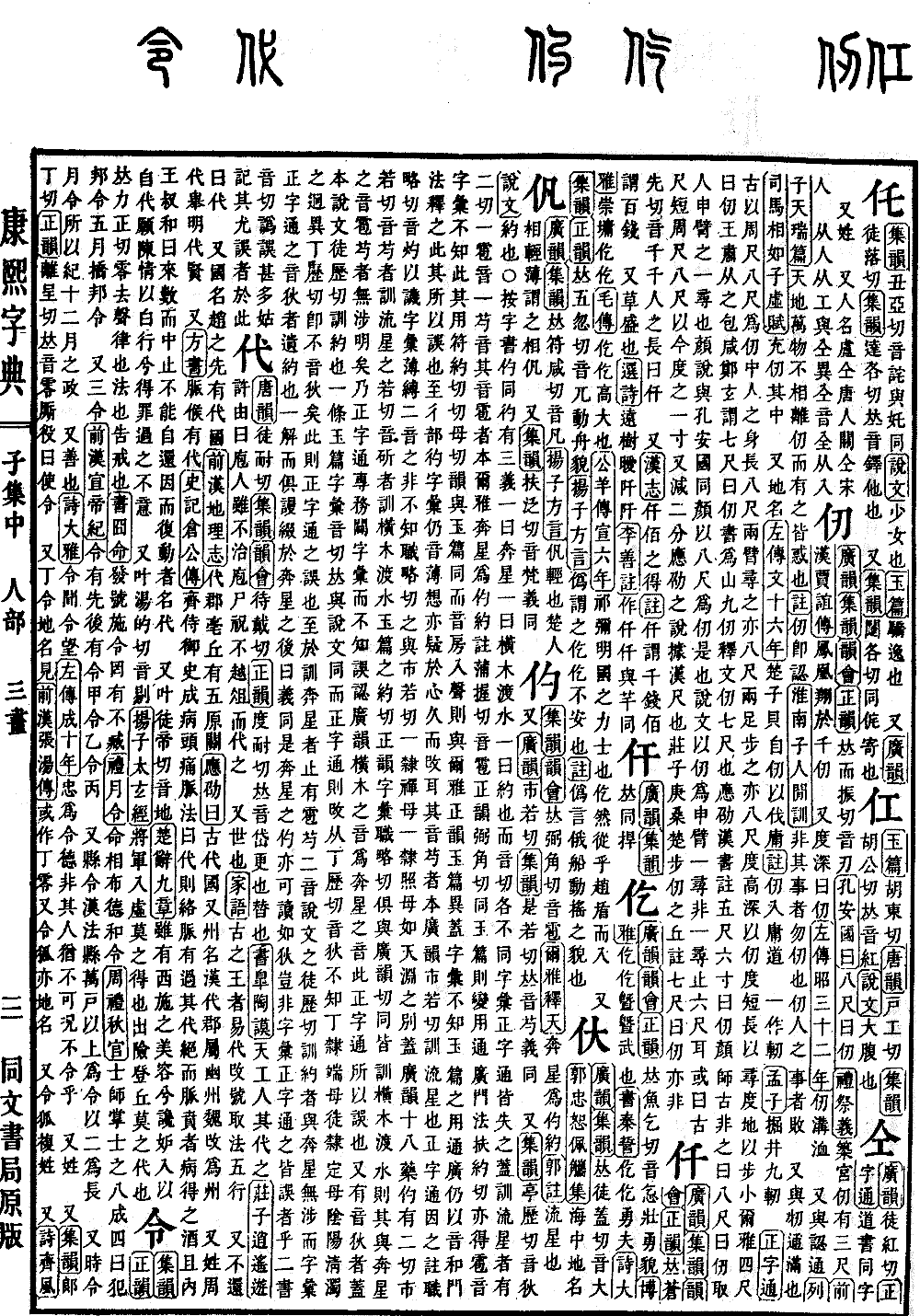
Zi Collection, Middle Volume Radical: Person (rén) ren; Kangxi stroke count: 5; Page number: page 93, entry 04.
Broad Rhymes (Guangyun), Collected Rhymes (Jiyun), Rhyme Meetings (Yunhui), Correct Rhymes (Zhengyun): Pronounced rèn.
Kong Anguo states: Eight feet equal one ren. Book of Rites (Liji), Ritual Meanings (Jiyi): Build the palace to a height of one ren and three feet. History of the Former Han (Qianhan), Biography of Jia Yi: The phoenix soars to a height of a thousand ren.
Also, measuring depth is called ren. Zuo Tradition (Zuo Zhuan), 32nd Year of Duke Zhao: Measuring the depth of ditches and canals.
Also, interchangeable with the term for recognize (rèn). Book of Liezi (Liezi), Heavenly Omens (Tianrui): Heaven, earth, and the myriad things do not separate from one another; to recognize them as one's own is all delusion. Commentary: Ren here is identical to recognize (rèn). Book of Huainanzi (Huainanzi), Human World Teachings (Renjianxun): Do not involve yourself in matters that are not yours. Those who involve themselves in the affairs of others will meet with failure.
Also, interchangeable with the term for fill (rèn). It means to be full or filled. Sima Xiangru, Rhapsody on Master Void (Zixu Fu): Filling the interior.
Also, a place name. Zuo Tradition (Zuo Zhuan), 16th Year of Duke Wen: The Viscount of Chu passed through Ren to attack the Rong. Commentary: Ren is the route used to enter the territory of the Rong. Sometimes written as a variant form (rèn). Book of Mencius (Mengzi): Digging a well to a depth of nine ren.
Correct Character Comprehensive Dictionary (Zhengzitong): In ancient times, the Zhou dynasty foot measurement of eight feet constituted one ren. The height of a person of average build, the span of one's outstretched arms, and the distance of a single stride were each approximately eight feet. Ren is used for measuring height and depth, xun is used for shorter lengths, and bu is used for measuring land.
The Small Erya (Xiao Erya) states that four feet constitute one ren; Wang Su followed this interpretation. Bao Xian and Zheng Xuan argued that seven feet constitute one ren. The Book of Documents (Shu) records a mountain of nine ren. The Commentary on Explanations (Shiwen) defines ren as seven feet. Ying Shao, in his Commentary on the History of the Han (Hanshu Zhu), notes: Five feet and six inches constitute one ren. Yan Shigu refuted this, stating: Eight feet constitute one ren, based on the length of a person extending their arms one xun. Yan Shigu's assertion aligns with that of Kong Anguo; Yan Shigu deemed the eight-foot measurement correct.
Analytical Dictionary of Characters (Shuowen Jiezi) claims that ren is the length of one xun with outstretched arms, which is incorrect. One xun is only six feet. Some suggest that ancient measurements were shorter; the eight-foot Zhou measurement, when converted to contemporary units, would be reduced by two-tenths of an inch. Ying Shao's assertion was based on Han dynasty measurements. The Book of Zhuangzi (Zhuangzi), Gengsang Chu: A hill of one bu and one ren. Commentary: Seven feet to one ren is also incorrect.