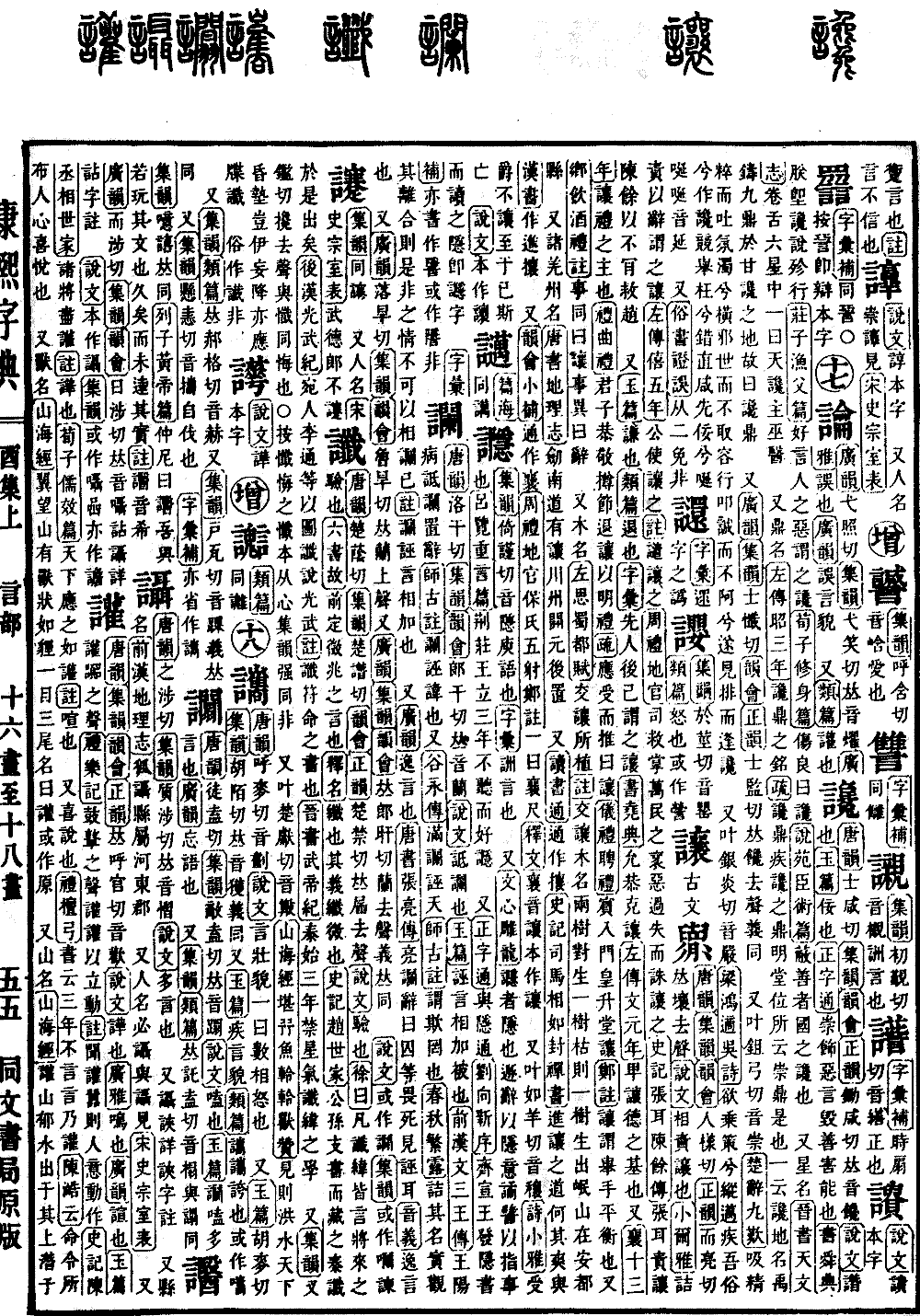
You Collection, Upper Volume
Radical: Speech (yán)
Kangxi Strokes: 24
Page 1187, Entry 12
Classical Citations:
According to Tang Rhymes (Tangyun), Collected Rhymes (Jiyun), and Rhyme Compendium (Yunhui), pronounced rang (falling tone). According to Correct Rhymes (Zhengyun), pronounced rang (falling tone). The pronunciation is similar to the character rang (falling tone).
Explaining Graphs and Analyzing Characters (Shuowen Jiezi) defines it as mutual reprimand.
Little Erya (Xiao Erya) defines it as questioning someone with words.
Book of Zuo (Zuozhuan), Year 5 of Duke Xi: The Duke sent men to reprimand him. Commentary: Defines this as to condemn and rebuke.
Rites of Zhou (Zhouli), Earth Officials: The Minister of Salvation manages the evil faults of the common people and reprimands them.
Records of the Grand Historian (Shiji), Biography of Zhang Er and Chen Yu: Zhang Er reprimanded Chen Yu for refusing to rescue the state of Zhao.
Also, Jade Chapter (Yupian) defines it as modesty.
Classified Chapters (Leipian) defines it as yielding.
Collection of Characters (Zihui) defines putting others before oneself as rang.
Book of Documents (Shujing), Canon of Yao: Sincerity and reverence lead to modesty.
Book of Zuo (Zuozhuan), Year 1 of Duke Wen: Modesty is the foundation of virtue.
Also, Year 13 of Duke Xiang: Modesty is the root of ritual.
Book of Rites (Liji), Summary of the Rules of Propriety (Quli): The superior man is respectful, self-restrained, and yielding in order to manifest the rites. Commentary: That which one ought to accept but pushes away is called rang.
Ceremonial Rites (Yili), Guest Rites: After entering the gate, the guest solemnly ascends the hall with modesty. Zheng Commentary: Rang refers to raising the hands to maintain balance.
Also, Commentary on the Village Drinking Rites: When matters are the same, it is called rang; when matters are different, it is called ci (declining).
Also, the name of a type of tree.
Rhapsody on the Capital of Shu (Shudu Fu) by Zuo Si: The place where the Jiaorang tree is planted. Commentary: Jiaorang is the name of a tree. Two trees grow facing each other; if one tree withers, the other grows. It originates from Min Mountain and is found in Andu County.
Also, the name of a Qiang tribe prefecture.
Book of Tang (Tangshu), Treatise on Geography: There was Rangchuan Prefecture in the Jiannan Circuit, established after the Kaiyuan era.
Also, Reading Through (Dushutong) records it as a phonetic loan for rang (to seize).
Records of the Grand Historian (Shiji), Treatise on the Feng and Shan Sacrifices: The path of advancement and yielding, how clear it is. The Book of Han (Hanshu) writes this as jinrang.
Also, Rhyme Compendium Supplement (Yunhui Xiaobu) records it as a phonetic loan for xiang.
Rites of Zhou (Zhouli), Earth Officials, The Protector, Five Archery Skills, Zheng Commentary: One type is called xiangchi. Interpretation: Xiang is pronounced the same as rang; originally written as rang.
Also, rhyming with the line, pronounced rang (rising tone).
Book of Odes (Shijing), Lesser Odes (Xiao Ya): Accepting a title without modesty, until one's own ruin.
Explaining Graphs and Analyzing Characters (Shuowen Jiezi) originally wrote this character in a variant form.