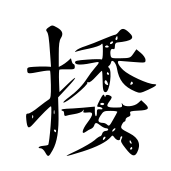
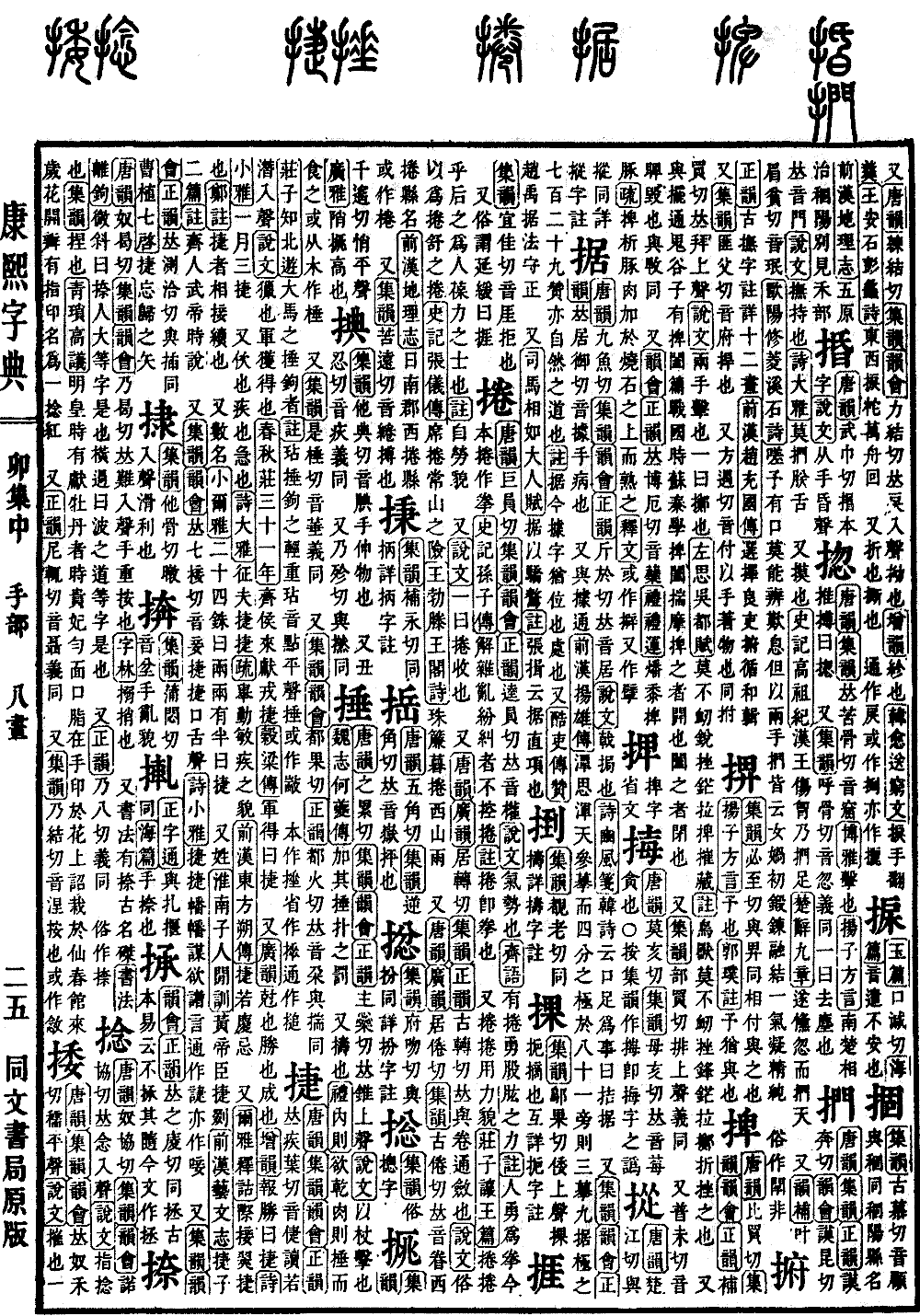
Mao Collection, Middle Volume. Radical: Hand (shǒu). Kangxi strokes: 12. Page 435, Entry 31.
Tang Rhyme (Tangyun), Collection Rhyme (Jiyun), and Rhyme Compilation (Yunhui) cite it as pronounced nuo (level tone). Explaining Characters (Shuowen) defines it as to break or destroy. Another source defines it as rubbing or pressing with both hands. Broad Rhyme (Guangyun) defines it as to rub or knead. Collection Rhyme (Jiyun) notes it is sometimes written in a variant form (rua). It is also written as (ruan).
Correct Rhyme (Zhengyun) cites it as pronounced na. The meaning is the same.
Tang Rhyme (Tangyun) and Collection Rhyme (Jiyun) cite it as pronounced rui. The meaning is the same.
Tang Rhyme (Tangyun) cites it as pronounced nai, and Collection Rhyme (Jiyun) and Rhyme Compilation (Yunhui) cite it as pronounced nuo, pronounced as indicated. This also refers to the act of rubbing objects with the hands.
Collection Rhyme (Jiyun) cites it as pronounced wei. It means to insert. It is also pronounced ruan (level tone). It is identical to the character (ruan).
It is also pronounced wo. It means to wrap around with the hands.
It is also pronounced wei. It means to caress.
It is also pronounced ruo (similar to the pronunciation of ruo). It means to knead or massage. This is a dialect of the Guanzhong region.
According to Xu Xuan in Explaining Characters (Shuowen), the contemporary common writing is (rua), which is incorrect. Note that (ruo) and (rua) are identical. They are used interchangeably in various books, so one need not be overly rigid about the distinction.