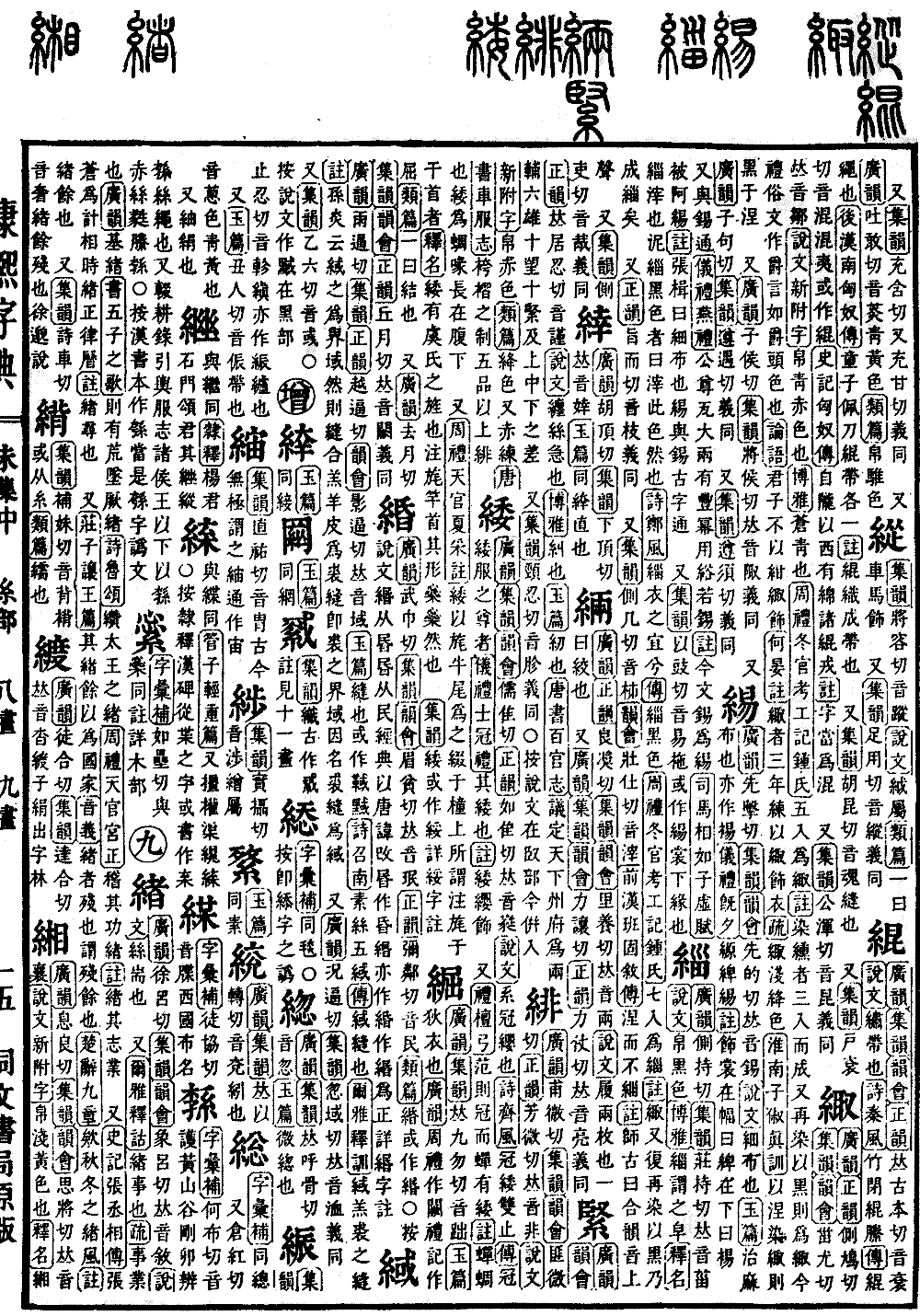
Wei Collection, Middle Volume
Radical: Silk (mì)
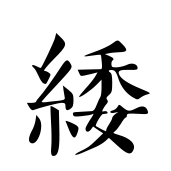
緌
Kangxi strokes: 14
Page 929, Entry 10
Pronounced rui.
As defined in the Analytical Dictionary of Characters (Shuowen Jiezi), this refers to the ribbons tied to a ceremonial cap.
In the Book of Odes (Shijing), under the Qi Airs, it is written: The ribbons of the cap hang down in pairs. The commentary states that the ribbons of a cap are a sign of honorable status.
In the Book of Etiquette and Ceremonial (Yili), under the capping ceremony for scholars, it says: The ribbons should be as follows. The commentary notes that these are decorative ribbons for the cap.
Also, in the Book of Rites (Liji), under the Tan Gong chapter, it says: Fan wore a cap adorned with cicada ribbons. The commentary notes that the cicada is a mantis-like insect; the ribbon represents the beak of the cicada, which hangs long below its abdomen.
Also, in the Rites of Zhou (Zhouli), under the commentary on the duties of the summer official, it says: The ribbons are made from the tail hair of a yak and attached to the top of a pole, commonly referred to as attaching a banner to the head of the staff.
As stated in the Explanation of Names (Shiming), the ribbon is the banner used by the clan of Yu the Great. When attached to the head of a banner staff, its shape hangs down loosely and gracefully.
According to the Collection of Rhymes (Jiyun), this character is sometimes written in a variant form (sui). See the detailed note under the character sui.