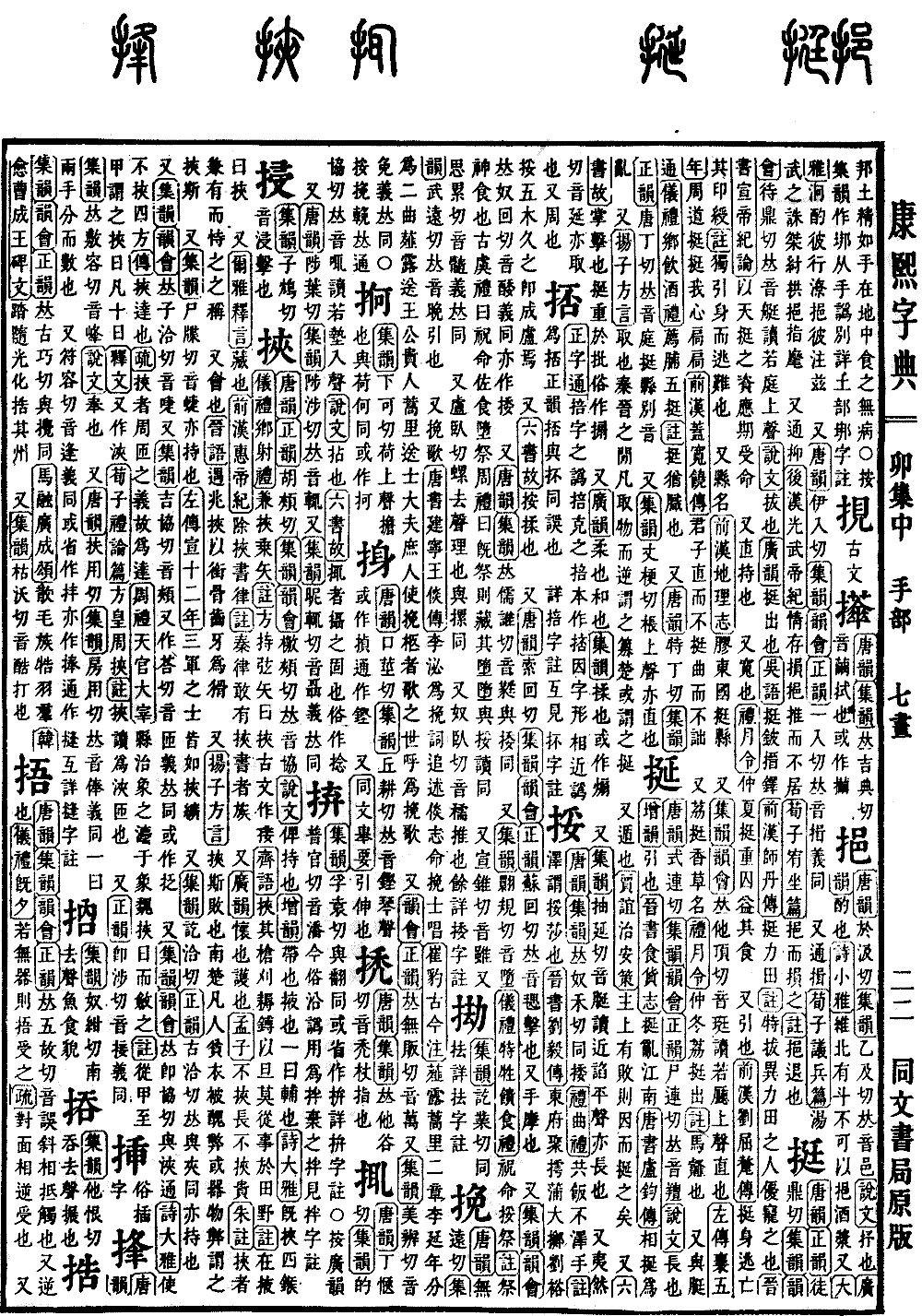
Mao Collection, Middle Volume
Radical: Hand (shǒu)
Kangxi Strokes: 11
Page 432, Entry 07
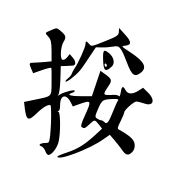
Tang Rhyme (Tangyun) and Collected Rhymes (Jiyun) state the pronunciation is nuo. It is the same as the character nuo. In the Book of Rites (Liji), record of etiquette: Do not moisten hands when sharing rice. The commentary states that moisten refers to the act of rubbing and kneading. In the Book of Jin (Jinshu), biography of Liu Yi: At the Eastern Prefecture, they gathered to gamble with dice. Liu Yu rubbed the five wooden dice, and after a long time, he achieved the winning throw.
Also, according to Origin of the Six Writings (Liushugu), it means to press and rub.
Also, according to Tang Rhyme (Tangyun), the pronunciation is suo, and according to Collected Rhymes (Jiyun), Rhyme Meetings (Yunhui), and Correct Rhymes (Zhengyun), the pronunciation is sui. It means to strike. It also means to rub with the hands.
Also, according to Collected Rhymes (Jiyun) and Rhyme Meetings (Yunhui), the pronunciation is nuo. The meaning is the same. It is also written as the character nuo.
Also, according to Tang Rhyme (Tangyun) and Collected Rhymes (Jiyun), the pronunciation is rui. It is the same as the character nuo.
Also, according to Collected Rhymes (Jiyun), the pronunciation is duo. In the Ceremonial Rites (Yili), rites for offerings of special livestock: The invoker commands the rubbing of the sacrificial offering. The commentary states that this refers to the sacrificial offering for the spirits. The Rites of the Gentleman (Shyuli) state: The invoker commands the assistant to offer the sacrifice. The Rites of Zhou (Zhouli) state: Once the sacrifice is performed, store the remainder. Duo and nuo are read identically.
Also, the pronunciation is sui.
Also, the pronunciation is sui. The meaning is the same.
Also, the pronunciation is luo (falling tone). It means to arrange. It is the same as the character luo.
Also, the pronunciation is nuo. It means to push. The remainder is detailed in the entry for the character nuo.
Textual research: The original text stated the ancient Rites of the Gentleman (Guyuli) says, The invoker commands the assistant to offer the sacrifice. This has been corrected according to the commentary on the Ceremonial Rites (Yili), rites for offerings of special livestock. The original Rites of the Gentleman (Guyuli) has been corrected to Rites of the Gentleman (Shyuli).