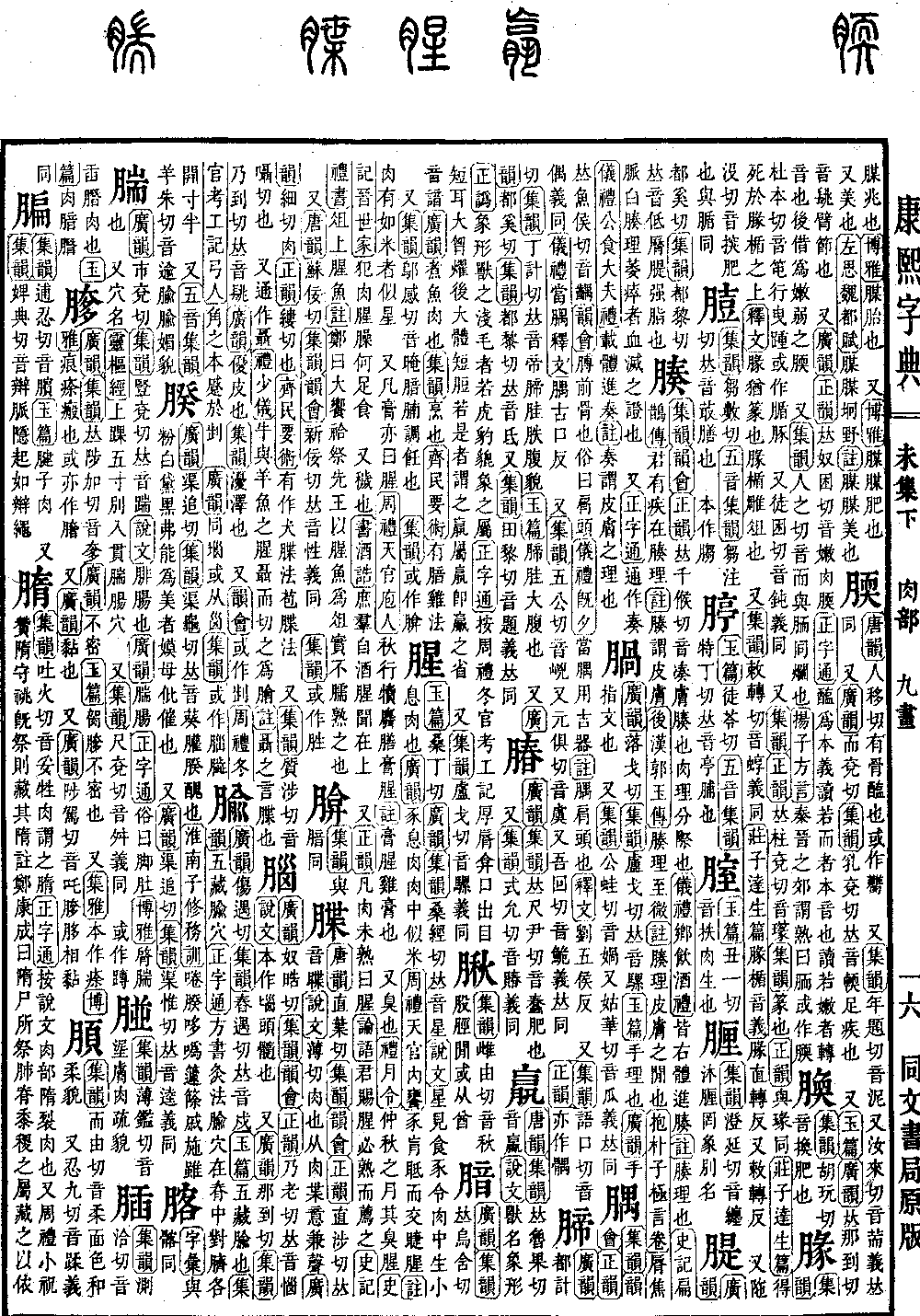
Wei Collection, Lower Volume
Radical: Meat (ròu)
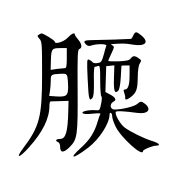
腝
Kangxi strokes: 15
Page 988, Entry 01
Pronounced yi (rising tone). A type of meat paste containing bone. Also written as a variant form (ni).
Also, according to the Collected Rhymes (Jiyun), pronounced ni (level tone). The meaning is the same.
Also, pronounced lai (rising tone). The meaning is the same.
Also, according to the Broad Rhymes (Guangyun), pronounced ruan (dipping tone), and according to the Collected Rhymes (Jiyun), pronounced ruan (dipping tone). Refers to a disease of the feet.
Also, according to the Jade Chapter (Yupian) and the Broad Rhymes (Guangyun), pronounced dao (falling tone). Refers to the joints of the arm.
Also, according to the Broad Rhymes (Guangyun) and the Correct Rhymes (Zhengyun), pronounced nen (falling tone). Refers to meat that is soft.
According to the Correct Character Guide (Zhengzitong), meat paste is the original meaning of the character. Pronounced with the sound of er (level tone), which is its original pronunciation. Pronounced with the sound of nen (falling tone), which is a modified pronunciation. It was later borrowed to represent the meaning of soft and fragile.
Also, according to the Collected Rhymes (Jiyun), pronounced er (level tone). It is the same as the character (er). It means thoroughly cooked.
According to the Model Sayings (Fangyan) by Yang Zi, in the suburban regions of the Qin and Jin states, being cooked is called (er). Also written as 腝.