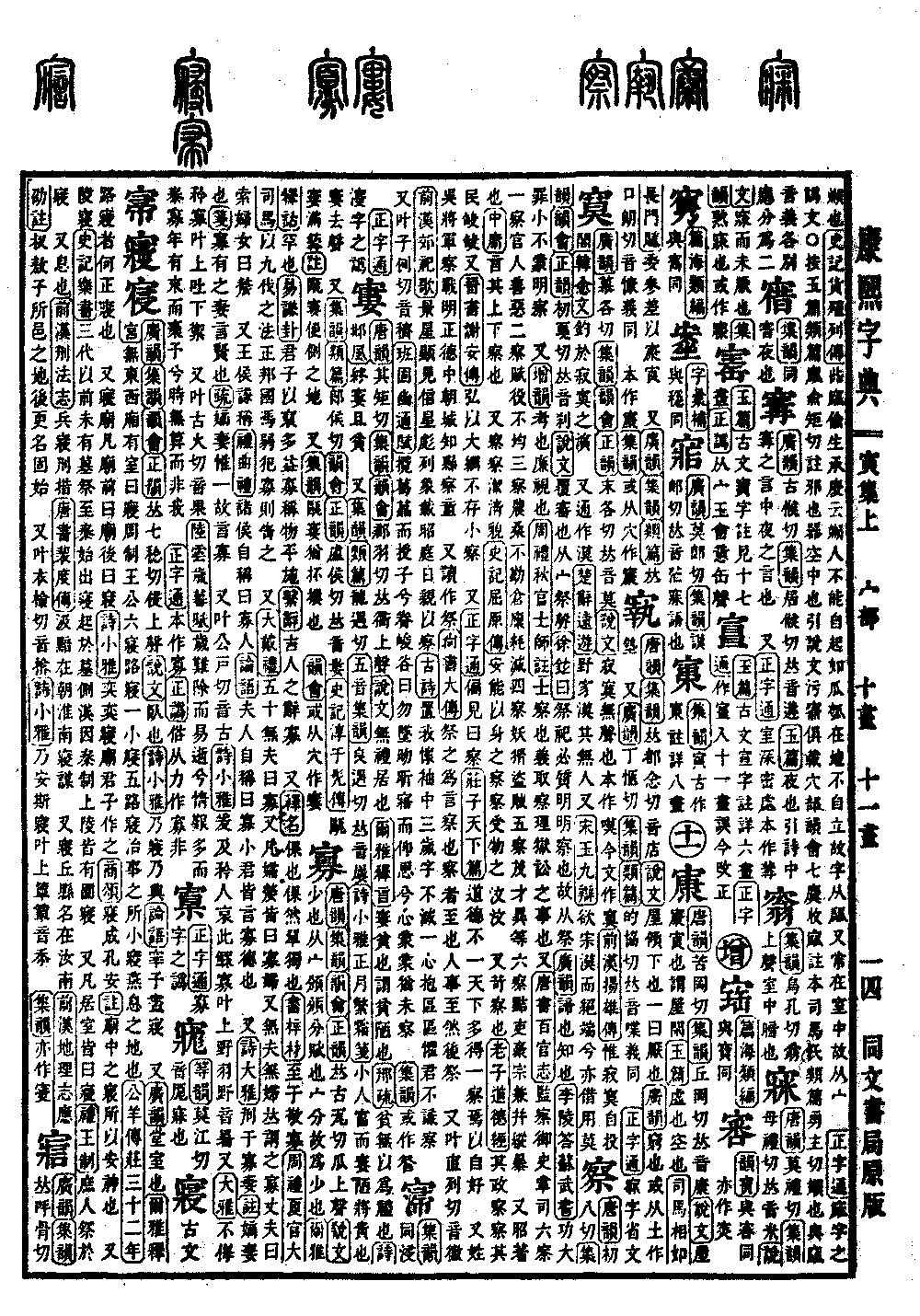
Yin Collection, Upper Volume
Radical: Roof (bù)
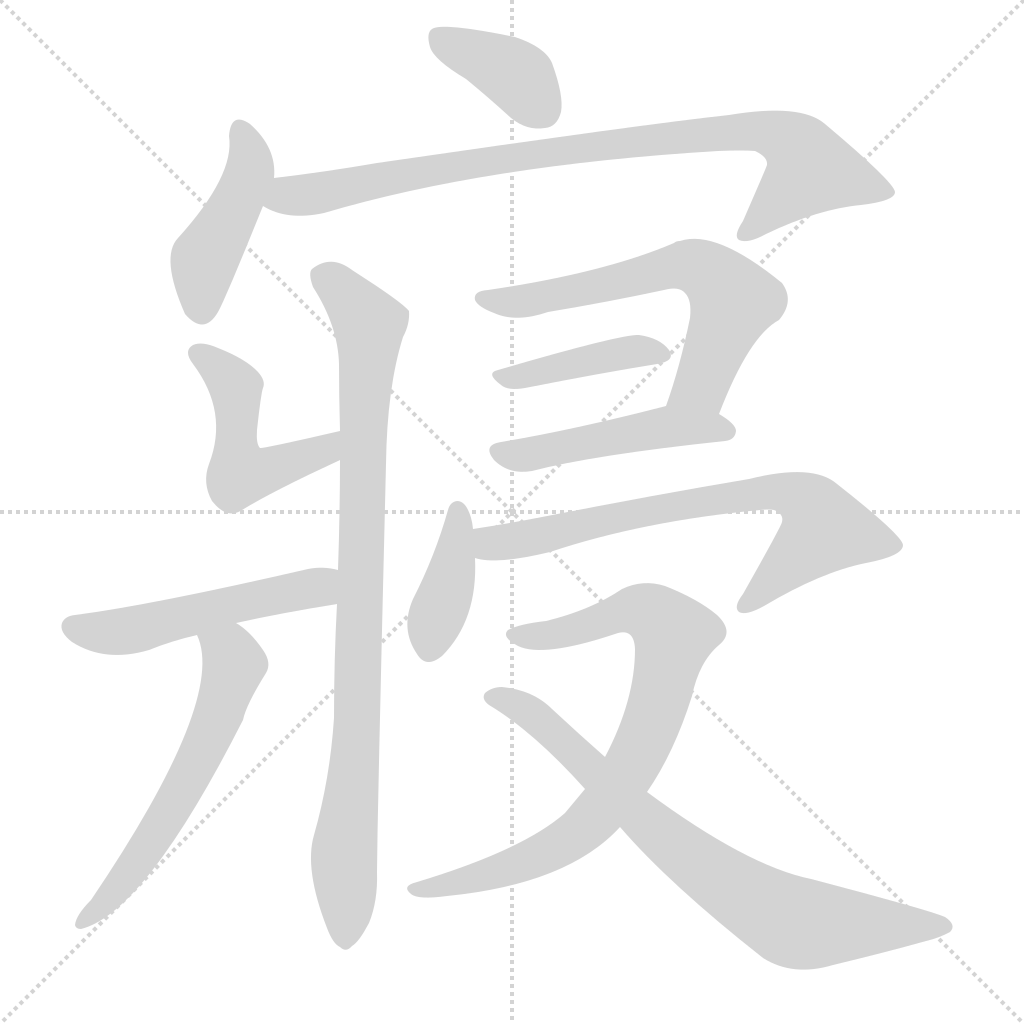
Character: Qin (to sleep)
Kangxi Strokes: 14
Page 290, Entry 22
Ancient form: Qin
According to the Broad Rhymes (Guangyun), the Collection of Rhymes (Jiyun), the Rhyme Compilation (Yunhui), and the Correct Rhymes (Zhengyun), it is pronounced qin (rising tone).
According to the Explaining Graphs and Analyzing Characters (Shuowen), it means to lie down.
Book of Odes (Shijing), Lesser Odes of the Kingdom: Then one sleeps, then one rises.
Analects (Lunyu): Zai Yu sleeps during the day.
Also, according to the Broad Rhymes (Guangyun), it refers to a hall or chamber.
According to the Literary Expositor (Erya), Commentary on Dwellings: A building without eastern or western side rooms is called a qin. Under the Zhou system, kings and dukes had six qin: one luqin (main hall) and five xiaoqin (smaller halls). The luqin is where administrative affairs are conducted, and the xiaoqin is where one rests.
According to the Gongyang Commentary (Gongyang Zhuan), 32nd Year of Duke Zhuang: What is the luqin? It is the zhengqin (principal hall).
Also, qinmiao (ancestral temple chambers). For all temples, the front is the miao and the rear is the qin.
Book of Odes (Shijing), Lesser Odes of the Kingdom: Magnificent are the temple chambers, the noble man built them.
Book of Odes (Shijing), Shang Odes: The chambers were completed in great peace. Commentary: The chambers within the temple are where the spirits are pacified.
Also, lingqin (mausoleum chambers). According to the Records of the Grand Historian (Shiji), Treatise on Music: Before the Three Dynasties, there were no sacrifices at graves. It was not until the Qin dynasty that the qin was introduced, built at the side of the grave. The Han dynasty followed the Qin system; above the imperial tombs, all had garden chambers.
Also, all residential dwellings are called qin.
Book of Rites (Liji), Royal Regulations: Commoners perform sacrifices in the qin.
Also, to rest or cease.
History of the Former Han (Qian Hanshu), Treatise on Law: Military actions ceased and were set aside.
History of the Tang (Tangshu), Biography of Pei Du: While Ji An was in the imperial court, the Prince of Huainan ceased his plotting.
Also, Qinqiu, a county name located in Runan. According to the History of the Former Han (Qian Hanshu), Geographical Treatise, commentary by Ying Shao: This was the place enfeoffed to the son of Shu Ao, later renamed Gushi.
Also, rhyme-linked with the pronunciation yan (rising tone).
Book of Odes (Shijing), Lesser Odes of the Kingdom: Then one is at peace in this chamber. Rhymes with dian. Dian is pronounced tian (rising tone).
According to the Collection of Rhymes (Jiyun), it is also written in a variant form.