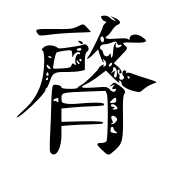
"Tang Yun" uses the sound combination of "kang" and "li" for切 (qie), and "Ji Yun" uses "qian" and "li" for切 (qie), pronounced "qi." "Shuowen Jiezi" explains it as the calf muscle. "Yupian" explains it as thick intestines. "Zilin" explains it as the muscle at the back of the lower leg. "Boyan" explains it as "cháng," which is the calf muscle.
It also refers to a country name. "Shanhaijing" records: The State of Wu Chang, located east of the State of Chang Gu, where people have no calf muscles. The annotation explains: Chang refers to the large intestine.
Furthermore, "Guang Yun" uses the sound combination of "ku" and "ji" for切 (qie), and "Ji Yun" uses "jie" and "ji" for切 (qie), pronounced "qi."
Also, "Ji Yun" uses "gu" and "li" for切 (qie), pronounced "mian."
Additionally, "Wu Yin Ji Yun" uses "kang" and "li" for切 (qie), pronounced "qi." It also uses "hu" and "li" for切 (qie), with a pronunciation similar to the rising tone of "xi." The meaning is the same.