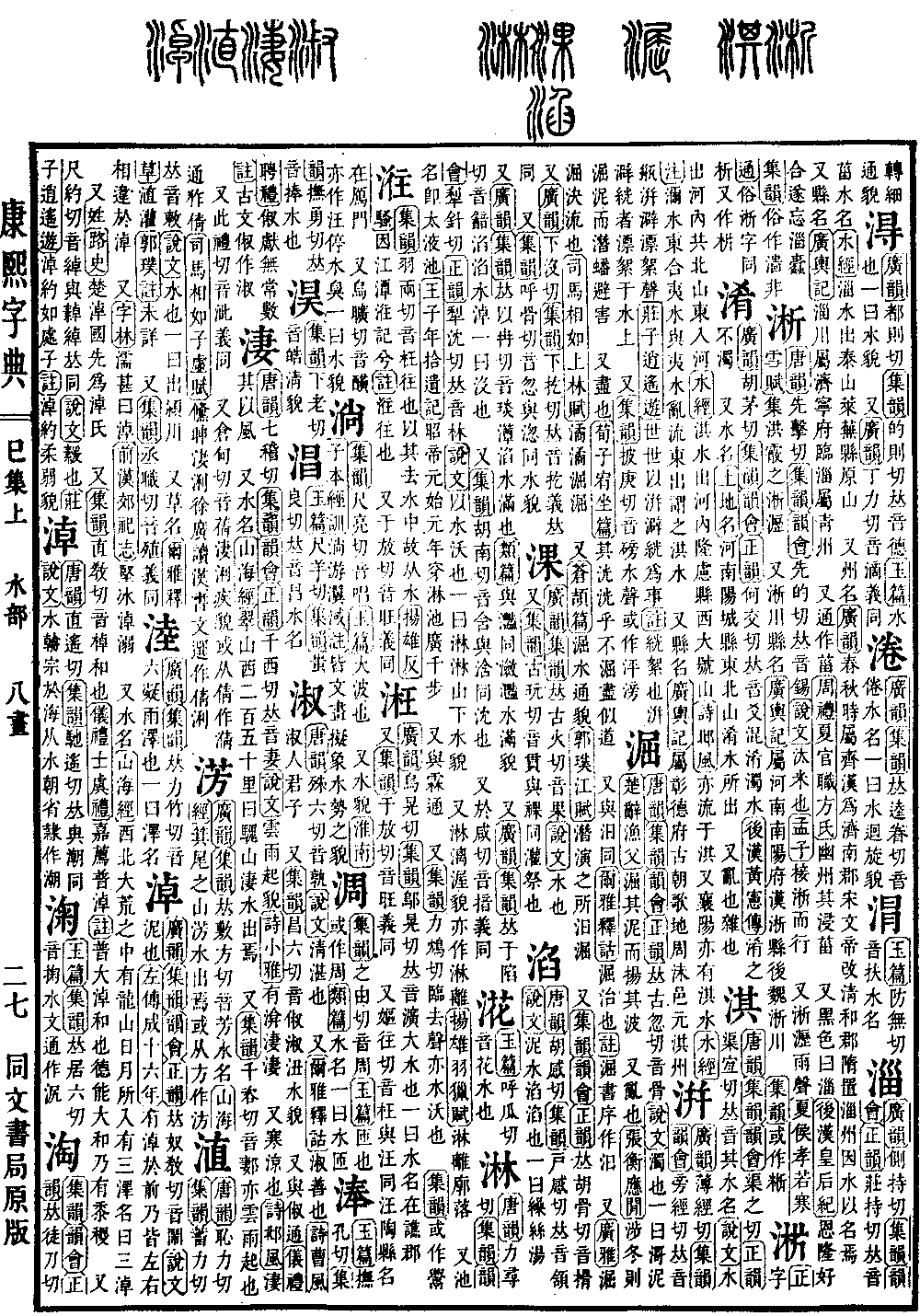
Si Collection, Upper Volume
Radical: Water (shuǐ)
Kangxi Strokes: 12
Page 629, Entry 23
Tang Rhyme (Tangyun): Pronounced qi.
Collected Rhymes (Jiyun), Rhyme Meetings (Yunhui), Correct Rhymes (Zhengyun): Pronounced qi.
Shuowen Jiezi says it describes the appearance of clouds and rain rising.
Book of Odes (Shijing), Lesser Odes: Clouds rising in a dense manner.
Also denotes cold.
Book of Odes (Shijing), Odes of Bei: Cold is the wind.
Also the name of a river.
Classic of Mountains and Seas (Shanhaijing): Two hundred and fifty li west of Cui Mountain is Gui Mountain, where the Qi River originates.
Also in Collected Rhymes (Jiyun): Pronounced qi. It also carries the meaning of clouds and rain rising.
Also pronounced ci. The meaning is the same.
Also pronounced qian. Describes a swift and rapid appearance. Sometimes written with the character for handsome (qian) as a variant. Commonly written as qian.
Sima Xiangru, Rhapsody on the Master of Void (Zixu Fu): Swift and rapid. Xu Guang read it as such. In the Book of Han (Hanshu) and Selections of Refined Literature (Wenxuan), it is written as qian.