Chen Collection, Upper Volume
Radical: Moon (yuè)
Kangxi Strokes: 12
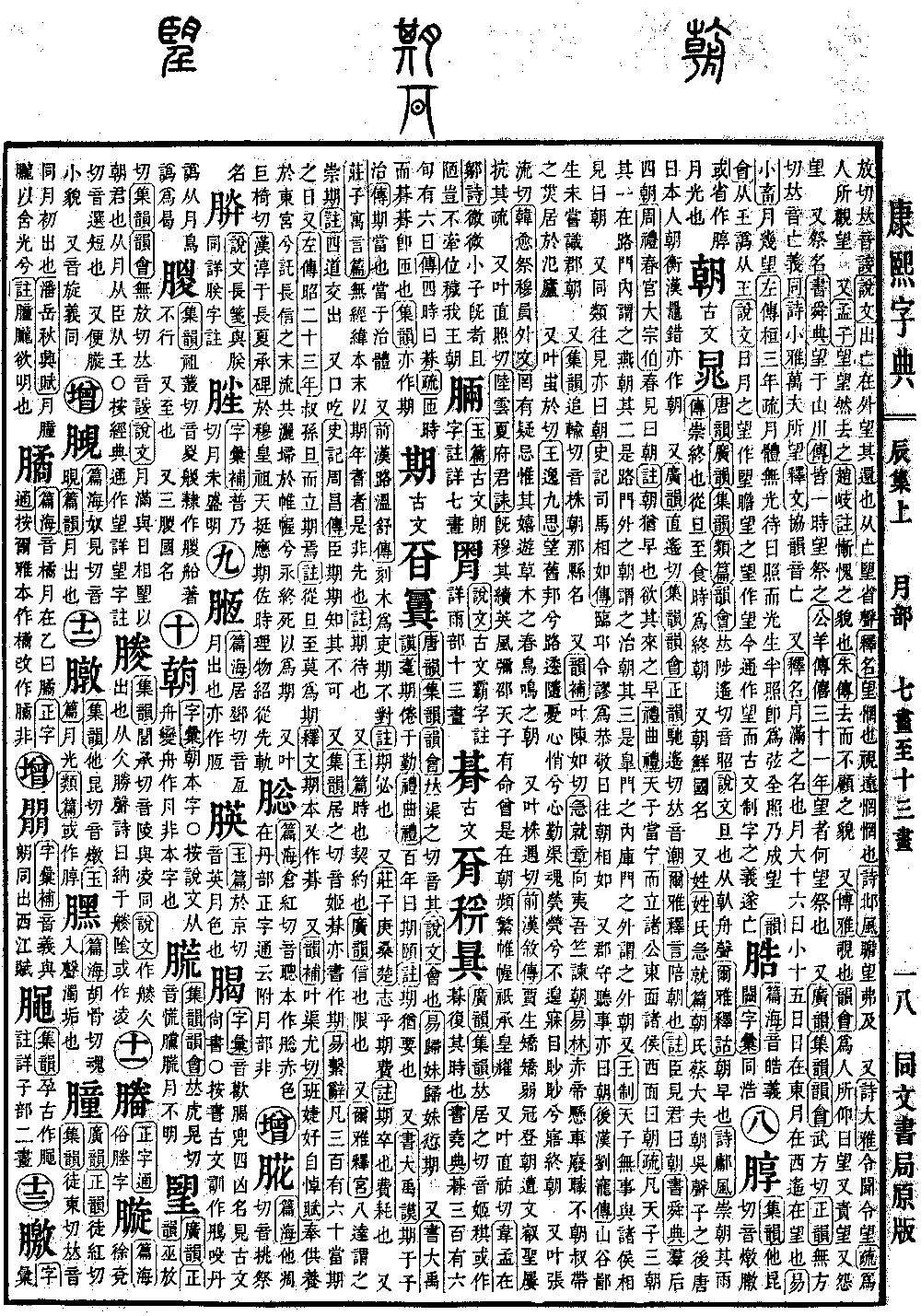
Page 506, Entry 11
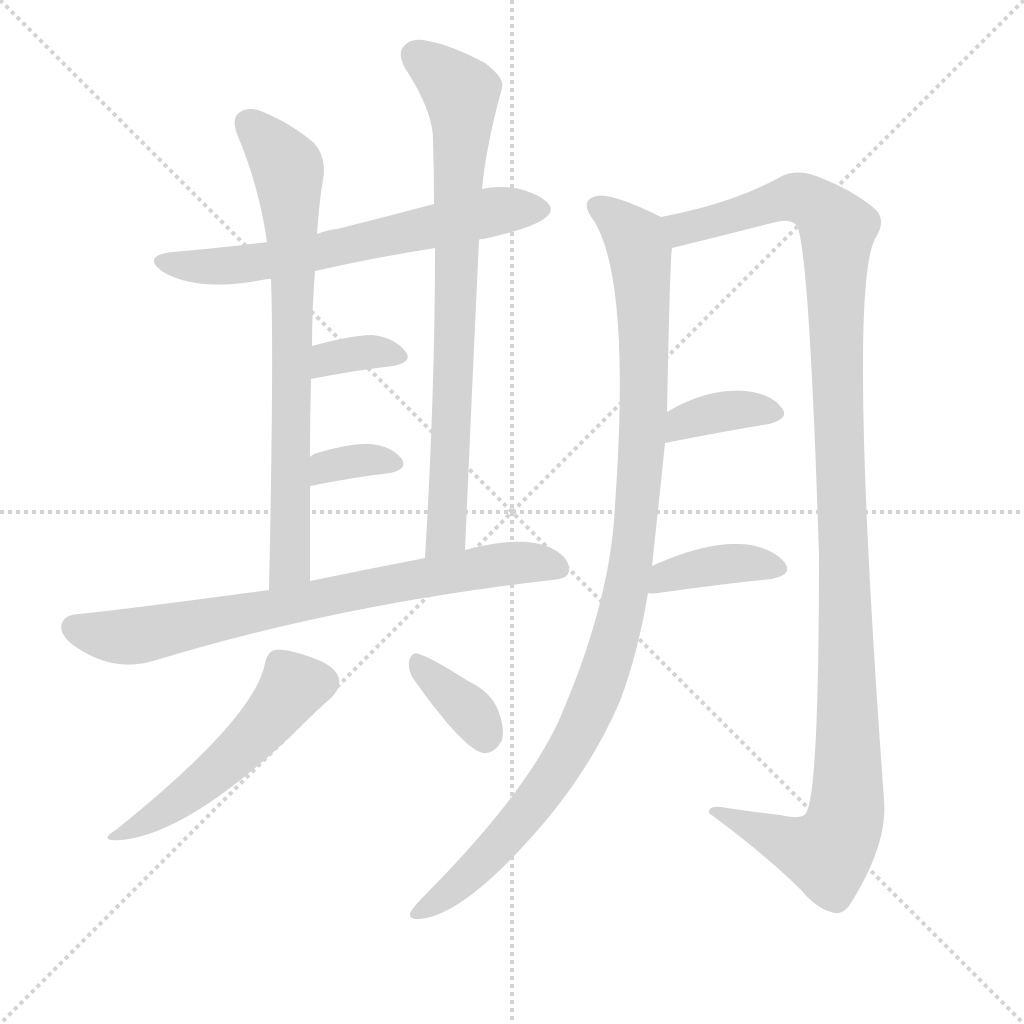
Pronounced qí.
Shuowen Jiezi (Dictionary of Explaining Graphs): To meet.
Book of Changes (Yijing): The maiden returning misses the time.
Book of Documents (Shangshu): At the age of eighty or ninety, one becomes weary of diligence.
Book of Rites (Liji): At one hundred years of age, it is called qiyi (a term for an elder requiring care). Commentary: Qi means to request or to wait for.
Book of Documents (Shangshu): To strive for my governance. Commentary: Qi means to be appropriate, to be appropriate to the body of governance.
History of the Former Han (Qianhan shu): Carving wood into officials, they definitely would not answer. Commentary: Qi means necessary or definite.
Zhuangzi: To focus on the end of expenditure. Commentary: Qi means end. Fei means consumption.
Zhuangzi: Without warp or weft, origin or end, to wait for the aged. Commentary: Qi means to wait.
Yupian: Time; a contract.
Guangyun: Trust; a limit.
Erya: Eight paths intersecting are called chongqi. Commentary: Four roads intersecting and going out.
Stammering. Records of the Grand Historian (Shiji): Your servant stammers, knowing it cannot be done.
Pronounced jī. Also written as the variant form (jī).
Book of Changes (Yijing): All three hundred and sixty days correspond to a full cycle.
Zuo Tradition (Zuo zhuan): Shusun stood from dawn until the appointed time. Commentary: From dawn until dusk is the period. Explanatory Text: The original text also uses the variant form (jī).
Rhyming correction: Pronounced qiú.
Ban Jieyu, Lamentation: Serving in the Eastern Palace, entrusting myself to the end of the Changxin stream. Sweeping within the curtains and tents, forever ending until death as the appointed time.
Also pronounced jǐ.
Han Dynasty, Chunyu Zhang, Xia Cheng: Oh, the imperial ancestor, Heaven produced a response for the time. Assisting the era in ordering matters, continuing to follow the former path.