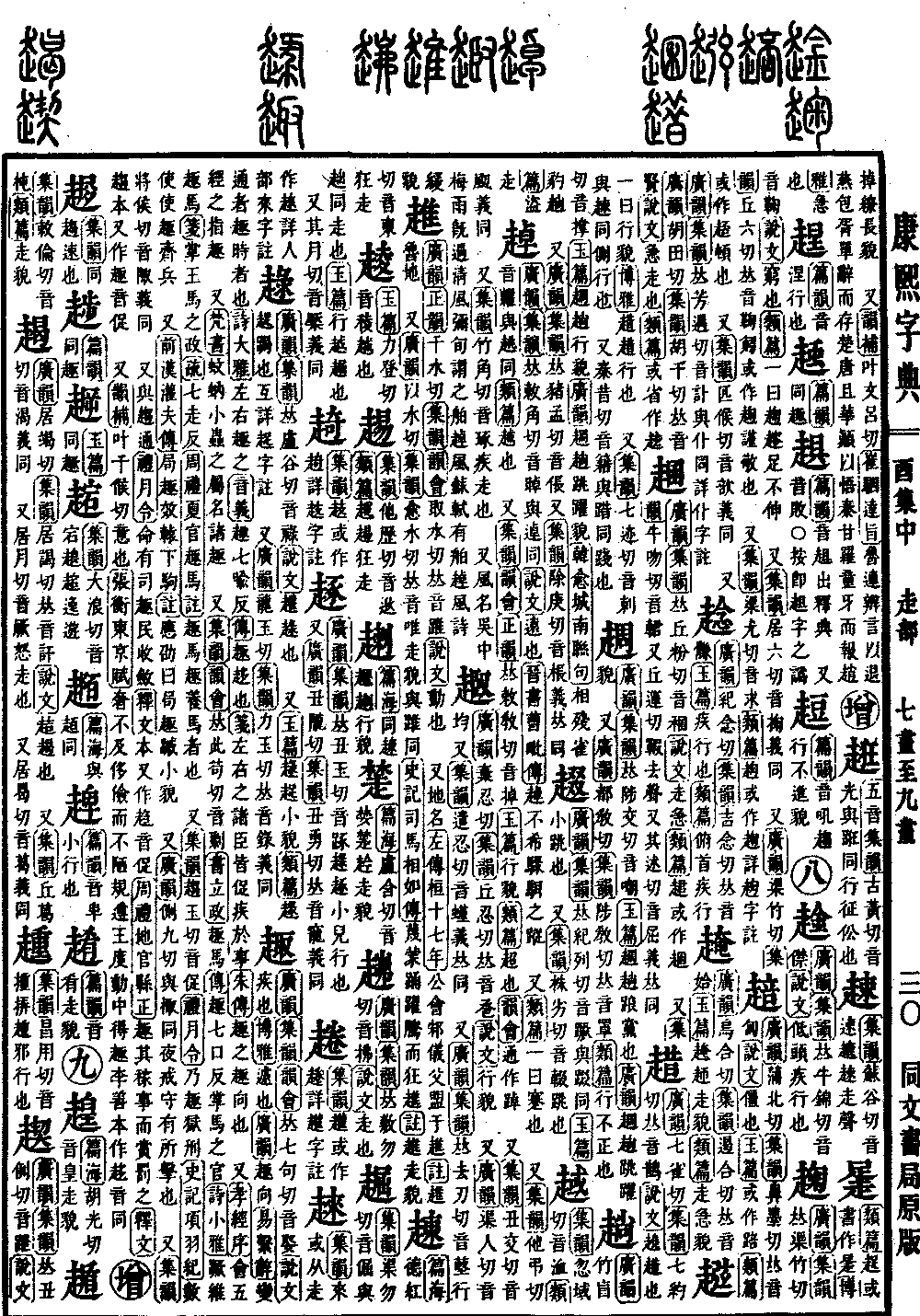
You Collection, Middle Volume
Radical: Walk (zǒu)
Kangxi Strokes: 15
Page 1218, Entry 35
Guangyun (Broad Rhymes), Jiyun (Collected Rhymes), and Yunhui (Collection of Rhymes) define it as pronounced qu (falling tone).
Shuowen (Explaining Graphs and Analyzing Characters): To be swift.
Boya (Broad Refinements): To be hurried.
Guangyun (Broad Rhymes): To incline toward; to head toward.
Book of Changes (Yijing), Commentary on the Appended Statements: Those who adapt and change are those who pursue the opportune time.
Book of Odes (Shijing), Greater Odes: Those on the left and right urge it on.
Pronunciation and Meaning: Qu, pronounced yu (falling tone).
Commentary: Qu is to hasten.
Notes: The various ministers on the left and right all act with haste regarding affairs.
Zhu Xi Commentary: To urge it on is to head toward it.
Also, Preface to the Classic of Filial Piety (Xiaojing Xu): To bring together the essence and direction of the Five Classics.
Also, Sanskrit texts: The names of mosquitoes, gnats, and small insects are categorized as various destinies (gati).
Also, Jiyun (Collected Rhymes) and Yunhui (Collection of Rhymes): Pronounced gou (rising tone).
Book of Documents (Shujing), Establishment of Government: The equerry (quma).
Commentary: Qu, pronounced kou (rising tone). An official in charge of horses.
Book of Odes (Shijing), Lesser Odes: The galloping steeds are urged on by the equerry.
Notes: In charge of the administration of the king's horses.
Sub-commentary: Pronounced zou (rising tone).
Rites of Zhou (Zhouli), Summer Offices, Note on Equerry: The equerry is one who hastens to care for the horses.
Also, Jiyun (Collected Rhymes): Pronounced cu (entering tone).
Book of Rites (Liji), Monthly Ordinances: Then hasten the administration of prisons.
Records of the Grand Historian (Shiji), Annals of Xiang Yu: Repeatedly sent envoys to urge on the Qi army.
Also, History of the Former Han (Qian Hanshu), Biography of Guan Fu: Cramped and small like a colt under a carriage shaft.
Note: Ying Shao says: Juqu means a small appearance.
Also, Guangyun (Broad Rhymes): Pronounced jiu (rising tone). Equivalent to the character sou. A night warning signal struck by guards.
Also, Jiyun (Collected Rhymes): Pronounced zou (level tone). Same meaning.
Also, interchangeable with the character qu (to hasten).
Book of Rites (Liji), Monthly Ordinances: Order the officials to hasten the people to complete the harvest.
Exegesis: Originally also written as qu (to hasten), pronounced cu (entering tone).
Rites of Zhou (Zhouli), Earth Offices, District Magistrate: Hasten their agricultural work and administer rewards and punishments.
Exegesis: Qu was originally written as qu, pronounced cu (entering tone).
Also, Yunbu (Supplement to Rhymes): Rhymes with qian, meaning intent.
Zhang Heng, Eastern Capital Rhapsody: Extravagance does not reach excess, frugality is not base. Rules follow the royal path, movements strike the mark and capture the intent. Li Shan's edition writes it as qu, same pronunciation.
Research Note: In the Rites of Zhou, Earth Offices, District Magistrate, the text originally read qu, which has been corrected to qu (to hasten).