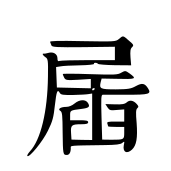
Guangyun (Broad Rhymes) indicates the pronunciation as ji (entering tone); Jiyun (Collected Rhymes) indicates the pronunciation as cha (entering tone), read the same as.
Shuowen Jiezi (Explaining Simple and Compound Characters) defines it as: to stack or press upon from behind.
Jiyun (Collected Rhymes) defines it as: to follow closely one after another in a sequence. Another definition refers to walking with small steps.
Also, Guangyun (Broad Rhymes), Jiyun (Collected Rhymes), and Leipian (Classified Chapters) indicate the pronunciation as zha (entering tone), read the same as zha. It refers to a thin wedge.
Note: Er ya (Approaching Elegance) records that a door post is called a wedge. The Book of Rites (Liji), in the section regarding funeral rites, records using a horn spatula to wedge the teeth. The commentary states: wedge is pronounced xie, shaped like, and is a tool used to prop open the mouth for the insertion of funerary offerings. Various commentaries state: a thin wedge. The specific definition is unclear, and it is recorded here as a supplement.