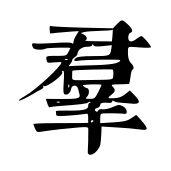
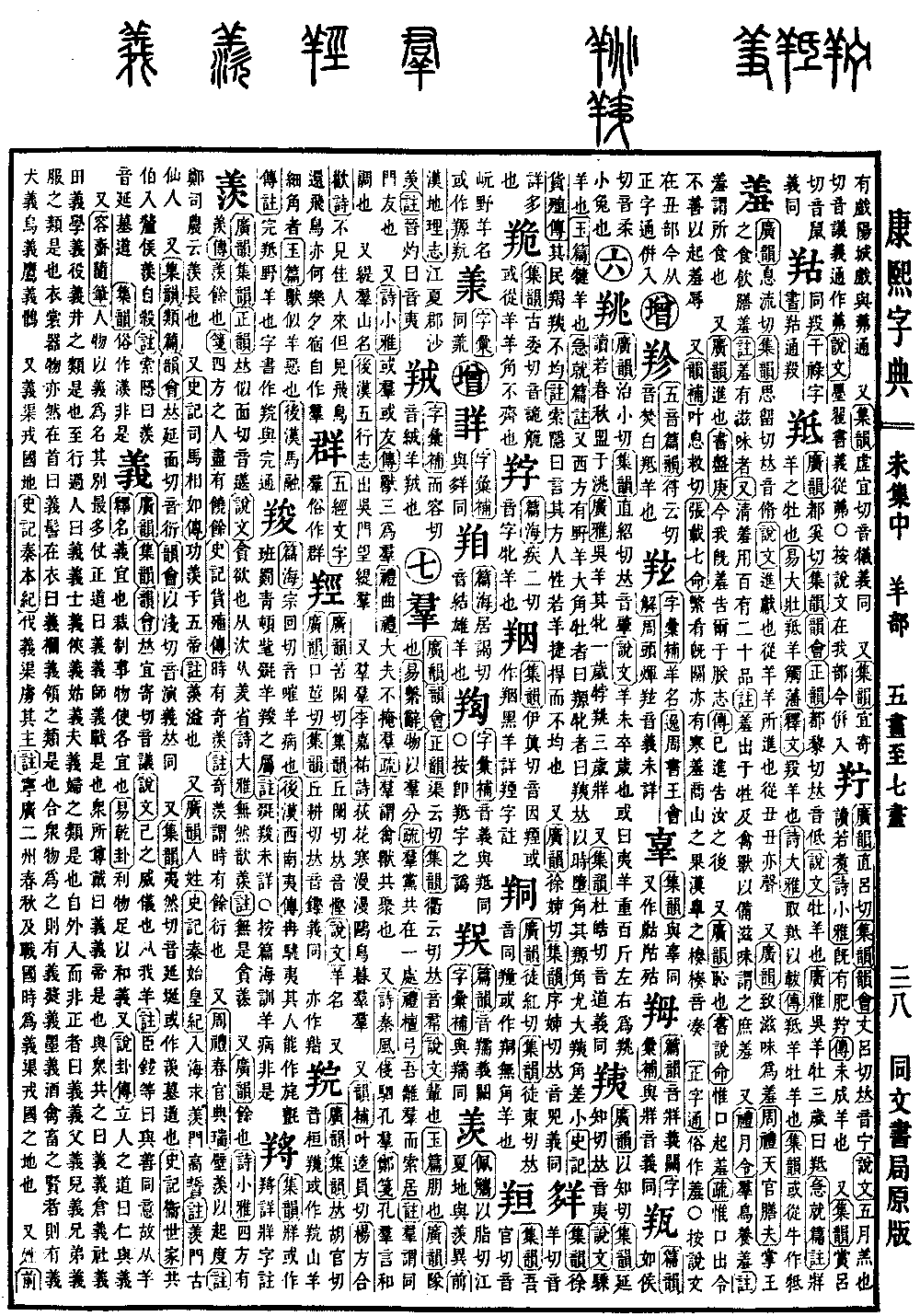
Zi Collection, Upper Volume, Page Position: Upper. Radical: Sheep (yáng). Page 295, Entry 01.
Guangyun (Guangyun), Yunhui (Yunhui), and Zhengyun (Zhengyun) state the pronunciation is qun (rising tone). Jiyun (Jiyun) also states the pronunciation is qun (rising tone). Shuowen (Shuowen) defines it as a peer or companion. Yupian (Yupian) defines it as a group or society. Guangyun (Guangyun) defines it as a band or team.
Book of Changes (Yijing), Commentary on the Appended Phrases: Things are classified by their groups. The commentary explains that groups and parties refer to those dwelling in one place.
Book of Rites (Liji), Tan Gong: I have been separated from my group and live alone. The commentary notes that group refers to fellow students and friends.
Also in Book of Odes (Shijing), Minor Odes of the Kingdom: Some gather in groups, some are friends. The traditional commentary states that for animals, three constitutes a group. Book of Rites (Liji), Qu Li: A great officer does not hunt a whole group. The commentary explains that group refers to birds or beasts gathered together.
Also in Book of Odes (Shijing), Odes of Qin: The shallow-bellied horses are very harmonious. The Zheng commentary notes that very harmonious refers to the animals being well-tempered and unified.
Also Tiqun, the name of a mountain. History of the Later Han (Hou Hanshu), Treatise on the Five Elements: Exiting Wu Gate, looking toward Tiqun.
Also qun qun, an adjective describing a gathering. Li Jiayou poem: The reed flowers are cold and vast, in the evening the gulls gather in groups.
Also, in Yunbu (Yunbu), it is pronounced kui yuan. Yang Fang, Hehuan Poem: I do not see the beautiful person come, I only see the flying birds return. What joy do the flying birds have, as they roost in the evening they form their own groups.