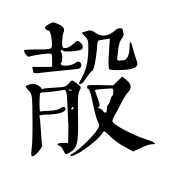
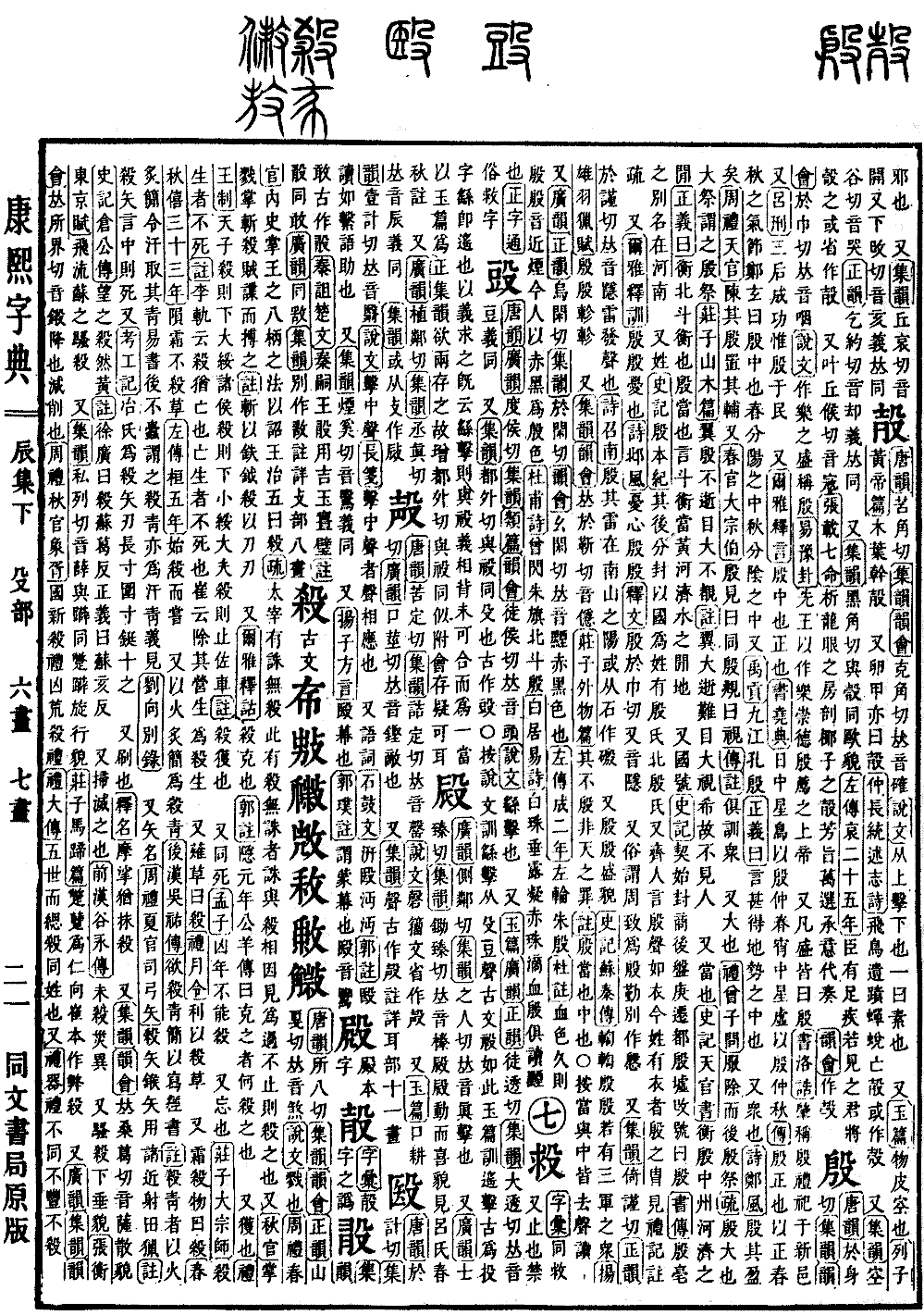
"Kǔ jiǎo" are used for the fanqie pronunciation in "Tang Yun (Tangyun)", and "kè jiǎo" are used in "Jiyun (Jiyun)" and "Yunhui (Yunhui)", both pronounced the same as "què". "Shuowen Jiezi (Shuowen Jiezi)" explains it as striking downwards from above. Another explanation is the meaning of plain white.
Also, "Yupian (Yupian)" explains it as the hollow outer layer of an object. "Liezi (Liezi), Chapter Huangdi" records: the leaves of trees wither into empty shells. Additionally, the outer shell of an egg is also called "gé". "Zhong Changtong (Zhong Changtong), Shu Zhi Shi" writes: birds leave footprints, cicadas shed their shells. Sometimes also written as "ké".
Furthermore, "Jiyun (Jiyun)" uses "kōng gǔ" for the fanqie pronunciation, which sounds like "kū"; "Zhengyun (Zhengyun)" uses "qī yuē" for the fanqie pronunciation, which sounds like "què". The meanings are the same.
Also, "Jiyun (Jiyun)" uses "hēi jiǎo" for the fanqie pronunciation, which is the same as the character "gè". It means the appearance of vomiting. "Zuo Zhuan (Zuo Zhuan), Duke Ai, 25th Year" records: a subject has a foot ailment, and if seen, the ruler will vomit. Sometimes abbreviated as "gé".
Also, it is read with the fanqie of "qiū" in the "yù" rhyme, sounding the same as "qiū". "Zhang Zai (Zhang Zai), Qi Ming" writes: peel open the fruit husks of longans, split open the hard shells of coconuts. Thousands of delicacies are selected and presented in order according to one's wishes. "Yunhui (Yunhui)" writes it as "gé".