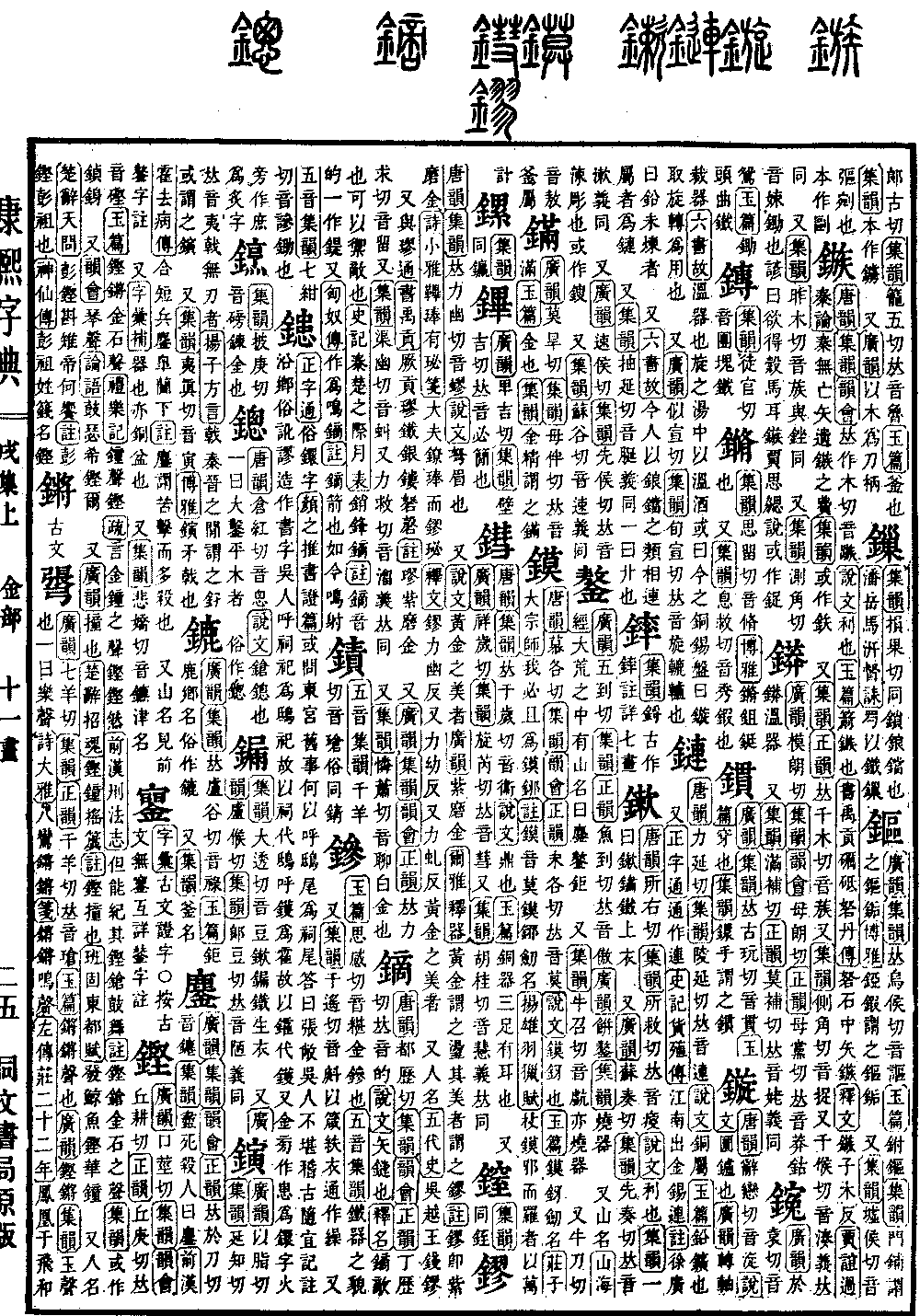
Xu Collection, Upper Volume
Radical: Metal (jīn)
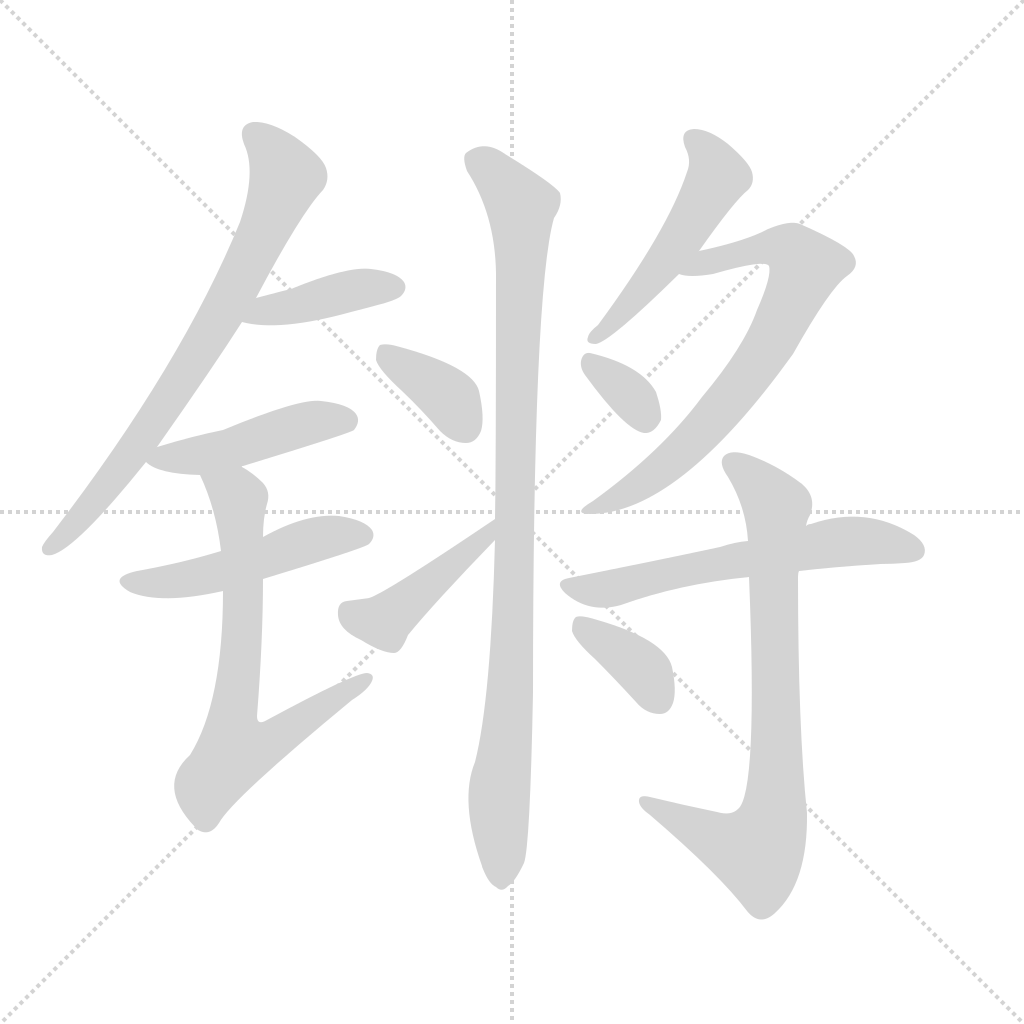
Qiang
Kangxi strokes: 19
Page 1319, Entry 01
In ancient texts: Broad Rhymes (Guangyun) says pronounced qiang; Collected Rhymes (Jiyun) and Orthophonic Rhymes (Zhengyun) say pronounced qiang. Comprehensive Glossary (Yupian) defines it as the sound of qiang-qiang. Broad Rhymes states it is the sound of clinking metal. Collected Rhymes defines it as the sound of jade. Another source states it is a musical sound. Book of Odes (Shijing), Greater Odes: Eight bells ring with a qiang-qiang sound. Commentary (Jian) states qiang-qiang is the sound of ringing. Zuo Commentary (Zuozhuan), 22nd year of Duke Zhuang: The phoenixes fly together, their harmonious calls are qiang-qiang. Book of Rites (Liji), Jade Beads: Only then will the jade emit a qiang sound. Annotations: Qiang is a sound. Also, from the Biography of Zhang Heng in the History of the Later Han (Hou Hanshu): Moving beyond the high pavilion in a qiang-qiang manner. Annotations: Qiang-qiang here indicates a tall appearance. It is also interchangeable with the variant qiang (qiàng). Book of Rites (Liji), Summary of Rules: A scholar moves in a qiang-qiang manner. Annotations: Qiang originally appears as another variant; some write it as qiang. Sub-commentary: This refers to a dignified and relaxed appearance. Also, Collected Rhymes says pronounced cheng; same meaning.