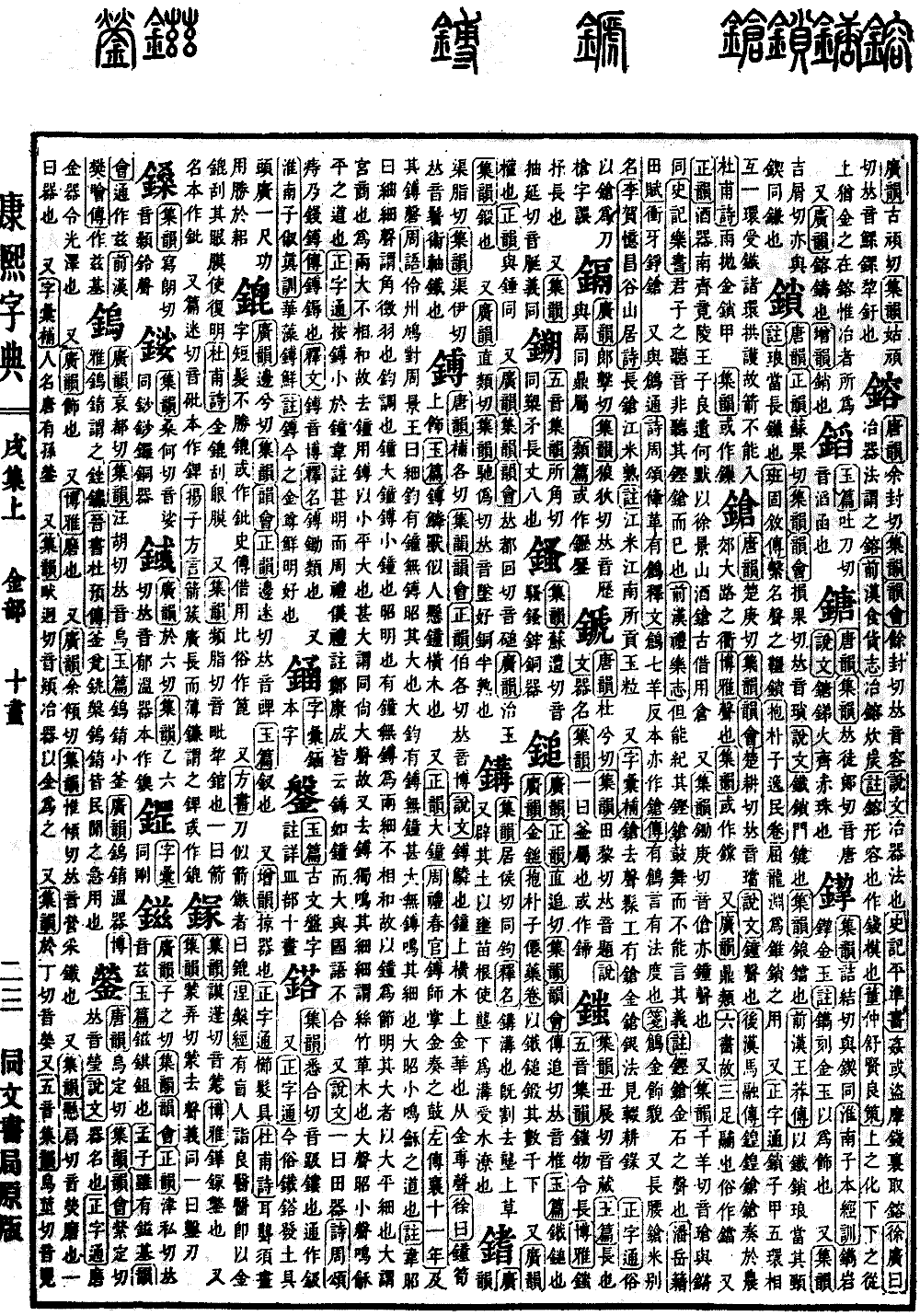
Xu Collection, Upper Volume
Radical: Metal (jīn)
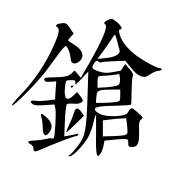
鎗
Kangxi strokes: 18
Page 1317, Entry 06
Pronounced chang
As defined in the Shuowen Jiezi (Shuowen), the sound of a bell.
In the Biography of Ma Rong from the History of the Later Han (Hou Hanshu), it is written: Resounding and clanging, played at the great intersections of the farming outskirts.
As defined in the Guangya (Boya), it refers to a sound.
In the Jiyun, it is sometimes written as the variant form (huò).
Also, according to the Guangyun, it is a type of tripod.
In the Liushu Gu, it is a three-legged cauldron. It is commonly written as (chēng).
Also, according to the Zhengyun, it is a wine vessel. In the Southern Qi Dynasty, Prince Jingling, Wang Ziliang, presented He Mo with an Xu Jingshan wine vessel. In ancient times, it was used interchangeably with (cāng).
Also, according to the Jiyun, pronounced cang. It also refers to the sound of a bell.
Also, according to the Jiyun, pronounced qiang. It is equivalent to (qiāng).
In the Records of the Grand Historian (Shiji), Music Treatise: The superior person who listens to music does not merely listen to its clanging sound.
In the History of the Former Han (Qian Hanshu), Rites and Music Treatise: One can only record its clanging and dancing, but cannot explain its meaning.
Note: Clanging refers to the sound of metal and stone.
In Pan Yue’s Rhapsody on Plowing the Fields (Jitian Fu): The metal ornaments clanged.
Also used interchangeably with (cāng).
In the Book of Odes (Shijing), Zhou Odes: The leather reins have a clanging sound.
In the commentary (Shìwén): (cāng) is pronounced qiang. Originally, it was also written as (qiāng).
In the commentary (Chuán): Having a clanging sound signifies having order and regulations.
In the commentary (Jiān): (cāng) describes gold ornamentation.
Also, long-waisted (qiāng) is a type of rice.
In Li He’s poem, Remembering My Mountain Home at Changgu: The long-waisted rice is ripe in the river.
Note: River rice refers to the jade-like grains offered as tribute from the Jiangnan region.
Also, according to the Zihui Bu, (qiāng) in the departing tone refers to a lacquer technique involving gold or silver inlay. See the Record of Planting the Plow (Chuogeng Lu).
According to the Zhengzitong, it is a mistake for the common people to use (qiāng) for the character meaning sword or spear.