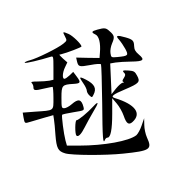
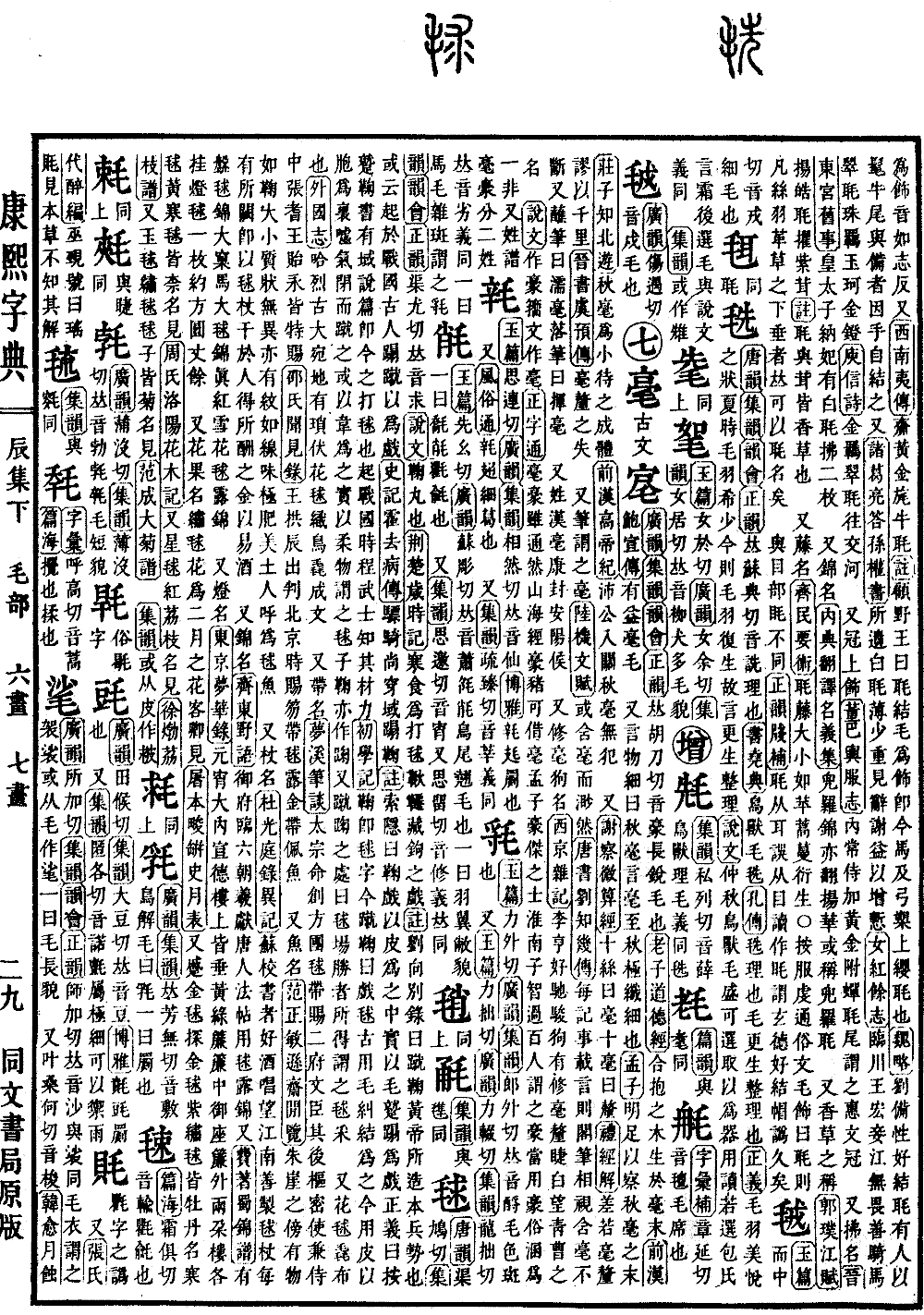
Chen Collection, Lower Volume
Radical: Hair (máo)
Page 593, Entry 17
Pronounced qiu
Shuowen Jiezi (Explanation of Simple and Compound Characters): A leather ball.
Jingchu Suishiji (Chronicle of Seasonal Festivals in Jingchu): During the Cold Food Festival, people engage in games such as ball-kicking, swinging, and the game of hide-the-hook. Commentary: Liu Xiang’s Bie Lu (Separate Records) states that the game of football (cuju) was created by the Yellow Emperor and was originally a form of military training. Others say it originated during the Warring States period. The ancients kicked football as a game.
Records of the Grand Historian (Shiji), Biography of Huo Qubing: The Cavalry General Huo Qubing marked out a field for playing ball. Commentary: The Suoyin (Search for Mysteries) states that this ball game uses leather filled with hair, which is kicked for amusement. The Zhengyi (Orthodox Meaning) states: According to the Book of Football (Cuju Shu), there is a chapter on field regulations, which refers to what is now called ball-kicking. It originated in the Warring States period and was used to test the abilities and strength of warriors.
Chuxue Ji (Records for Elementary Learning): The ball (ju) is the same as the ball (qiu); today, football is called playing ball. In ancient times, it was made by tangling hair together. Now it is made of leather, using an animal bladder as an inner core, inflated with air and sealed for kicking. Alternatively, it is made of cured leather and filled with soft material, called a ball (qiuzi). The character ju is also written as a variant form (ju).
Also, a place where football is played is called a ball field, and the prize won by the victor is called ball winnings.
Also, flowered ball refers to a type of woolen fabric.
Waiguozhi (Records of Foreign Countries): Herat, a region in ancient Dayuan, produces suofu flowered balls, which are woven with patterns using the fine down of birds.
Also, the name of a type of waist belt.
Mengxi Bitan (Brush Talks from Dream Stream): Emperor Taizong of Song ordered the creation of square and round ball-patterned belts to reward ministers of the Secretariat and the Bureau of Military Affairs. Later, Commissioners of Military Affairs and concurrently Grand Secretaries Zhang Qi and Wang Yiyong were both specially rewarded.
Shaoshi Wenjianlu (Record of Things Seen and Heard by the Shao Family): When Wang Gongchen was transferred to serve as the Guardian of Beijing, he was rewarded with an ivory tablet belt, ball-patterned belt ornaments, a gold belt, and a fish-shaped pendant.
Also, the name of a type of fish.
Fan Zhengmin, Xunzhai Xianlan (Idle Observations from the Xun Studio): Near Zhuya, there is a creature like a ball, with no difference in size, texture, or shape, and it has thread-like patterns; its flavor is extremely rich. The locals call it ball fish.
Also, the name of a type of cane.
Du Guangting, Luyiji (Record of Strange Things): There was a proofreader named Su who loved to drink, enjoyed singing the song "Watching the Southern River," and was skilled at making ball-patterned canes. Whenever he lacked something, he would use his cane to solicit help from others, using the proceeds to buy wine.
Also, a type of brocade.
Qidong Yeyu (Wild Tales from Eastern Qi): The imperial treasury used ball-patterned brocade for mounting calligraphic scrolls by Wang Xizhi, Wang Xianzhi of the Six Dynasties period, and various Tang dynasty masters.
Also, Fei Zhu, Shujin Pu (Treatise on Sichuan Brocade) records coiled-ball brocade, large-pattern horse-ball brocade, and true red snowflake ball-patterned brocade.
Also, a type of lantern.
Dongjing Menghualu (Dream of Splendor in the Eastern Capital): During the Lantern Festival, yellow-green curtains were hung at the Xuande Gate of the imperial palace; inside the curtains was the Emperor's seat, and outside the curtains were two towers, each hanging a lantern ball over ten feet in circumference.
Also, a type of flower called the hydrangea, which is considered a flower guest minister in the second month of the flower calendar. See Tu Benjun, Pingshi Yuebiao (Monthly Tables of the History of Vases).
Also, pressed-gold ball, gold-seeking ball, and purple embroidered ball are all names for the peony. Cold ball and yellow cold ball are names for the crabapple. See Zhou, Luoyang Huamu Ji (Records of Flowers and Trees in Luoyang).
Also, star-ball red is a name for the litchi. See Xu, Lizhi Pu (Treatise on Litchi).
Also, jade ball, embroidered ball, and ball-child are all names for the chrysanthemum. See Fan Chengda, Ju Pu (Treatise on Chrysanthemums).
Jiyun (Collection of Rhymes): Sometimes also written in a variant form using the skin radical (qiu).