Wu Collection, Lower Volume
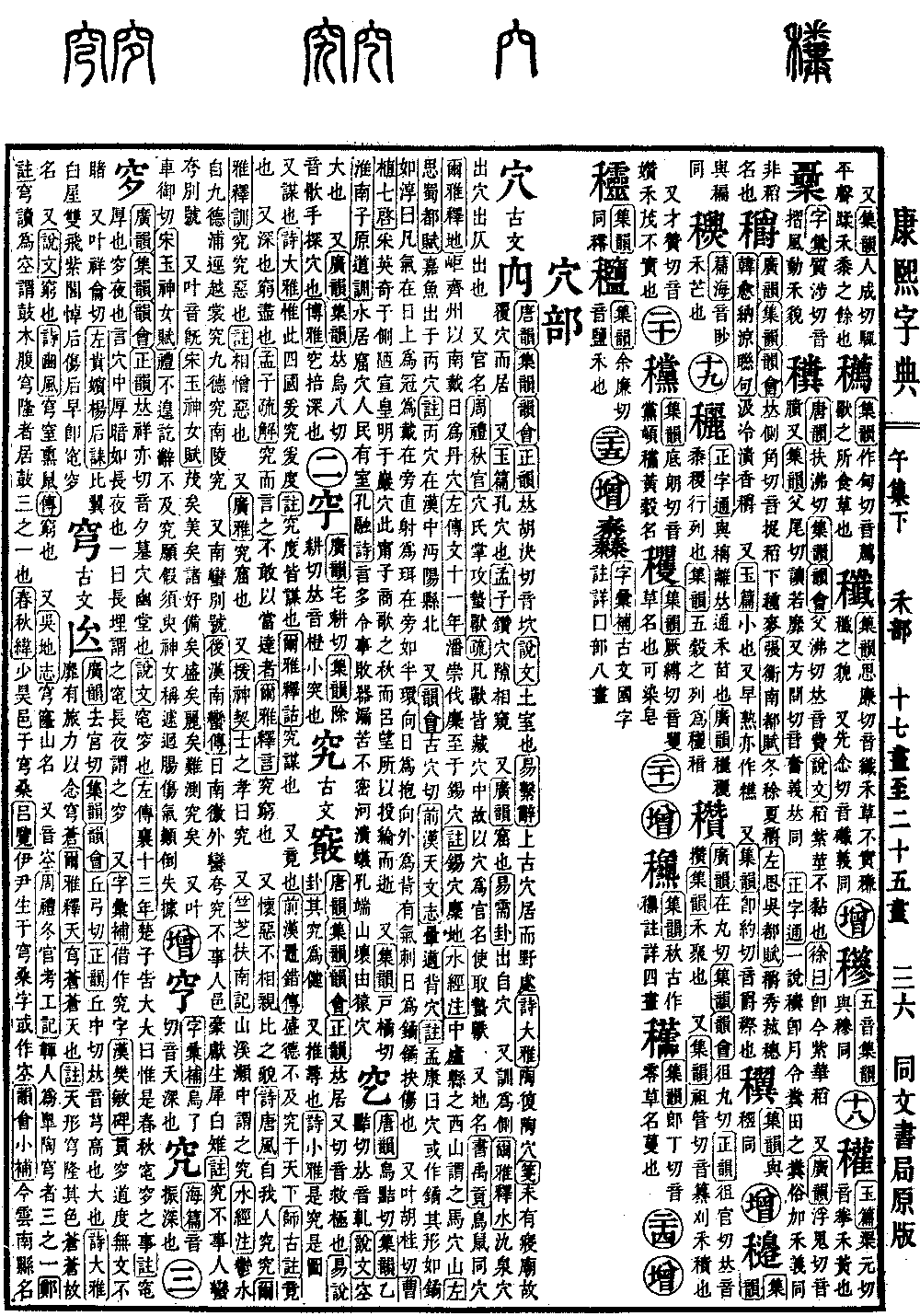
Radical: Cave (xué)
Qiong; Kangxi stroke count: 8; Page 862, Entry 29
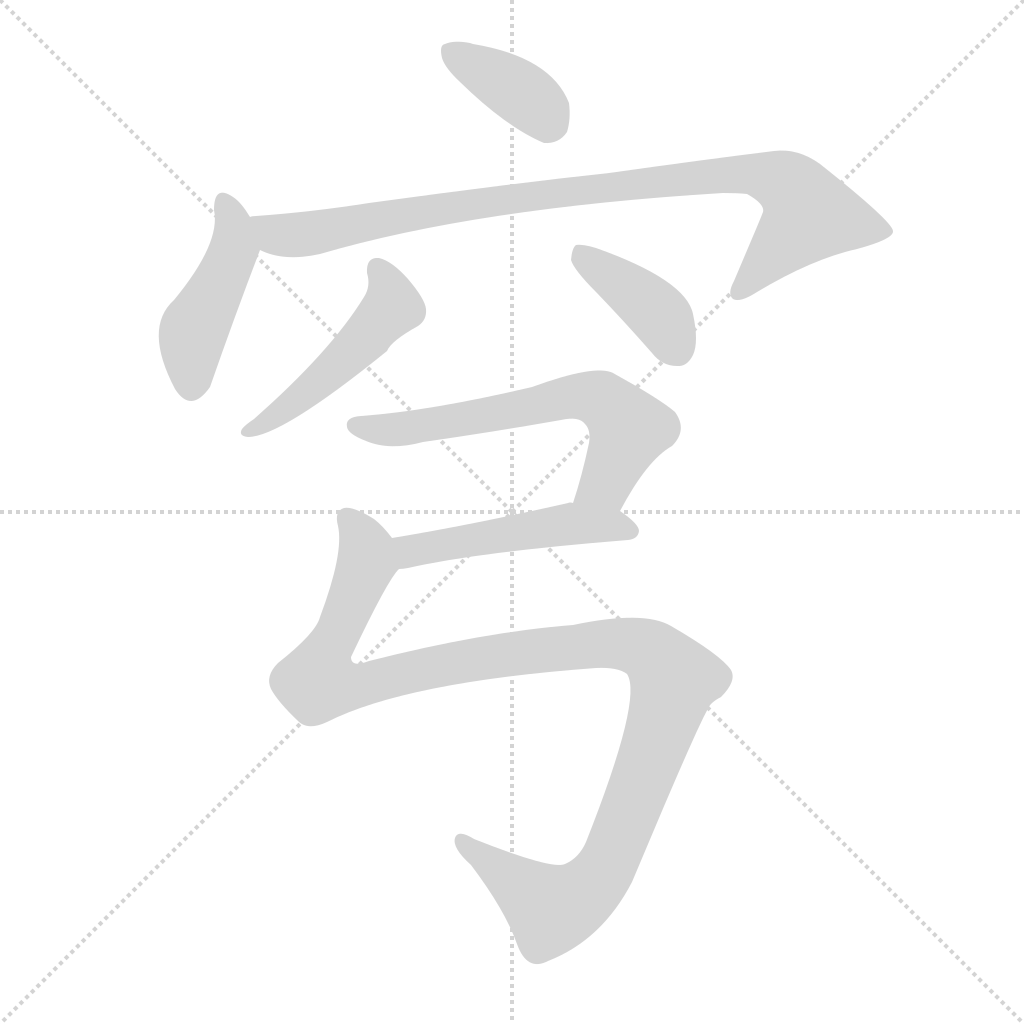
Ancient form. According to the Extensive Rhymes (Guangyun), pronounced qiong. According to the Collected Rhymes (Jiyun) and the Rhyme Compendium (Yunhui), pronounced qiong. According to the Correct Rhymes (Zhengyun), pronounced qiong. Means high or large. From the Book of Odes (Shijing): Without the strength to travel, I ponder the vast heavens. From the Erya: Vast heavens refers to the blue sky. Commentary: The shape of the sky is vaulted and arched, and its color is deep blue, hence the name. Also, according to the Explaining Graphs (Shuowen), it means exhausted. From the Book of Odes (Shijing): Stop the gaps and smoke them out. Commentary: Means exhausted. Also, in the Record of Wu Lands (Wudizhi), Qionglong is the name of a mountain.
Also pronounced kong. From the Rites of Zhou (Zhouli): The drum maker ensures the curvature of the drum barrel is one-third of the total. Commentary: Qiong is read as kong. It refers to the bulging, arched shape of the wooden drum belly, which occupies one-third of the drum. From the Spring and Autumn Weft Texts (Chunqiu Wei): Shaohao established his capital at Qiongsang. From the Master Lu’s Spring and Autumn Annals (Lushi Chunqiu): Yi Yin was born at Qiongsang. This character is sometimes written in a variant form (kong). According to the Supplementary Rhyme Compendium (Yunhui Xiaobu), the modern district name Langqiong in Yunnan is pronounced as Langkong in the local dialect. It is also used interchangeably with xiong. From Sima Xiangru’s Rhapsody on the Sir Fantasy (Zixu Fu): Qiongqiong and calamus. Commentary: Qiongqiong resembles ligusticum. It is currently called jiangli in Liyang.