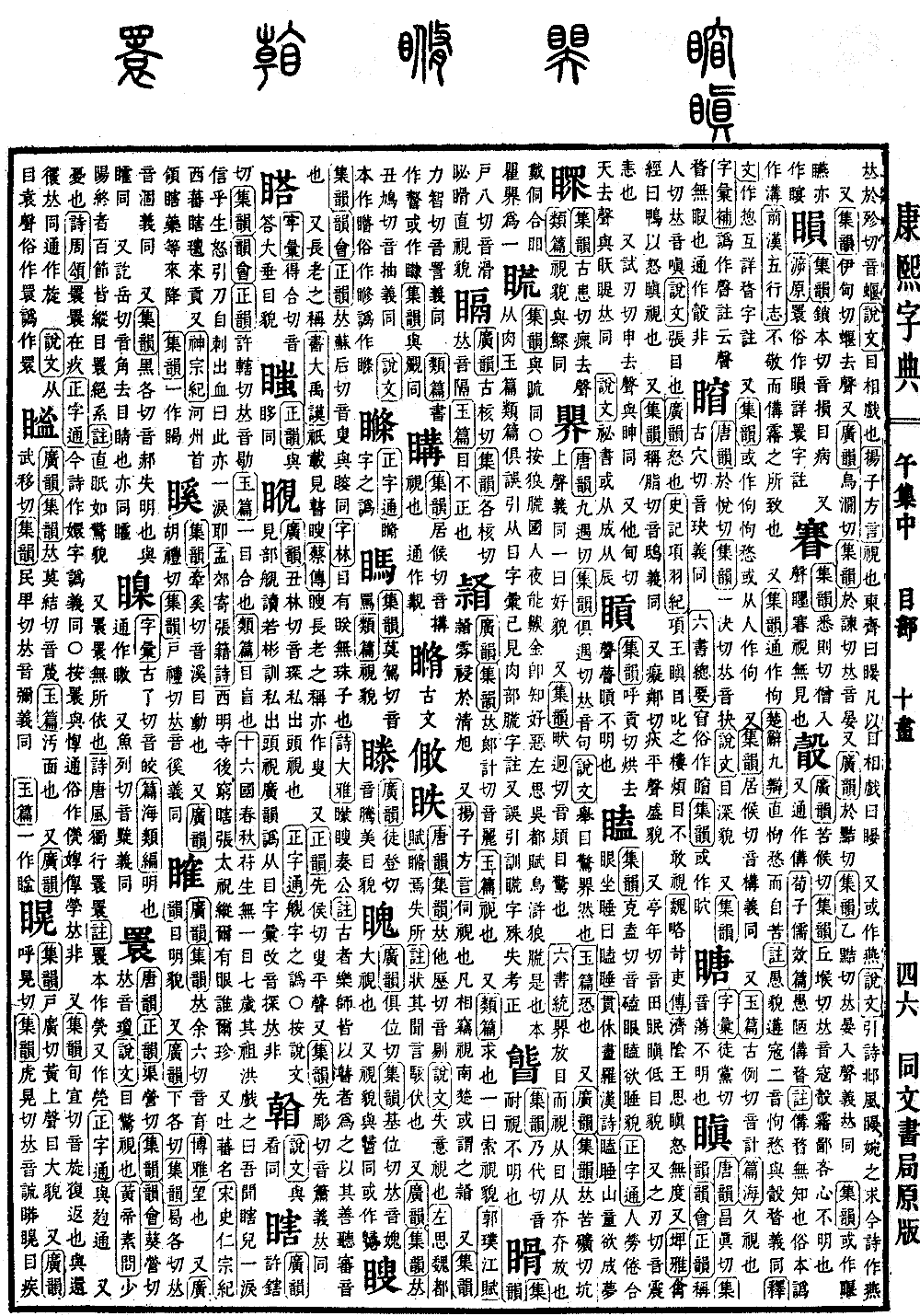
Wu Collection, Middle Volume
Radical: Eye (mù)
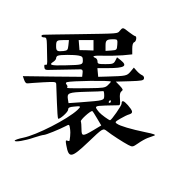
Huan
Kangxi strokes: 15
Page 814, Entry 33
Pronounced qiong
According to the Shuowen Jiezi (Shuowen), this describes the appearance of eyes looking in a state of shock.
In the Yellow Emperor's Inner Canon (Huangdi Neijing), it is written: When Shaoyang ends, all joints relax and the eyes stare fixedly as if severed. The commentary notes that this refers to a fixed, wide-eyed stare as if startled.
Also, huan-huan describes a state of having no one to rely upon.
In the Book of Odes (Shijing), it is written: Walking alone, huan-huan. The commentary notes that huan was originally written as qiong, and is also written as qiong.
According to the Correct Character Guide (Zhengzitong), it is interchangeable with the character qiong (qiong). It also refers to sorrow.
In the Book of Odes (Shijing), it is written: Huan-huan in distress. The Correct Character Guide notes that in contemporary versions of the Odes, it is written as huan, which is a corrupt form of the character but carries the same meaning.
Note that huan is interchangeable with qiong (qiong). The common form is incorrect.
Also, pronounced xuan. It refers to returning. It is interchangeable with huan (to return). It is also used interchangeably with xuan.
According to the Shuowen Jiezi (Shuowen), it is formed from the radical eye and the phonetic element yuan. The common form is written as huan. It is incorrectly written as huan. The character qiong was originally derived from the character for eye and the character for even.