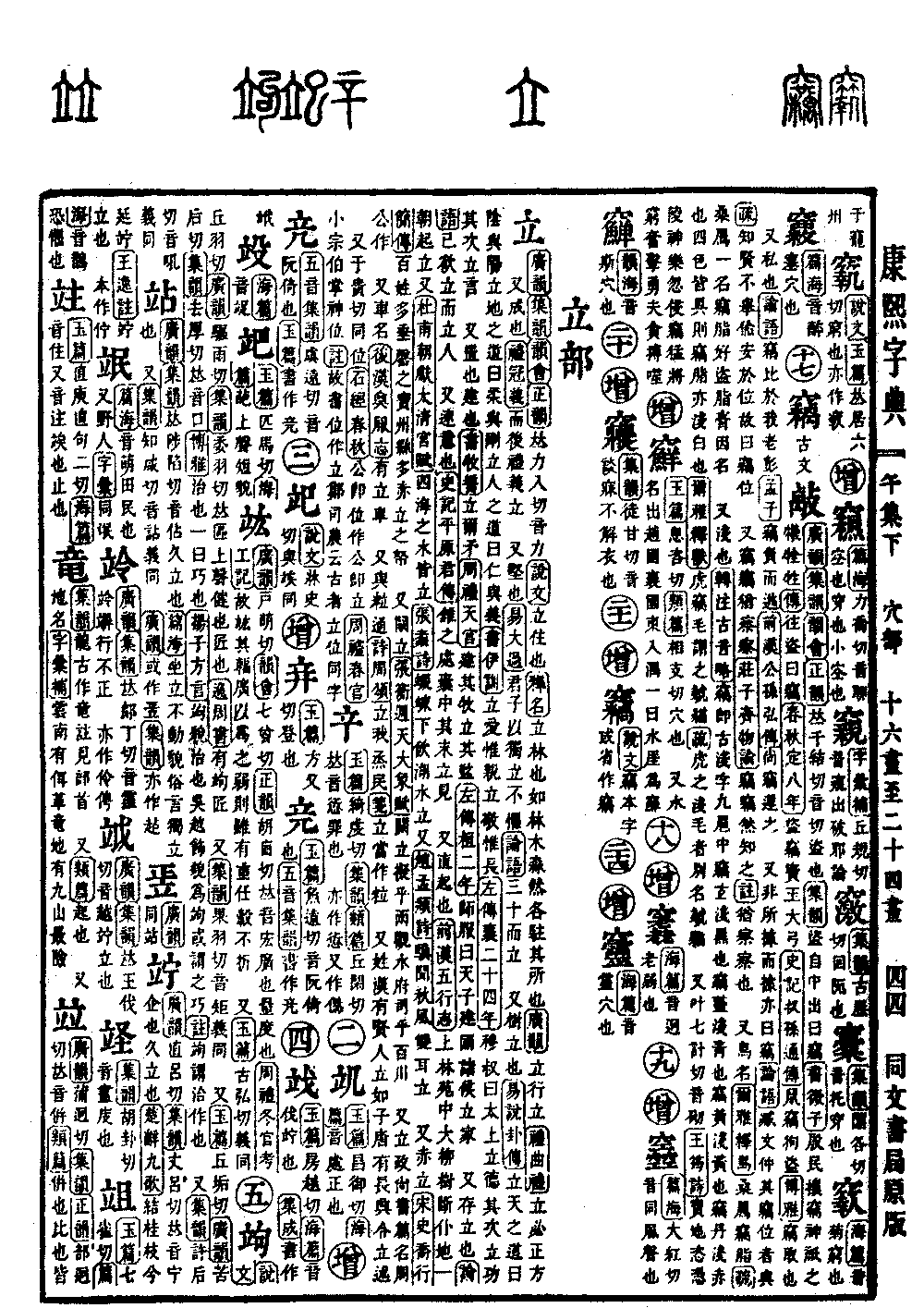
Wu Collection, Lower Volume
Radical: Cave (xué)
Kangxi Strokes: 22
Page 870, Entry 06
Ancient characters. According to the Broad Rhymes (Guangyun), Collected Rhymes (Jiyun), Rhyme Compilation (Yunhui), and Correct Rhymes (Zhengyun), pronounced qie. It means to steal. According to the Collected Rhymes, stealing from within is called qie. In the Book of Documents (Shujing), specifically the Micro-prince (Weizi) section: The people of Yin stole the sacrificial animals of the gods. The commentary states: To go and steal is called qie. In the Spring and Autumn Annals (Chunqiu), eighth year of Duke Ding: Stole the precious jade and great bow. In the Records of the Grand Historian (Shiji), Biography of Shusun Tong: Petty dog theft. According to the Bolya, qie means to take. It also means privately. In the Analects (Lunyu): I privately compare myself to our Old Peng. In the Mencius (Mengzi): Carrying it on one's back and escaping privately. In the History of the Former Han (Qianhan), Biography of Gongsun Hong: Still privately delayed it. It also refers to occupying what one is not entitled to. In the Analects: Is Zang Wenzhong one who has stolen his position? The sub-commentary states: Knowing a worthy person but not recommending him, while remaining safely in one's position, is therefore called stealing a position. It also refers to qie qie, meaning suspicious or discerning. In the Zhuangzi, Equality of Things (Qiwulun): Suspiciously knowing it. The commentary states: It means the same as discerning. It is also the name of a bird. In the Erya, Explaining Birds: The sanghu is also called qiezhi. The sub-commentary states: The sanghu, also known as qiezhi, likes to steal fat, hence the name. It also means shallow. According to the Zhuanzhu Guyin Lue, qie is the ancient character for shallow. Among the nine categories of birds, qie means shallow black. Qie blue means shallow blue. Qie yellow means shallow yellow. Qie red means shallow red. If all four colors are present, then qiezhi means shallow white. In the Erya, Explaining Beasts: A tiger with shallow-colored fur is called a zhan cat. The sub-commentary states: A tiger with shallow-colored fur is alternatively called a zhan cat. It also rhymes with qie, pronounced qi. In the poems of Wang Yun: Treasures are wantonly invaded, divine music is suddenly encroached upon and stolen. Fierce generals struggle to the end, brave men are greedy for combat.