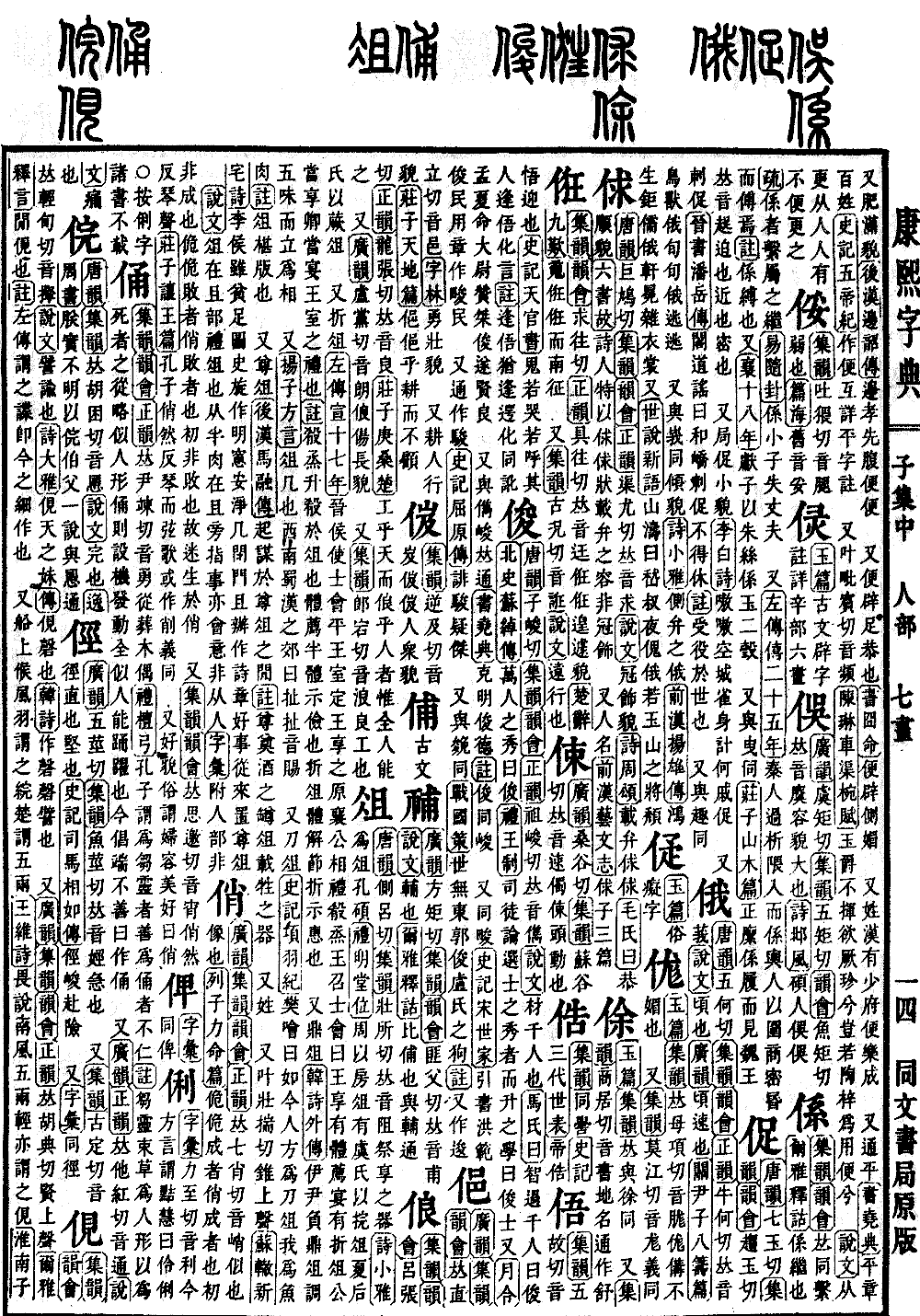
Zi Collection, Middle Volume
Radical: Person (rén)
Character: qiàn
Kangxi Stroke Count: 9
Page 104, Number 28
According to the Collected Rimes (Jiyun) and the Collected Rimes for the Exams (Yunhui), the pronunciation is derived from the fanqie sounds of qing and dian, sounding like qiàn.
Explaining Graphs and Analyzing Characters (Shuowen Jiezi): To illustrate with a metaphor or comparison.
Book of Odes (Shijing): Like a sister of Heaven.
Mao Commentary: The word qiàn means a metaphor.
Han Version of the Odes: Written as qing. The word qing means a metaphor.
Also according to the Expanded Rimes (Guangyun), the Collected Rimes (Jiyun), the Collected Rimes for the Exams (Yunhui), and the Correct Rimes (Zhengyun), the pronunciation is derived from the fanqie sounds of hu and dian, in the rising tone of the sound xián (pronounced xiàn).
Erya: To act as a spy or scout.
Commentary: The Commentary of Zuo (Zuo Zhuan) refers to this as a dié, which is the same as the modern term xìzuò (secret agent).
Additionally, a wind vane made of feathers on a boat is called a huán. In the state of Chu, it was called a wǔliǎng (five-tael weight).
A poem by Wang Wei: Fearing to say the south wind makes the five-tael vane light.
This vane is also called a qiàn.
Huainanzi: Just as a wind vane reacts to the wind, it does not remain still for even a brief moment.
One definition describes it as an observation pole.
Also used interchangeably with the character xiàn.
In the writings of Han Yu: Appearing fearful and cautious (xǐnxǐn xiànxiàn).