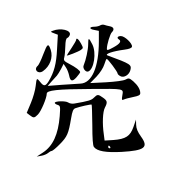
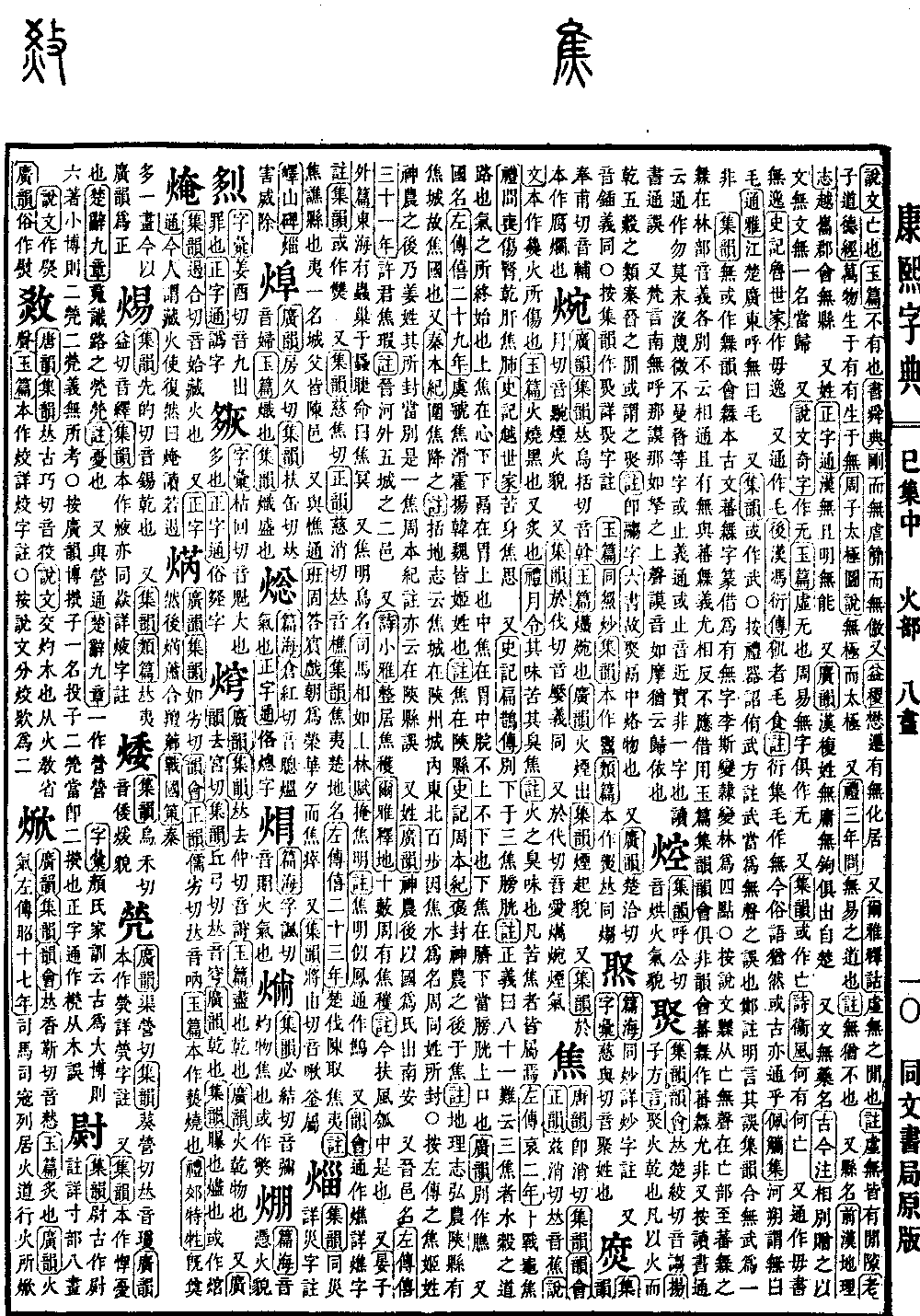
Si Collection, Middle Volume. Radical: Fire (huǒ). 12 Kangxi strokes. Page 674, Entry 20. Pronounced qióng. In the Broad Rhymes (Guangyun), it is the original form of qióng. For a detailed explanation, see the entry for qióng. According to the Collected Rhymes (Jiyun), it is also the original form of qióng, meaning sorrow. In the Songs of Chu (Chuci), Nine Chapters (Jiuzhang), it says: Recognizing the road as lonely and sorrowful. The commentary states: It means sorrow. It is also interchangeable with yíng. In the Songs of Chu (Chuci), Nine Chapters (Jiuzhang), some versions are written as yíngyíng. The Comprehensive Collection of Characters (Zihui) cites the Family Instructions of Yan (Yanshi Jiaxun) as follows: In ancient times, the large board game used six sticks, while the small board game used two qióng. The meaning of the two qióng cannot be verified. According to the records in the Broad Rhymes (Guangyun), the gaming pieces used in board games are also called tóuzǐ (dice); two qióng should be two dice. The Correct Interpretation of Characters (Zhengzitong) writes it as a character with the wood radical, which is incorrect.