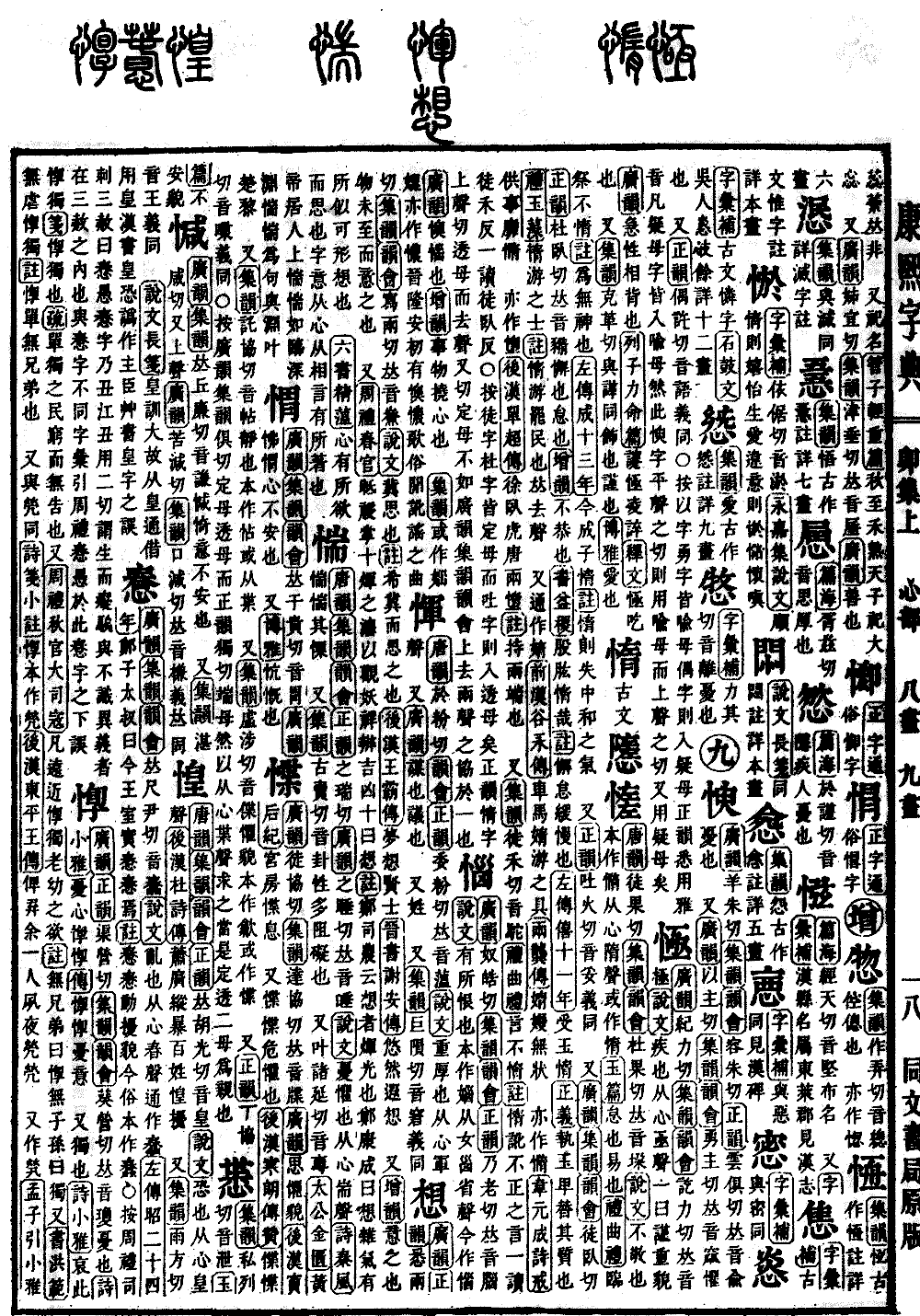
Mao Collection, Upper Volume
Radical: Heart (xīn)
Kangxi stroke count: 13
Page 392, Entry 34
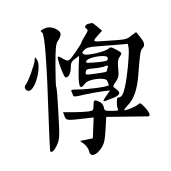
Pronounced qióng. Meaning: sorrowful. Book of Odes (Shijing), Lesser Odes of the Kingdom: Sorrowful heart is qióng-qióng. Commentary: Qióng-qióng means the appearance of being sorrowful. Also means lonely. Book of Odes (Shijing), Lesser Odes of the Kingdom: Alas for the lonely and solitary. Annotation: Qióng means lonely. Sub-commentary: Refers to people who are alone and without support, impoverished and with nowhere to voice their grievances. Also, Rites of Zhou (Zhouli), Autumn Office, Grand Minister of Justice: Regarding all near and far who are lonely and solitary, and the old and young who wish to present appeals to the superior. Zheng's Annotation: Those without brothers are called qióng. Also, Book of Documents (Shangshu), Great Plan (Hongfan): Do not oppress the lonely and solitary. Annotation: Qióng refers to being alone without brothers. Also written as the same as the character qióng. Small Annotations to the Book of Odes (Shijing) Commentary: Qióng was originally written as qióng. Book of the Later Han (Houhanshu), Biography of the Prince of Dongping: Allowed me to keep to myself, from morning till night qióng-qióng. Also written as qióng. Mencius, quoting the Lesser Odes of the Kingdom, poem of the first month: Written as alas for this solitary one. Collected Rhymes (Jiyun): Also written as qióng.
Note: The character qióng is explained as sorrowful, and also explained as lonely; most recent character dictionaries explain these separately. However, in the classical canons, the character qióng is interpreted as both sorrowful and lonely. Because sorrow is often born of loneliness, and the characters qióng, qióng, and others are interchangeably quoted and appear for one another in classical texts, they are generally understood to be synonymous.
Textual research: Rites of Zhou (Zhouli), Autumn Office, Grand Minister of Justice: Regarding all near and far who are lonely and solitary, the old and young who wish... Annotation: Note that the cited scriptural sentence is incomplete; according to the original text, the four characters have复于上 (have appeals to the superior) should be added after the characters 之欲 (wish to). The character Zheng should be added before Annotation. The five characters meaning those without children or grandchildren are called solitary are omitted.