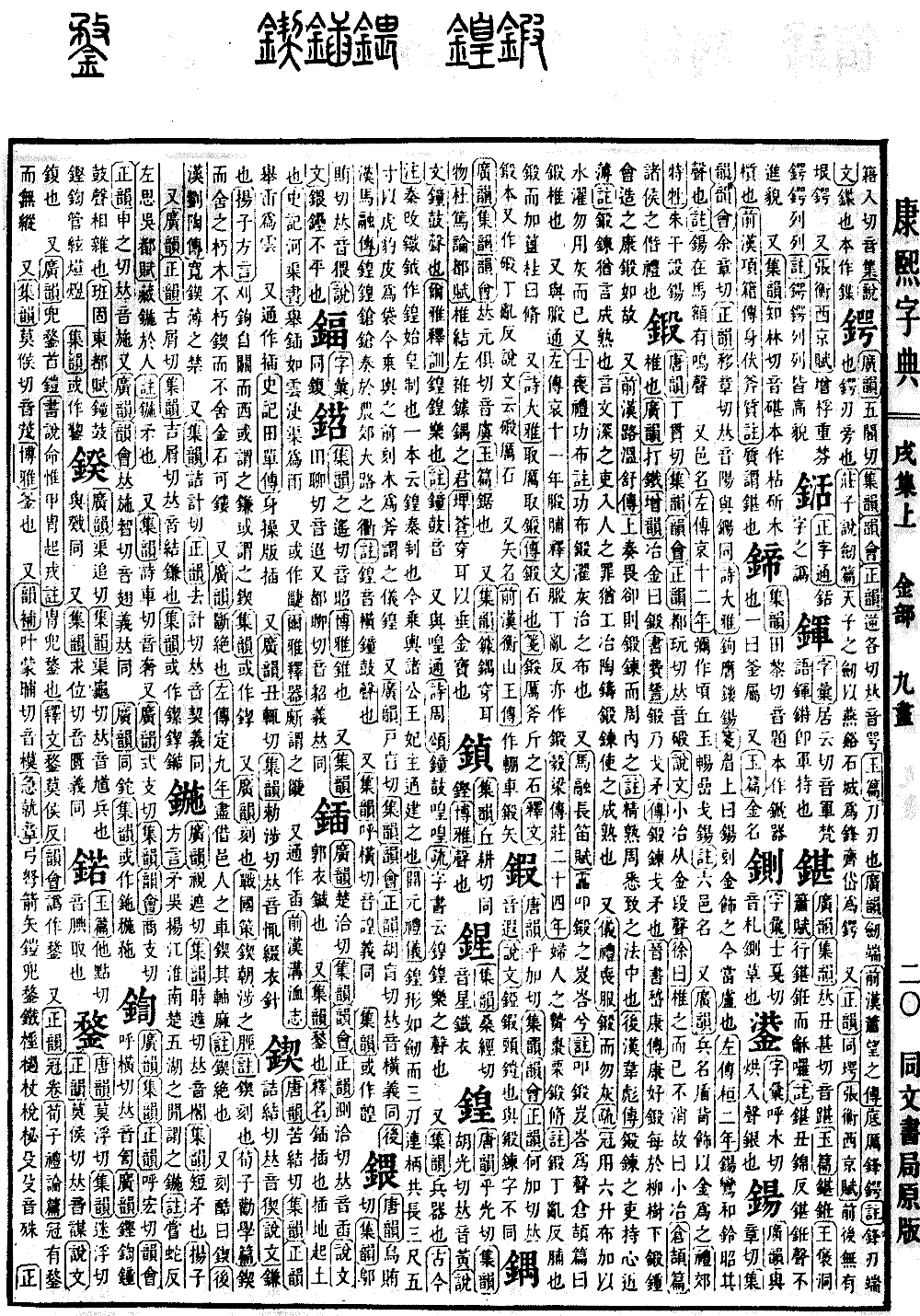
Xu Collection, Upper Volume
Radical: Metal (jīn)
17 strokes
Page 1314, Entry 19
According to the Tang Rhymes (Tangyun), pronounced jie. According to the Collected Rhymes (Jiyun) and Correct Rhymes (Zhengyun), pronounced jie. According to the Explaining Graphs (Shuowen), it means a sickle. According to Master Yangs Regional Dialects (Fangyan), a reaping hook is called a sickle in regions west of the pass, and is also called a jie. According to the Collected Rhymes (Jiyun), it is also written in a variant form. Also, according to the Broad Rhymes (Guangyun), it means to carve. According to the Strategies of the Warring States (Zhanguoce), to carve the shin of one who crosses the river in the morning. Note: Jie means to carve. According to the Xunzi, specifically the Encouraging Learning chapter, if you carve and then give up, even rotten wood will not break; if you carve and do not give up, metal and stone can be carved. Also, according to the Broad Rhymes (Guangyun), it means to cut off. According to the Zuo Commentary (Zuozhuan), in the ninth year of Duke Ding, he borrowed all the carts from the people of the town and cut off their axles. Note: Jie means to cut off. Furthermore, harsh and severe behavior is called jie. According to the History of the Later Han (Houhan-shu), in the biography of Liu Tao, to relax the prohibitions against harshness and severity. Also, according to the Collected Rhymes (Jiyun) and Correct Rhymes (Zhengyun), pronounced qi. The meaning is the same. Also, according to the Broad Rhymes (Guangyun) and Correct Rhymes (Zhengyun), pronounced jie. According to the Collected Rhymes (Jiyun), it means a sickle. According to the Collected Rhymes (Jiyun), it is also written in a variant form.
Textual Research: Regarding the entry for the Xunzi, specifically the Encouraging Learning chapter, if you carve and then give up, rotten wood will not break. Following the original text, not rot has been corrected to not break. Regarding the entry for the Zuo Commentary (Zuozhuan), in the ninth year of Duke Ding, he borrowed all the carts from the people of the town and cut off their axles. Following the original text, the sentence ends at cut off their axles; the character ma is not read as part of the previous phrase. The character ma has been omitted.