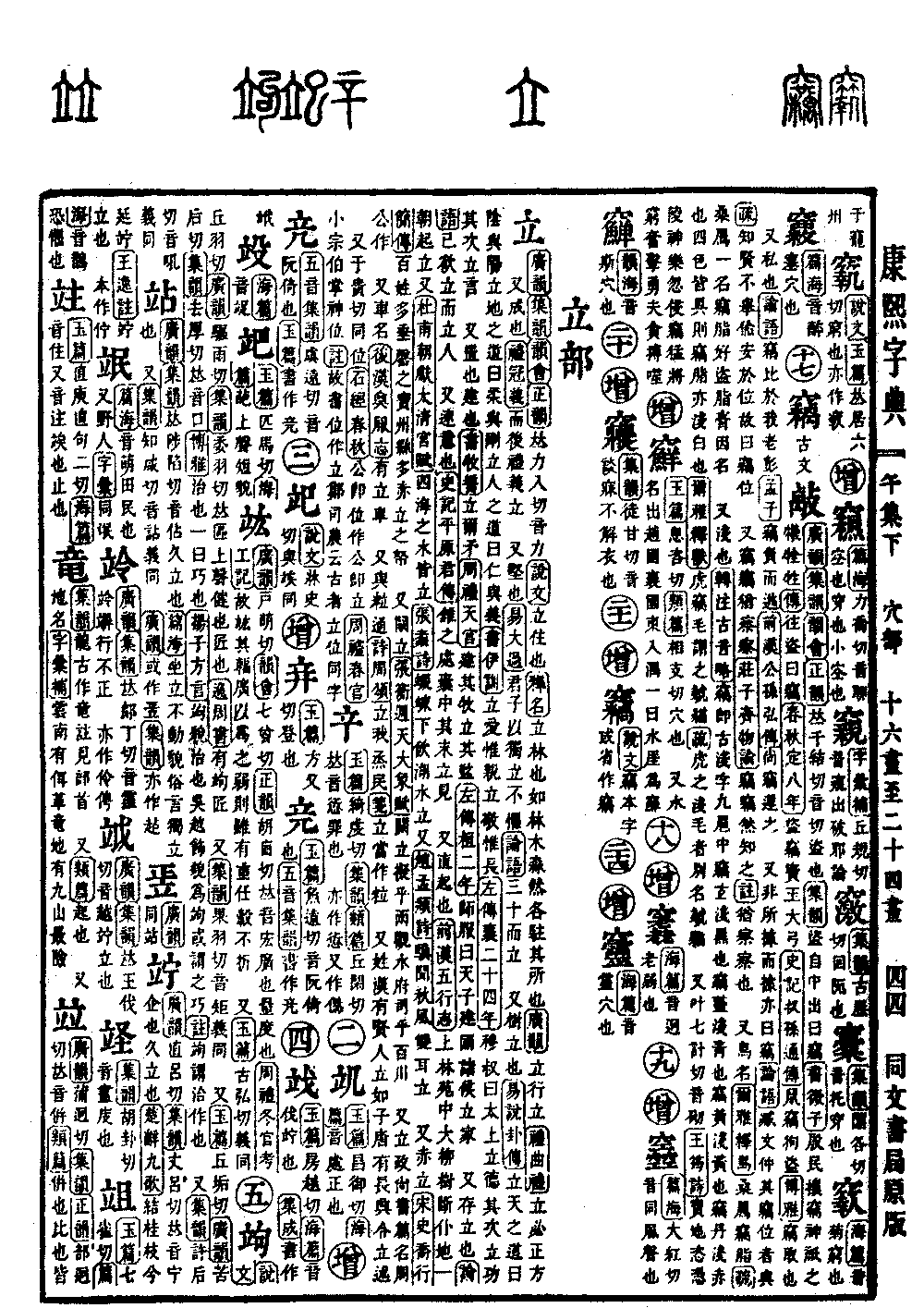
Wu Collection, Lower Volume
Radical: Cave (xué)
Kangxi Strokes: 22
Page 870, Entry 08
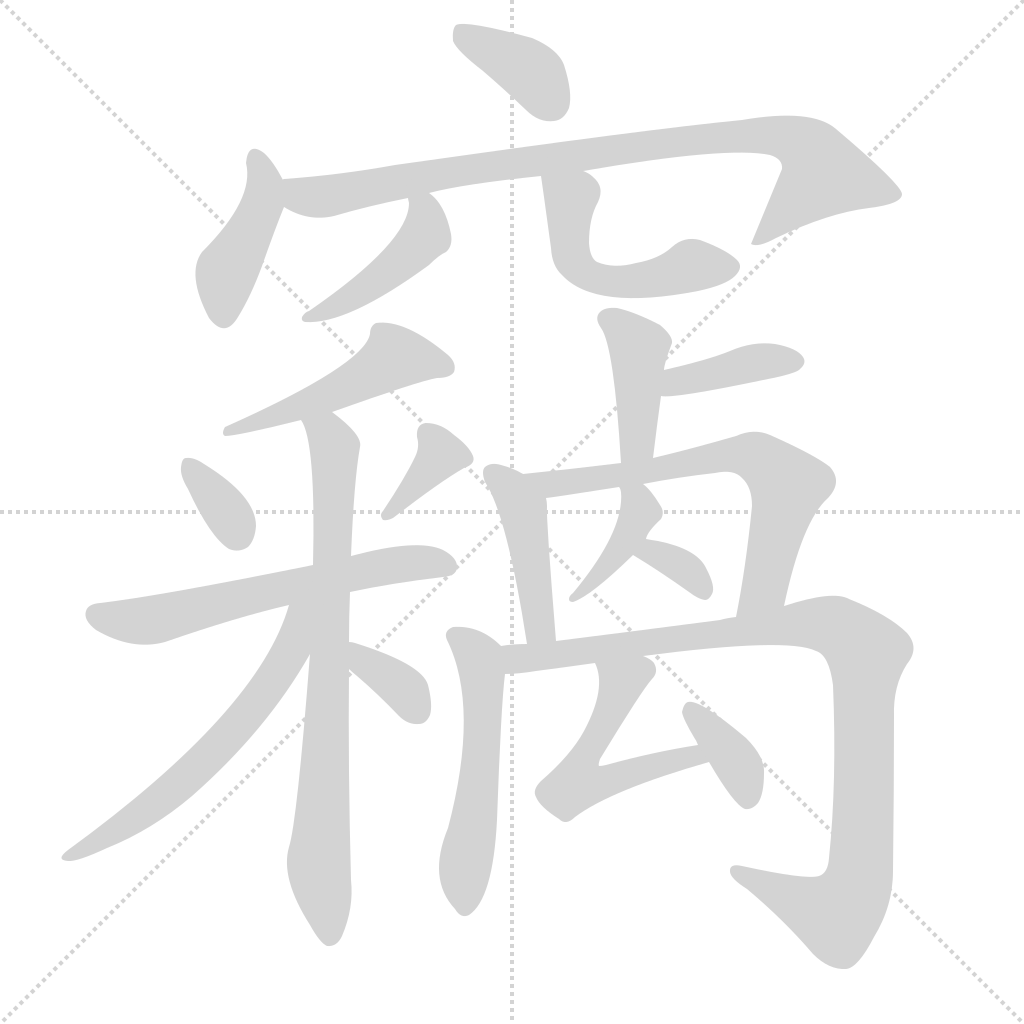
Ancient script. According to the Broad Rhymes (Guangyun), the Collection of Rhymes (Jiyun), the Rhyme Assembly (Yunhui), and the Correct Rhymes (Zhengyun), it is pronounced qie. It means to steal or take. According to the Collection of Rhymes (Jiyun), taking something from inside is called qie. In the Book of Documents (Shujing), specifically the Microscopic Son (Weizi) chapter, it mentions the people of the Shang dynasty stealing livestock meant for the sacrifice to the spirits. The Commentary (Zhuan) states that to go and steal is called qie. In the Spring and Autumn Annals (Chunqiu), in the eighth year of Duke Ding, it records the theft of precious jade and a great bow. In the Records of the Grand Historian (Shiji), in the biography of Shusun Tong, it mentions petty thievery like stealing dogs. In the Erudite Elegant (Boya), qie is defined as to take.
It also refers to doing something privately or secretly. In the Analects (Lunyu), it records one privately comparing oneself to Old Peng. In the Book of Mencius (Mengzi), it describes someone secretly carrying their father away to escape. In the Former Han History (Qianhan Shu), in the biography of Gongsun Hong, it states that he still privately felt he was slow. It further refers to occupying a position one should not, which is also called qie. In the Analects (Lunyu), Zang Wenzhong is described as perhaps someone who stole a position. The Subcommentary (Shu) explains that knowing of a virtuous person yet failing to recommend them, while lazily holding onto an official post, is therefore called stealing a position (qiewei).
Also, qieqie refers to the appearance of being clearly observant. In the Book of Master Zhuang (Zhuangzi), in the chapter On the Equality of Things (Qiwulun), it says qieqie as if knowing it. The Commentary (Zhu) explains this as the appearance of being clearly observant.
Also the name of a bird. In the Literary Expositor (Erya), in the chapter Explaining Birds (Shiriao), it mentions the mulberry bird, the qie zhi. The Subcommentary (Shu) states that the mulberry bird is also called qie zhi, which likes to steal and eat fat, and thus gets its name.
It also refers to light colors. In the Expanded Ancient Sounds Overview (Zhuanzhu Guyin Lue), it states that qie is the ancient form of the character for light or shallow. Among the nine types of hoopoe birds, qie refers to light black. Qie blue refers to light blue. Qie yellow refers to light yellow. Qie red refers to light red. If all four colors are present, then qie zhi is light white. In the Literary Expositor (Erya), in the chapter Explaining Beasts (Shishou), it says that a tiger with light-colored fur is called a zhan cat. The Subcommentary (Shu) states that a light-furred tiger has the alternative name of zhan cat.
Also rhyming with qie, pronounced qi. In the poems of Wang Yun, it writes: The precious land is wantonly encroached upon, and the divine music is suddenly invaded and stolen. The fierce general exerts his strength to fight, and the brave man covets the struggle to devour.