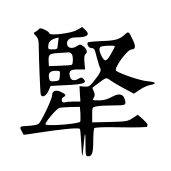
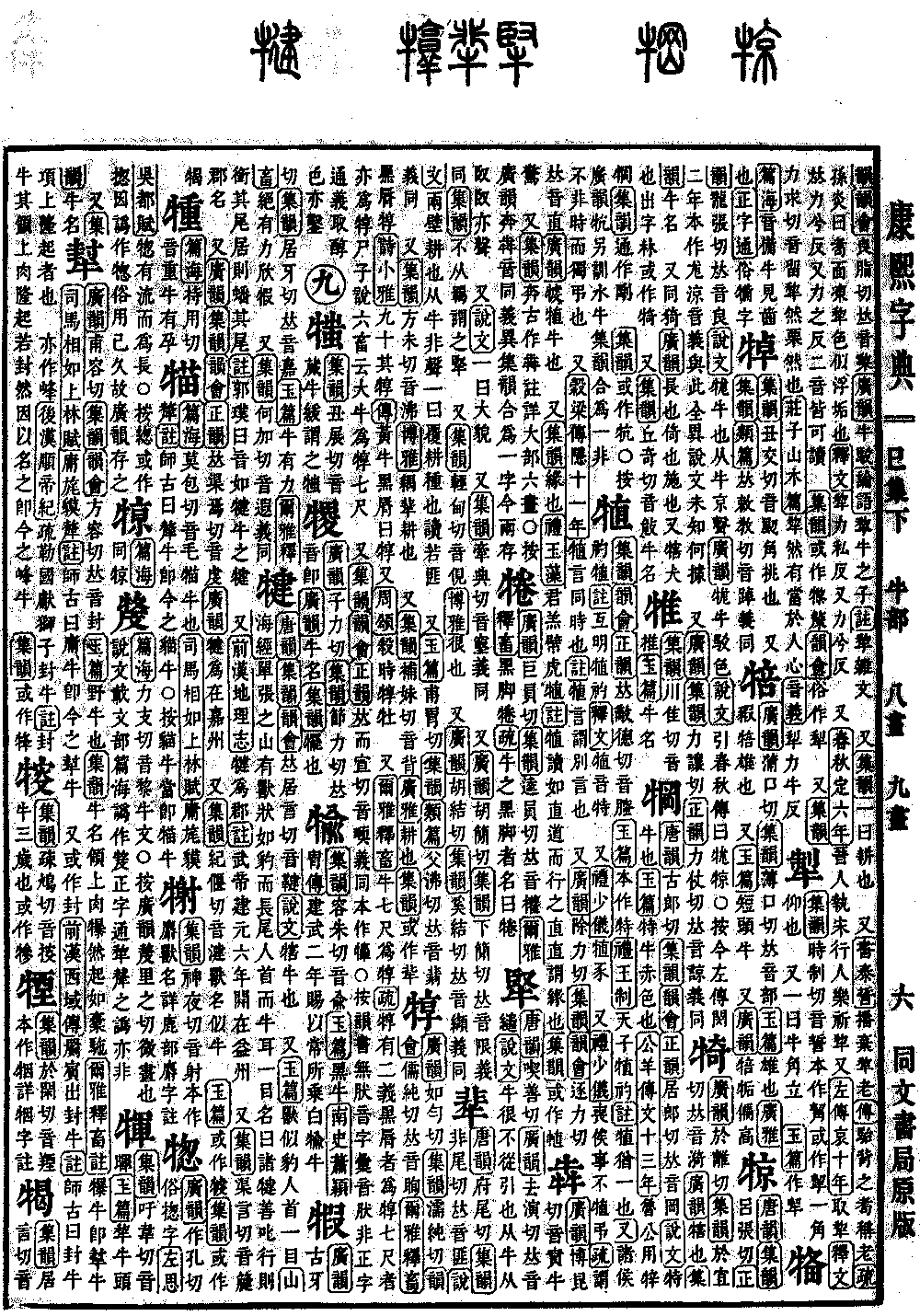
Pronounced qie shan qie in "Tang Yun" (Tang Yun), and qu yan qie in "Guang Yun" (Guang Yun), with the same pronunciation as "qian" (qǎn). "Shuowen Jiezi" (Shuowen Jiezi) explains it as: an ox that is stubborn and does not obey being led. The character is composed of "niu" (ox) and "qian" (qiān), with "qian" also indicating the pronunciation.
Another explanation in "Shuowen Jiezi" (Shuowen Jiezi) is: the appearance of something large in size.
Also pronounced qian dian qie in "Jiyun" (Jiyun), with the same meaning.
Also pronounced hu jian qie in "Guang Yun" (Guang Yun) and xia jian qie in "Jiyun" (Jiyun), with the same pronunciation as "xian" (xiàn). "Jiyun" (Jiyun) explains it as: an ox that is not restrained by a halter is called "lan" (lán).
Also pronounced qing dian qie in "Jiyun" (Jiyun), with the same pronunciation as "xian" (xiān). "Boyao" (Boyao) explains it as: stubborn, obstinate.
Also pronounced hu jie qie in "Guang Yun" (Guang Yun) and xi jie qie in "Jiyun" (Jiyun), with the same pronunciation as "xie" (xié). The meaning is the same.