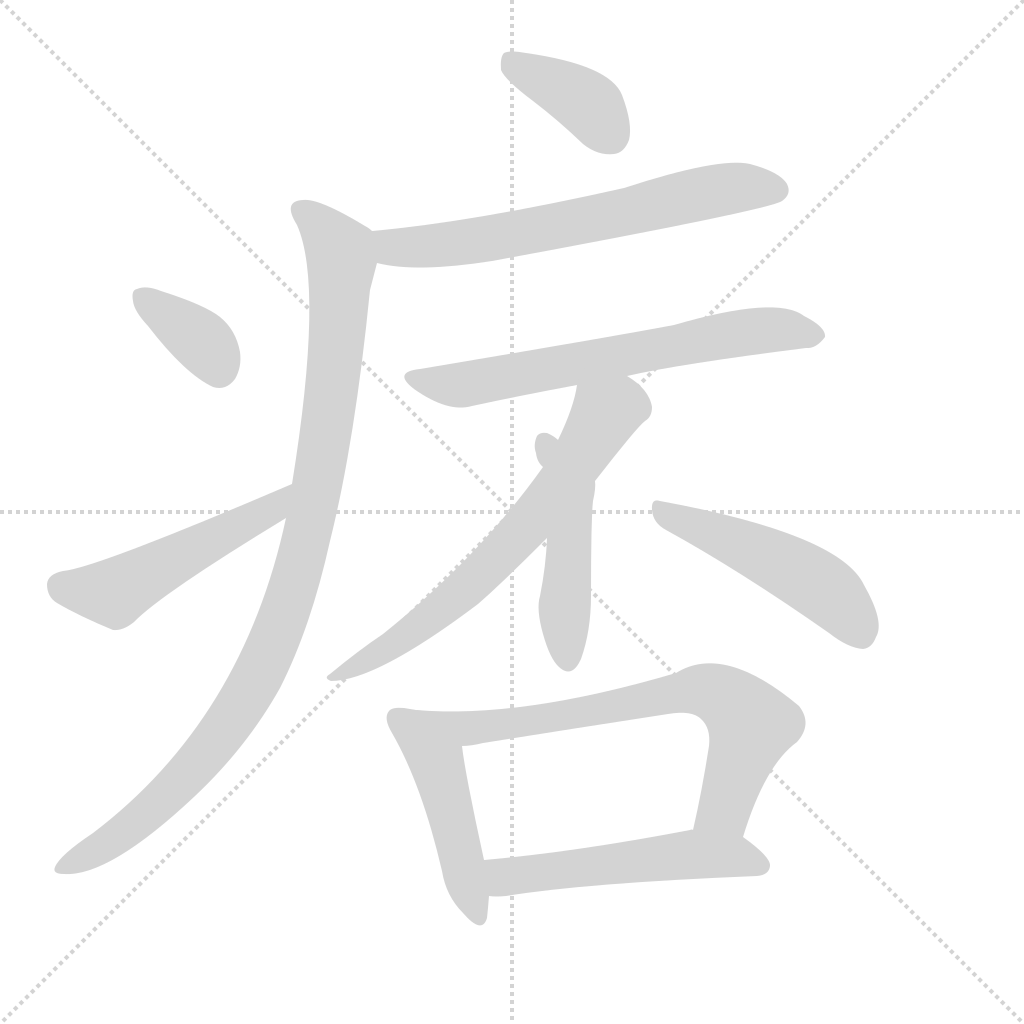
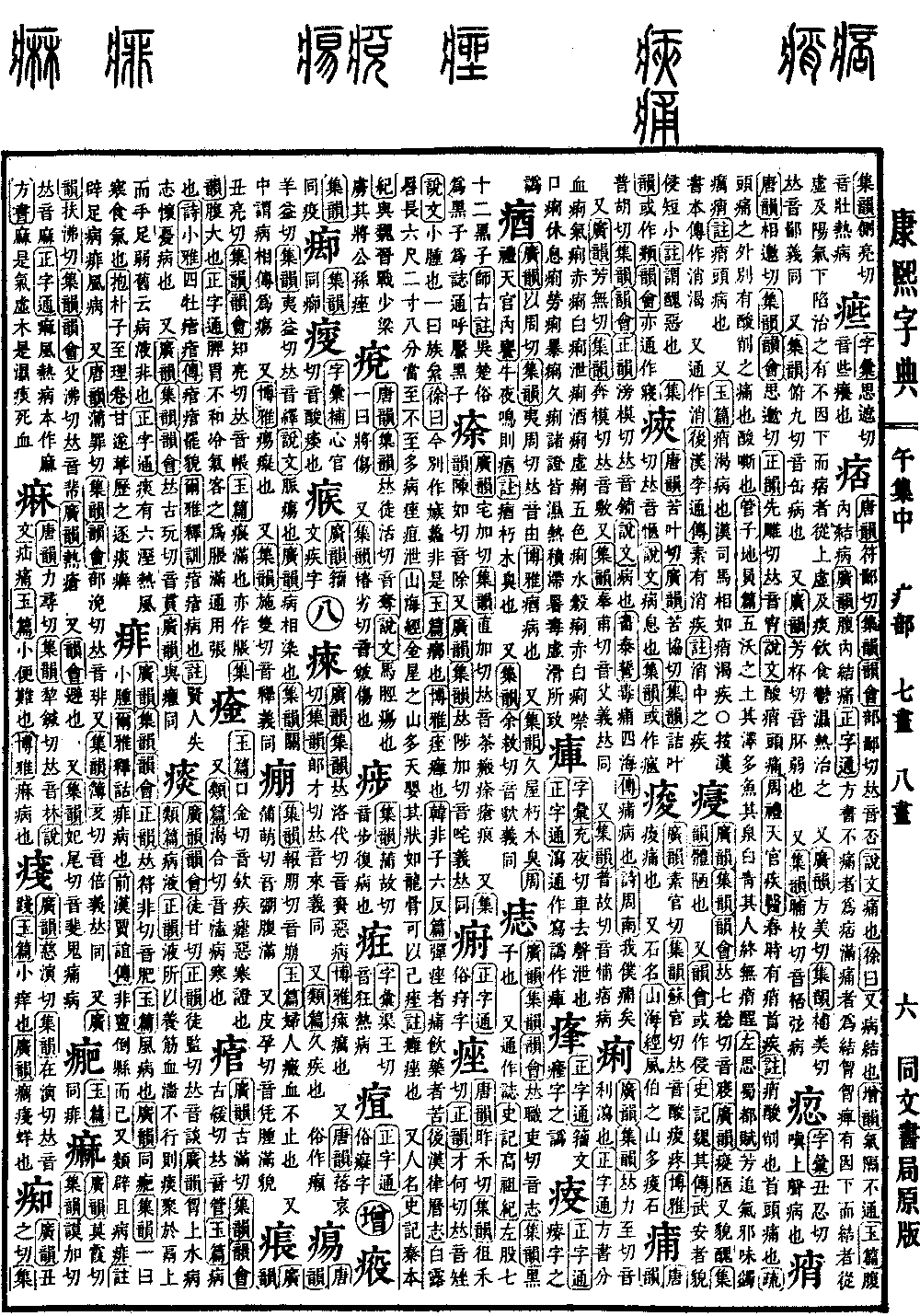
Wu Collection, Middle Volume
Radical: Sickness (bìng)
Pi; Kangxi stroke count: 12
Page 774, Entry 02
According to Tang Rhymes (Tangyun), pronounced fou (rising tone). According to Collected Rhymes (Jiyun) and Rhyme Anthology (Yunhui), pronounced fou (rising tone).
According to Explaining Graphs and Analyzing Characters (Shuowen), it means pain.
Xu says: It also refers to a knotted illness.
According to Expanded Rhymes (Zengyun), qi is obstructed and does not pass.
According to Jade Articles (Yupian), an internal abdominal knotted illness.
According to Extensive Rhymes (Guangyun), internal abdominal knotted pain.
According to Correct Character Penetration (Zhengzitong), in medical treatises, that which is not painful is called pi-man (fullness/obstruction), while that which is painful is called jie-xiong (knotted chest). Chest impediment may be caused by purgation leading to knotting, in which case one treats it starting from the deficiency and the sinking of yang-qi. There are cases not caused by purgation but by obstruction, in which one treats it starting from upper deficiency and the stagnation of phlegm, food, or damp-heat.
Also, according to Extensive Rhymes (Guangyun), pronounced bi (rising tone). According to Collected Rhymes (Jiyun), pronounced bi (rising tone). The meaning is the same.
Also, according to Collected Rhymes (Jiyun), pronounced fou (rising tone). It is an illness.
Also, according to Extensive Rhymes (Guangyun), pronounced pei (level tone). It means weak.
Also, according to Collected Rhymes (Jiyun), pronounced bei (level tone). It is a string-like pulse illness.