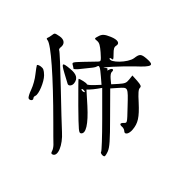
Broad Rimes (Guangyun) indicates the pronunciation as pei (falling tone). Jade Chapters (Yupian) indicates the pronunciation as pei (falling tone), sounding the same as pei (falling tone). Jade Chapters (Yupian) defines it as the act of becoming angry. Some versions are written with the variant form derived from the radical for dog (quǎn) and the phonetic element ba (bá).
Furthermore, Broad Rimes (Guangyun) and Collected Rimes (Jiyun) indicate the pronunciation as bei (falling tone), sounding the same as bei (falling tone).
Furthermore, Collected Rimes (Jiyun) indicates the pronunciation as pai (falling tone).
Furthermore, Broad Rimes (Guangyun) and Collected Rimes (Jiyun) indicate the pronunciation as fei (falling tone), sounding the same as fei (falling tone).
Furthermore, Broad Rimes (Guangyun) and Collected Rimes (Jiyun) indicate the pronunciation as fu (rising tone). The meaning is the same.
Furthermore, Broad Rimes (Guangyun) and Collected Rimes (Jiyun) indicate the pronunciation as bo (entering tone), sounding the same as bo (entering tone). The meaning is to be unhappy at heart. The original text was written with the character form consisting of heart (xīn) and the phonetic element ba (bá); the common simplified form is written as fei (falling tone).