Hai Collection, Upper Volume
Radical: Carriage (mǎ)
Kangxi Strokes: 18
Page 1440, Entry 15
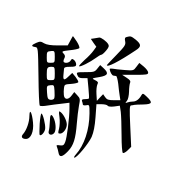
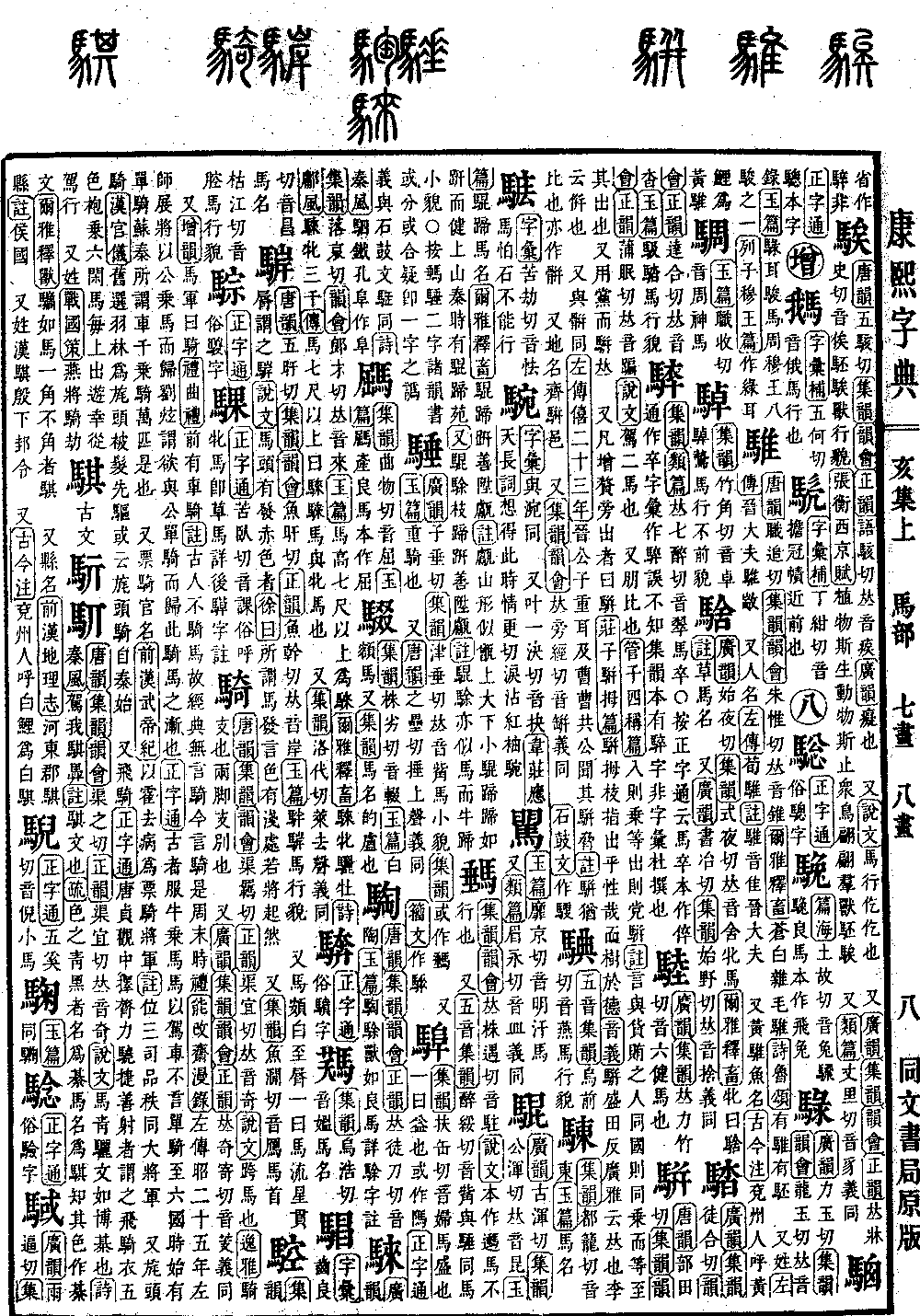
Pronounced pian. According to the Tang Rhyme (Tangyun), Collected Rhymes (Jiyun), Rhyme Compendium (Yunhui), and Orthodox Rhymes (Zhengyun), the pronunciation is the same as pian. According to the Analytical Dictionary of Characters (Shuowen), it refers to two horses harnessed side-by-side to a carriage. It also refers to forming factions or clinging to others. In the Four Evaluations chapter of the Guanzi (Guanzi), it states: When inside the court, one shares the same rank and rides in the same carriage; when outside, one forms factions and clings to others. The commentary states: This means that if one is in the same state as a person who offers bribes, one rides in the same carriage and holds equal status. When going abroad, one forms a clique and clings to one another. Furthermore, anything redundant or growing from the side is also called pian. In the Chapter on Joined Toes of the Zhuangzi (Zhuangzi), it asks: Are joined toes and extra fingers born that way, or is it a virtue formed artificially? The Phonetic Definitions state: The pronunciation of pian is given as sheng tian. The Guangya (Guangya) states: It means to join or be side-by-side. Li Yi states: It means to merge. It is also the same as the character pian. In the twenty-third year of Duke Xi in the Zuo Commentary (Zuo Zhuan), it mentions that when Prince Chong'er of Jin arrived in the state of Cao, Duke Gong of Cao heard that his ribs were joined together. The commentary states: Pian means the same as to be side-by-side. It is also written as the variant form pian. It is also a place name, referring to Pian Town in the state of Qi. Furthermore, according to the Collected Rhymes (Jiyun) and the Rhyme Compendium (Yunhui), the pronunciation is the same as ping. The meaning remains the same. In the Stone Drum Inscriptions (Shiguwen), it is written in this form.