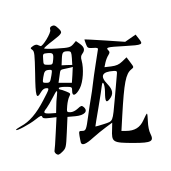
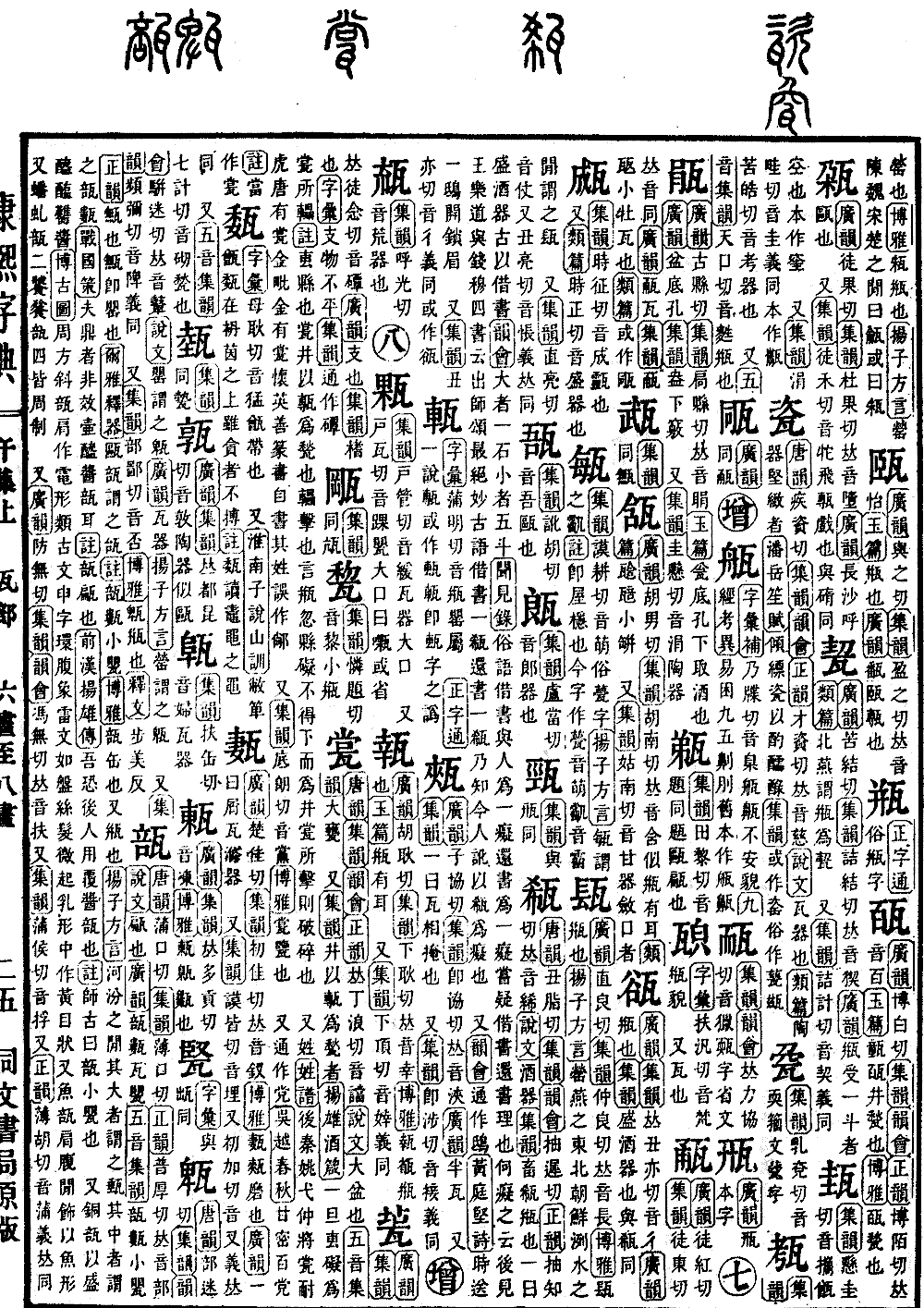
Zi Collection, Upper Volume, Page 12, Entry 01
Pronounced mi (falling tone) and pi (falling tone).
The "Tang Yun" (Tang Rhymes) annotates the pronunciation as mi (falling tone) and pi (falling tone).
The "Ji Yun" (Rhyme Collection) and "Yun Hui" (Rhyme Gathering) annotate the pronunciation as pi (falling tone) and mi (falling tone). The pronunciation is the same as "pí".
"Shuowen Jiezi" (Explaining Characters and Analyzing Words) explains that the vessel called yīng is also called pí.
"Guang Yun" (Broad Rhymes) states that it is a pottery vessel.
"Yangzi Fangyan" (Regional Words of Yangzi) states that the vessel called yīng is also called pí.
Additionally, the "Ji Yun" (Rhyme Collection) annotates the pronunciation as pín (falling tone) and mí (rising tone). The pronunciation is the same as "pí". The meaning is the same as above.
Furthermore, the "Ji Yun" (Rhyme Collection) annotates the pronunciation as bù (falling tone) and bǐ (falling tone). The pronunciation is the same as "pǐ".
"Bo Ya" (Comprehensive Glossary) explains that pí is a píng.
"Shuwen" (Explanation of Rhymes) annotates the pronunciation as bù (falling tone) and měi (departing tone).