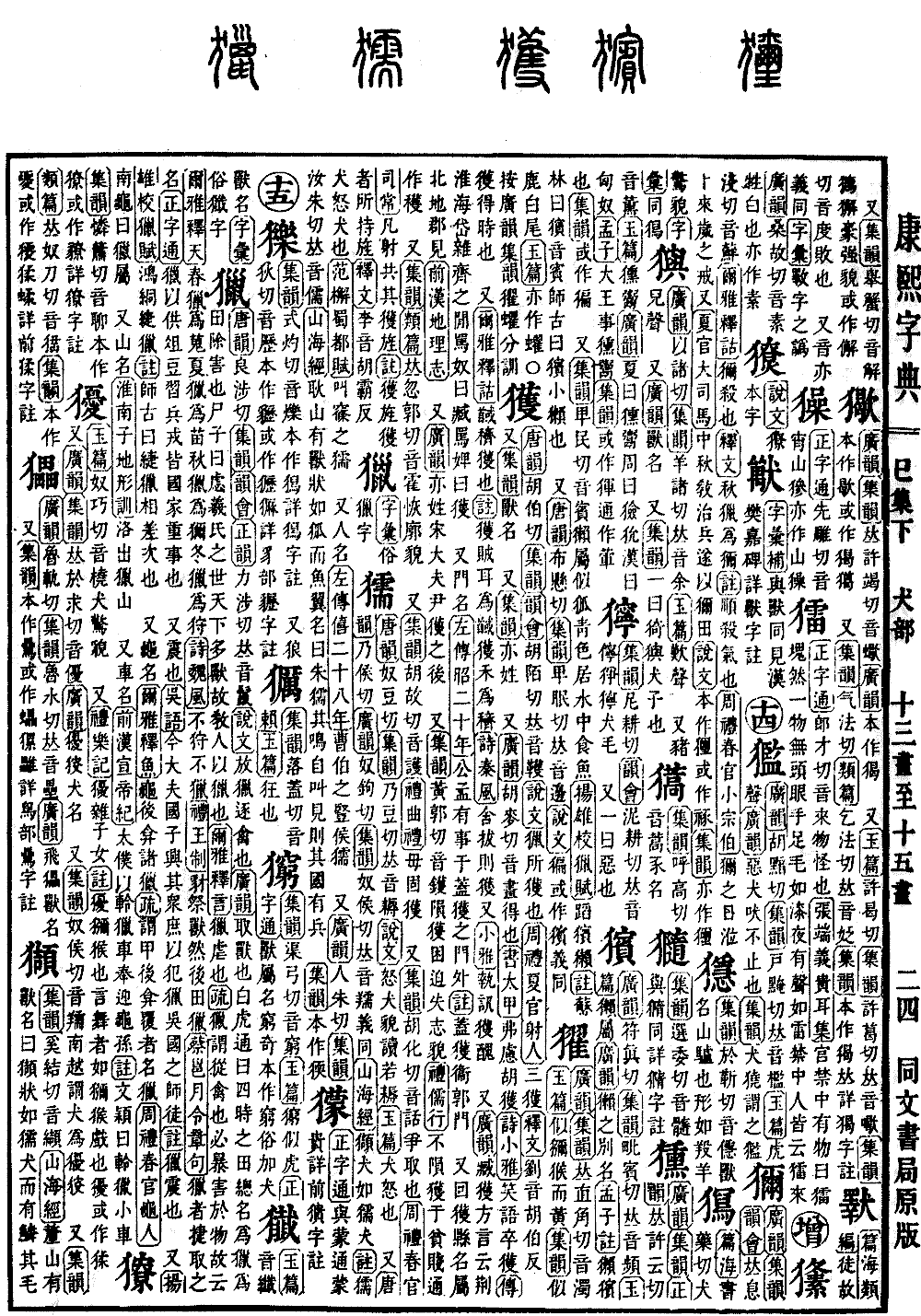
Si Collection, Lower Volume
Radical: Dog (quǎn)
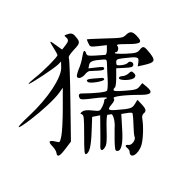
Character: Nóng
Kangxi Strokes: 18
Page 720, Entry 21
Pronounced nòu.
According to the Explaining Graphs and Analyzing Characters (Shuowen Jiezi), it refers to the appearance of an angry dog. It is read like the character for hoe.
According to the Jade Chapters (Yupian), it means a dog being angry.
Also pronounced náu. Meaning is the same.
According to the Classic of Mountains and Seas (Shanhaijing), there is a dog, similar to a snarling dog. The commentary notes that a snarling dog is an angry dog.
In the Rhapsody on the Capital of Shu (Shudu Fu) by Fan Jie, there is the phrase regarding the snarling of dogs.
Also used as a personal name. In the Zuo Tradition (Zuozhuan), in the twenty-eighth year of Duke Xi, there is mention of the servant of the Earl of Cao, Hou Nóng.
Also pronounced rú.
According to the Classic of Mountains and Seas (Shanhaijing), on Geng Mountain there is a beast shaped like a fox with fish wings, named Zhu Nóng. It makes a sound like its own name. When it appears, the state will have cause for fear.
In the Collected Rhymes (Jiyun), this is the original form.
Textual Research: In the Classic of Mountains and Seas, it is noted that on Geng Mountain there is a beast named Zhu Nóng, whose cry is like its own name, and its appearance signifies that the state will have fear. The original text has been corrected from state will have soldiers to state will have fear.