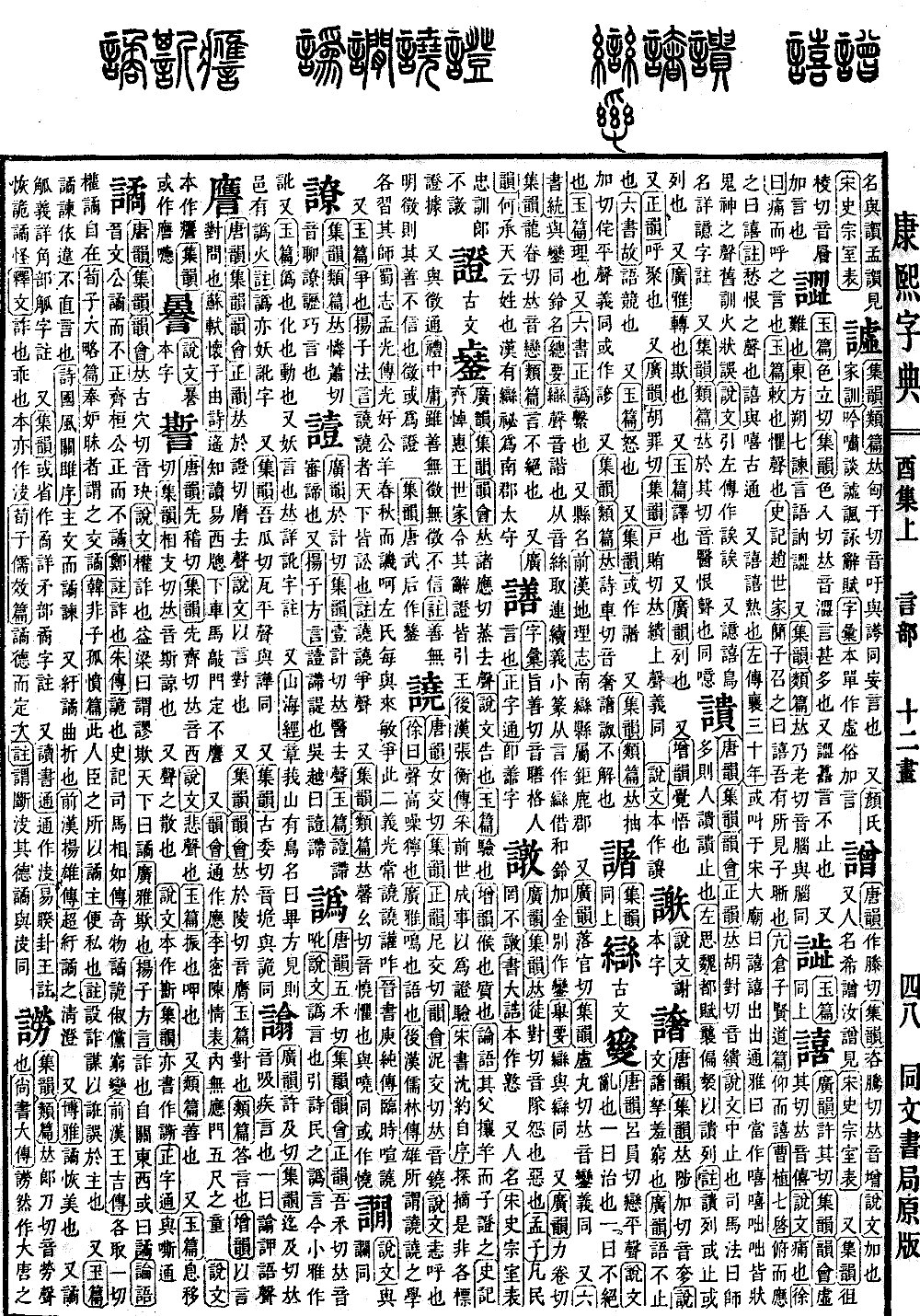
You Collection, Upper Volume
Radical: Speech (yán)
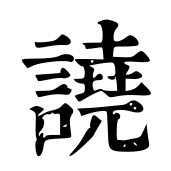
Nao
Kangxi strokes: 19
Page 1180, Entry 16
Pronounced nao.
According to the Explaining and Analyzing Characters (Shuowen Jiezi), it means to shout in anger. Xu remarks that it refers to a high-pitched, noisy, and fierce sound. The Broad Reference (Guangya) states it means to cry out or to speak.
In the History of the Later Han (Houhanshu), within the Biographies of the Confucian Scholars, it mentions: Yang Xiong spoke of the learning of shouting and clamoring, with each studying their own teacher. In the Records of Shu (Shuzhi), within the Biography of Meng Guang, it is written: Guang loved the Gongyang Commentary on the Spring and Autumn Annals (Gongyang Chunqiu) and criticized the Zuo Commentary (Zuozhuan); whenever he debated these two meanings with Lai Min, Guang was always shouting and clamoring. In the Book of Jin (Jinshu), within the Biography of Yu Chun, it refers to the scene being noisy and clamorous.
Additionally, according to the Jade Compendium (Yupian), it means to contend. In the Model Sayings (Fayan) by Yang Xiong, it states: Those who are shouting are all litigating throughout the world. The commentary explains that this refers to the sounds of contention.
Furthermore, according to the Collected Rhymes (Jiyun) and the Classified Dictionary (Leipian), it is pronounced xiao. It means to fear. It is the same as the character xiao. It is sometimes written in a variant form (jiao).