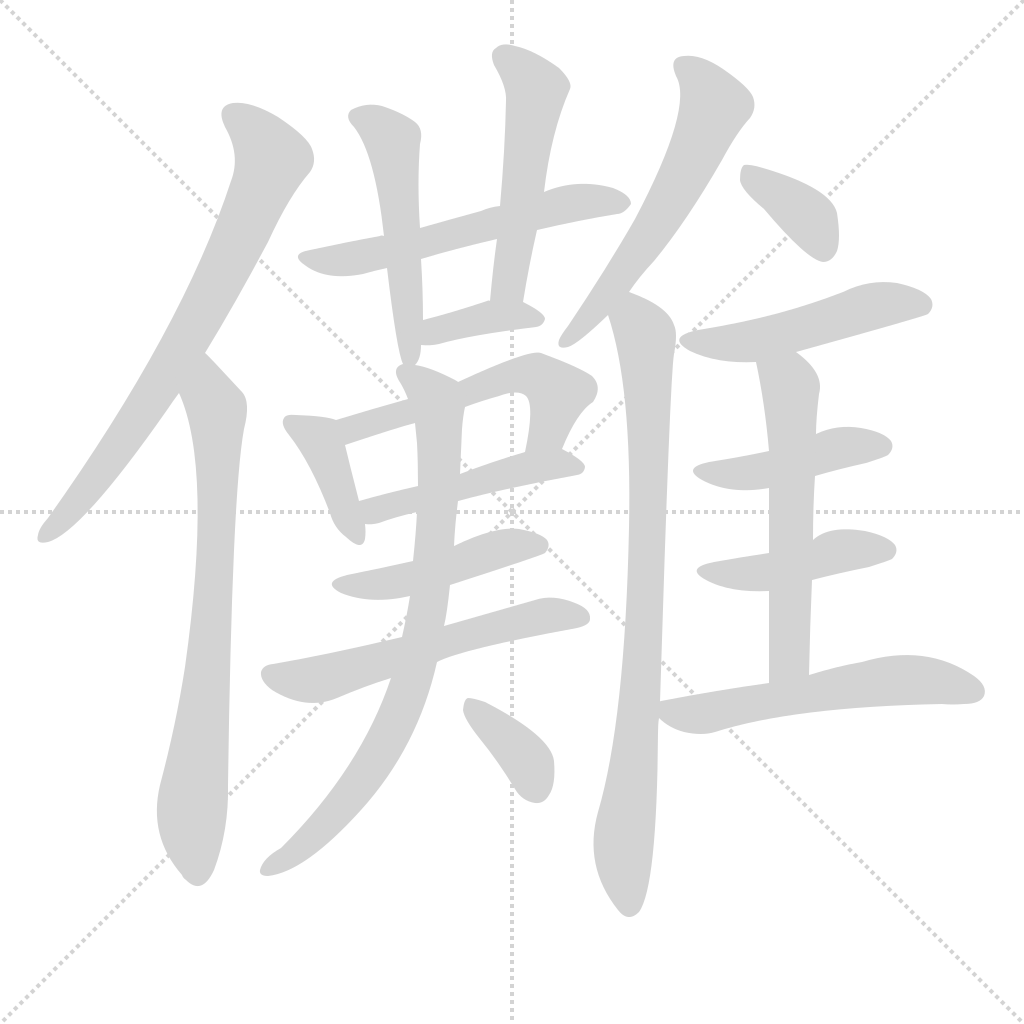
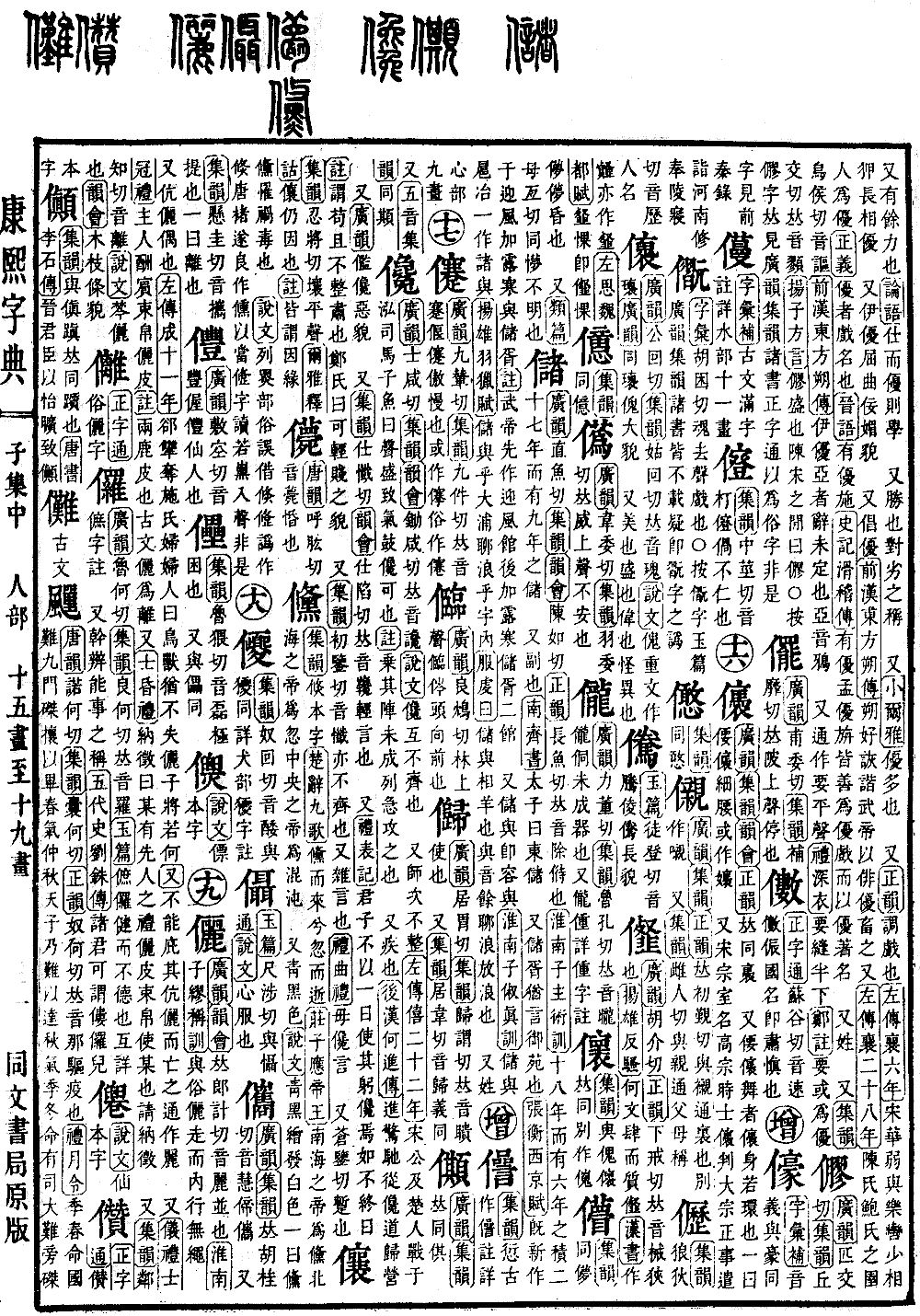
Zi Collection, Middle Volume Radical: Person (rén) Nuo; Kangxi strokes: 21; Page 121, Entry 42
Ancient text. Pronounced nuo. Meaning to expel pestilence. Book of Rites (Liji), Monthly Ordinances (Yueling) records: In the last month of spring, the order is given to hold a Nuo ritual, dividing sacrificial animals at the nine gates to appease spirits and eliminate calamities, thereby ending the breath of spring. In the middle month of autumn, the Son of Heaven holds a Nuo ritual to harmonize the breath of autumn. In the last month of winter, the official in charge is commanded to hold a grand Nuo ritual, dividing sacrificial animals at the gates of the four directions and creating clay oxen to drive away the cold. Annotation: The character is interchangeable with Nuo. Treatise on Curiosities (Bowuzhi), citing old records of the Han dynasty, states that during the Nuo ritual, wooden figures of peach wood, ropes made of reeds, Xanthium, and tigers are set up. Comprehensive Erudition (Tongya) explains: Jian'er is the same as Xanthium. Furthermore, there are twelve Nuo spirits, all of whom are dispatched to pursue and expel malevolent ghosts. Detailed records are found in Book of the Later Han (Hou Hanshu), Treatise on Rites and Ceremonies (Liyizhi).
Also, yi-nuo means a soft and compliant appearance. Book of Odes (Shijing), Odes of Gui (Guifeng): In the lowlands there are sheep-peach trees, their branches are swaying and compliant. Also, Minor Odes (Xiaoya): How beautiful the mulberry trees in the lowlands, how lush their leaves. Annotation: This refers to a lush appearance.
Also, pronounced na. Book of Odes (Shijing), Odes of Wei (Weifeng): The jade ornaments rhythmically chime while walking. Annotation: Nuo refers to an elegant and graceful manner of walking. Examination of Ancient Sounds in Mao’s Odes (Maoshi Guyinkao) states that yi-nuo is pronounced e-na.
Also interchangeable with yini, ana, and enuo. Songs of Chu (Chuci), Nine Arguments (Jiubian): (Trees and plants) swaying lushly and softly within a magnificent house. Song Yu, Rhapsody on Gaotang (Gaotangfu): Clouds and vapors are soft and abundant. Zhang Heng, Rhapsody on the Southern Capital (Nanfufu): Trees and plants are soft and lush. Cao Zhi, Rhapsody on the Goddess of the Luo River (Luoshenfu): A beautiful countenance, light and graceful. The pronunciation and meaning are the same.