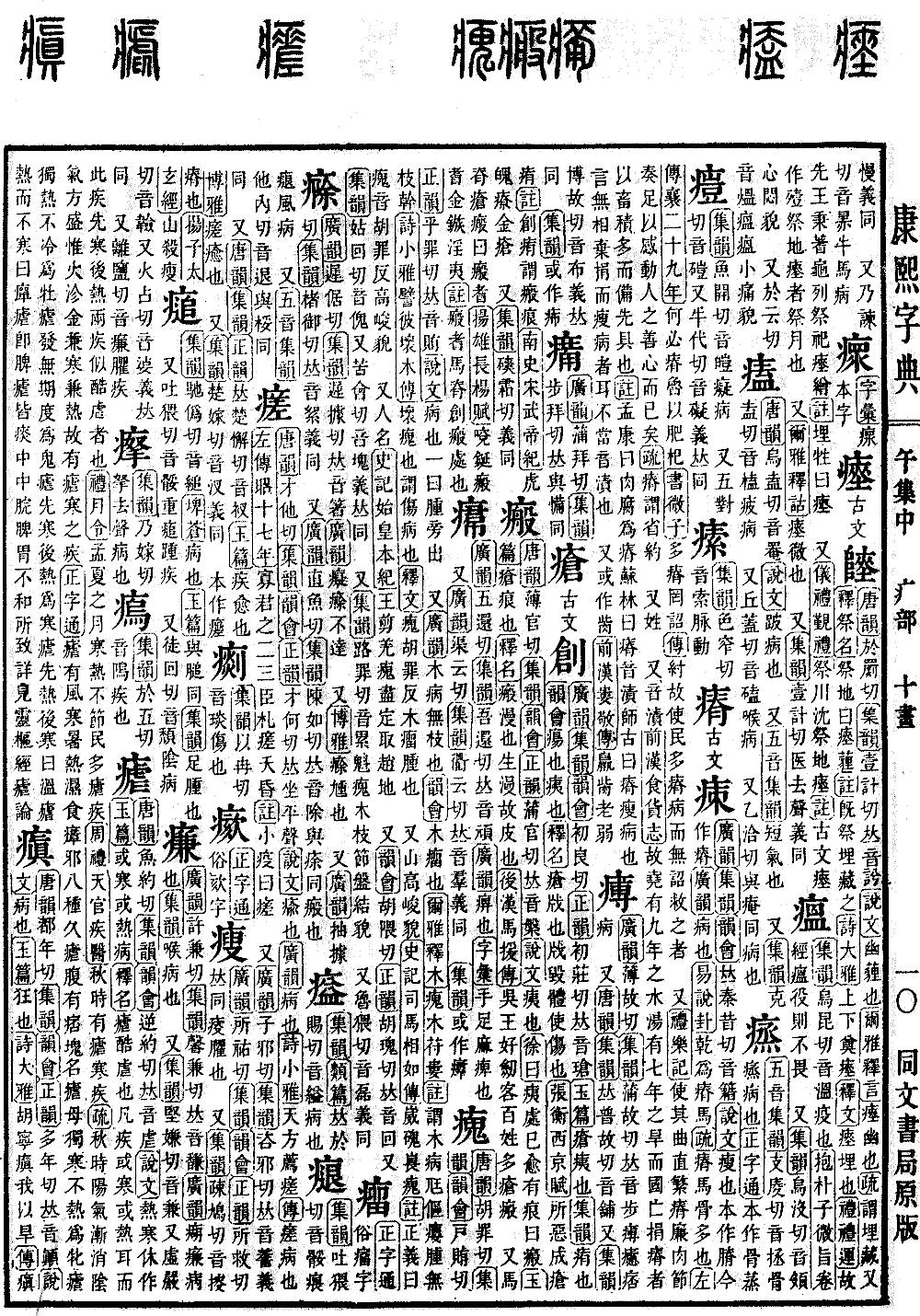
Xu Collection, Middle Volume
Radical: Sickness (nì)
Page 1098, Entry 02
Tang Rhymes (Tangyun) states this character is pronounced yue. Collected Rhymes (Jiyun) and Rhyme Collection (Yunhui) state it is pronounced yue, with the same pronunciation as the word for cruel. Explaining Graphs and Analyzing Characters (Shuowen Jiezi) defines it as the alternating onset of fever and chills. Jade Chapters (Yupian) states it is an illness of alternating cold and heat. Explanation of Names (Shiming) states that the character for malaria implies cruel treatment. Common illnesses are either cold or hot, but this illness involves cold followed by heat, with two symptoms tormenting the person in succession, much like cruel abuse. Record of Rites (Liji), section Monthly Ordinances (Yueling) records that at the beginning of autumn, when cold and heat fluctuations are irregular, the common people often suffer from malaria. Rites of Zhou (Zhouli), section Offices of Heaven (Tianguan), subsection Physicians (Jiyi) records that in autumn, cold-type diseases such as malaria are common. The Sub-commentary (Shu) explains that in autumn, the yang energy gradually recedes while yin energy begins to flourish, and the fire element overcomes the metal element, causing the climate to fluctuate between cold and hot, thus generating malaria, an illness characterized by the interplay of cold and heat. Correct Meaning Treatise (Zhengzitong) records that there are eight types of malaria: wind, cold, summer-heat, heat, dampness, food, miasma, and evil. Those who suffer from malaria for a long time develop a hard mass in the abdomen called the malaria mother. Malaria with only chills and no fever is called female malaria; malaria with only fever and no chills is called male malaria. Malaria that occurs without a regular pattern is called ghost malaria; malaria that starts with chills followed by fever is called cold malaria; malaria that starts with fever followed by chills is called warm malaria; malaria with only fever and no chills is called scorching malaria, which is also known as spleen malaria. These are all caused by phlegm-dampness residing in the middle of the abdomen, leading to a dysfunction of the spleen and stomach. For detailed information, see the Spiritual Pivot (Lingshujing), section Treatise on Malaria (Nue-lun). Textual Correction: The record in Record of Rites (Liji), section Monthly Ordinances (Yueling) mentions early summer as the time when cold and heat fluctuations are irregular. Note: According to the original text, this has been corrected from Early Summer to Early Autumn.