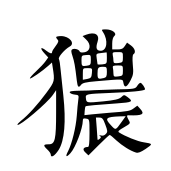
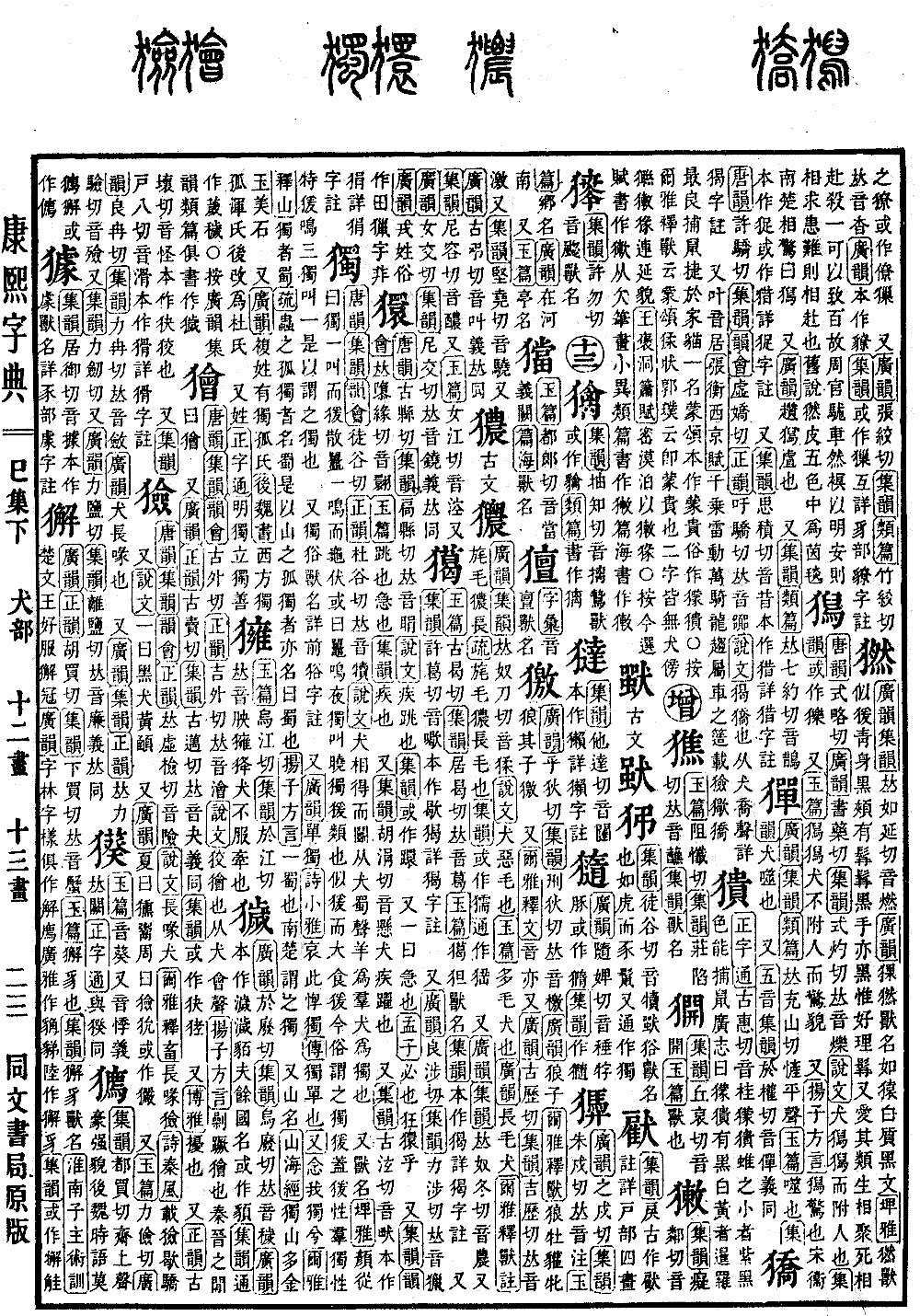
Xu Collection, Middle Volume, Page 1350, Entry 07
Radical: Dog (quǎn)
Pronounced náo.
From "Guangyun" and "Jiyun": Pronounced náo (entering tone). Same pronunciation as "náo".
"Shuowen Jiezi" explains it as the coarse, stiff hair on a dog.
"Yupian" explains it as a hairy dog.
"Guangyun" explains it as a long-haired dog.
"Erya, Shishou, Zhu" mentions "Mao Mao, 㺜chang" (Mao Mao, 㺜 is long).
"Shu" explains: Mao Mao refers to the long hair of the 㺜.
"Jiyun" records that some versions are written as "獳" (nú), and it is also commonly used as "峱" (náo).
Also, from "Guangyun" and "Jiyun": Pronounced nóng (entering tone). Same pronunciation as "nóng".
Also, from "Jiyun": Pronounced nóng. Same pronunciation as "nóng".
Also, from "Yupian": Pronounced kōng. Same pronunciation as "kōng".
Also, from "Guangyun": Pronounced náo (entering tone). From "Jiyun": Pronounced náo (entering tone). Same pronunciation as "náo". The meaning is the same.