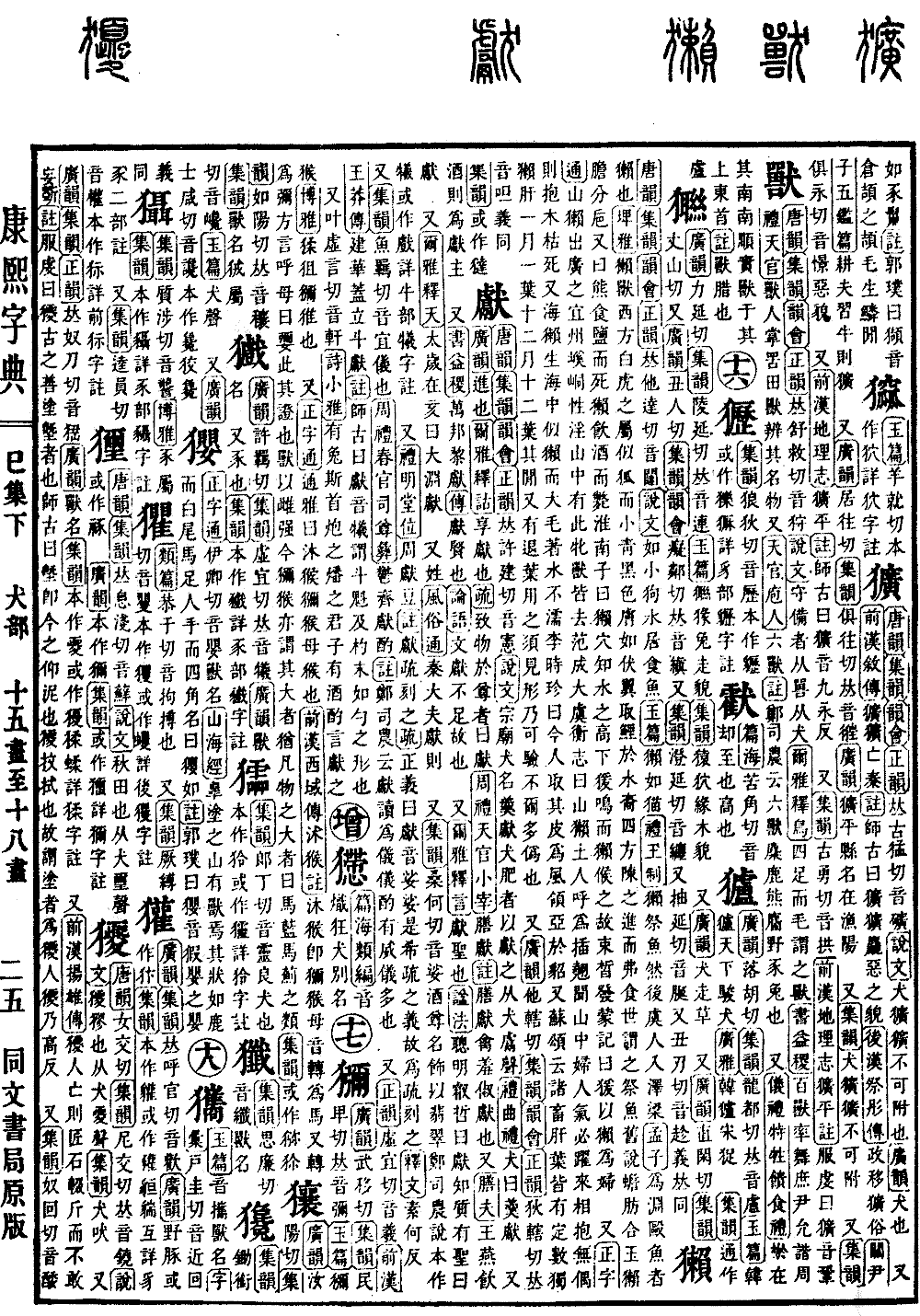
Si Collection, Lower Volume
Radical: Dog (quǎn)
Kangxi strokes: 22
Page 721, Entry 23
Pronounced nao.
Shuowen Jiezi (Dictionary of Explanations and Analyses of Characters): A term meaning to be. Composed of the radical for dog and the phonetic element nao.
Collection of Rhymes (Jiyun): The barking of a dog.
Also pronounced nao.
Guangyun (Broad Rimes): Name of a beast.
Collection of Rhymes (Jiyun): Originally written as nao. Sometimes written as nao, nao, or rou. Refer to the notes under the entry for the character nao.
Also in the Biography of Yang Xiong in the History of the Former Han (Hanshu): When the plasterer is gone, the master mason stays his axe and dares not hack at random.
Notes: Fu Qian states that this refers to an ancient artisan skilled in plastering and coating. Yan Shigu states that coating refers to modern plastering. The term refers to the act of wiping or smoothing; thus, one who plasters is called a plasterer. Pronounced nai.
Also pronounced nai.
Ancient term for one skilled in plastering and coating.
Notes on the History of the Former Han (Hanshu): Yan Shigu states it is also pronounced nai.
Collection of Rhymes (Jiyun): Sometimes written in a variant form, commonly used interchangeably with other variants.
Pronounced nao.
Guangyun (Broad Rimes): A dog startled.
Collection of Rhymes (Jiyun): The appearance of a dog barking in fear.
Pronounced rao.
Meaning is the same.