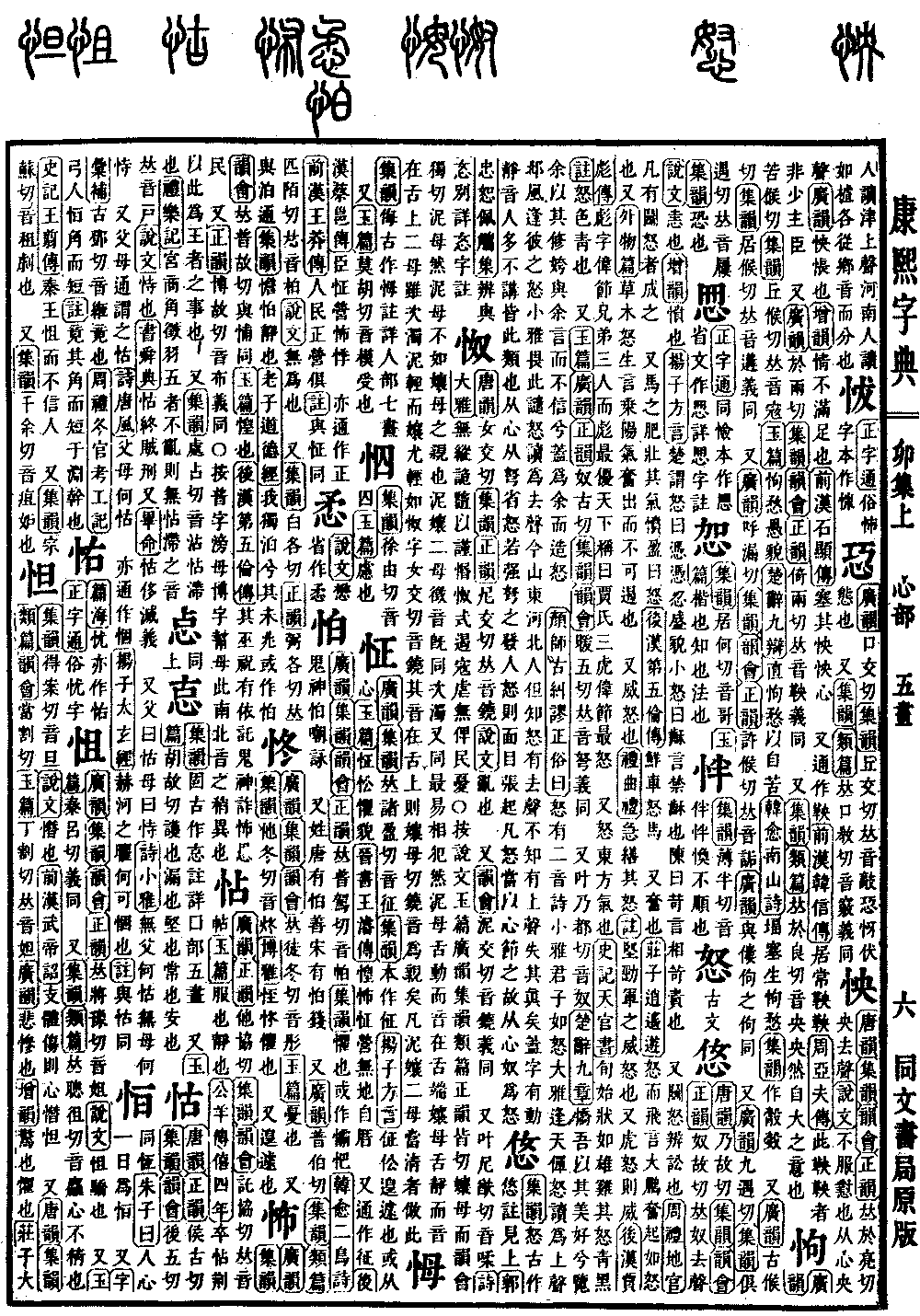
Mao Collection, Upper Volume
Radical: Heart (xīn)
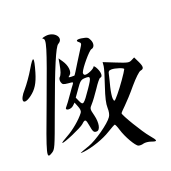
Character: Nao
Kangxi strokes: 9
Page 380, Entry 11
Pronounced nao.
Shuowen Jiezi (Shuowen) states it means disorder.
Yunhui states it is pronounced nao. The meaning is the same.
Also pronounced ni.
From the Book of Odes (Shijing), Great Odes: Do not indulge in deceitful behavior, so as to restrain the confused and chaotic. Prevent tyrannical behavior, and do not cause the people sorrow.
Note: Shuowen, Yupian, Guangyun, Jiyun, Leipian, and Zhengyun all use the initial consonant niang, while Yunhui alone uses the initial consonant ni. However, the ni initial is less precise than the niang initial. The ni and niang initials share the same musical note classification and the same secondary voiced quality, making them easily confused. Yet with the ni initial, the tongue moves and the sound is at the tip of the tongue. With the niang initial, the tongue is still and the sound is on the upper part of the tongue. Although both initials are secondary voiced, the ni initial is light and the niang initial is especially light. Taking the character nao as an example, pronounced nao, the sound is produced on the upper part of the tongue, so the niang initial is the more precise pronunciation. Whenever the ni and niang initials are considered, one should follow this logic.