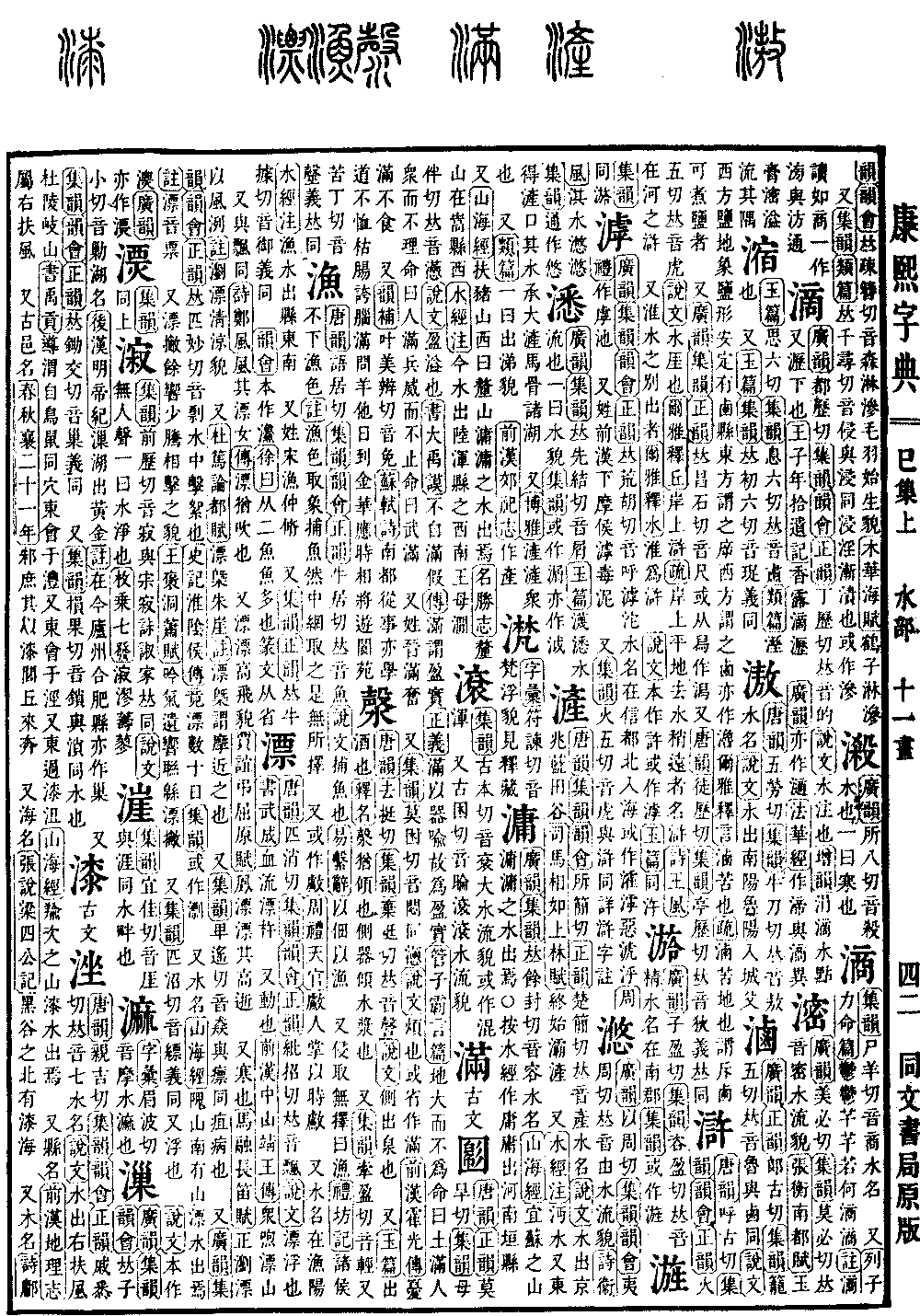
Si Collection, Upper Volume
Radical: Water (shuǐ)
Man
Kangxi strokes: 15
Page 644, Entry 18
Archaic script.
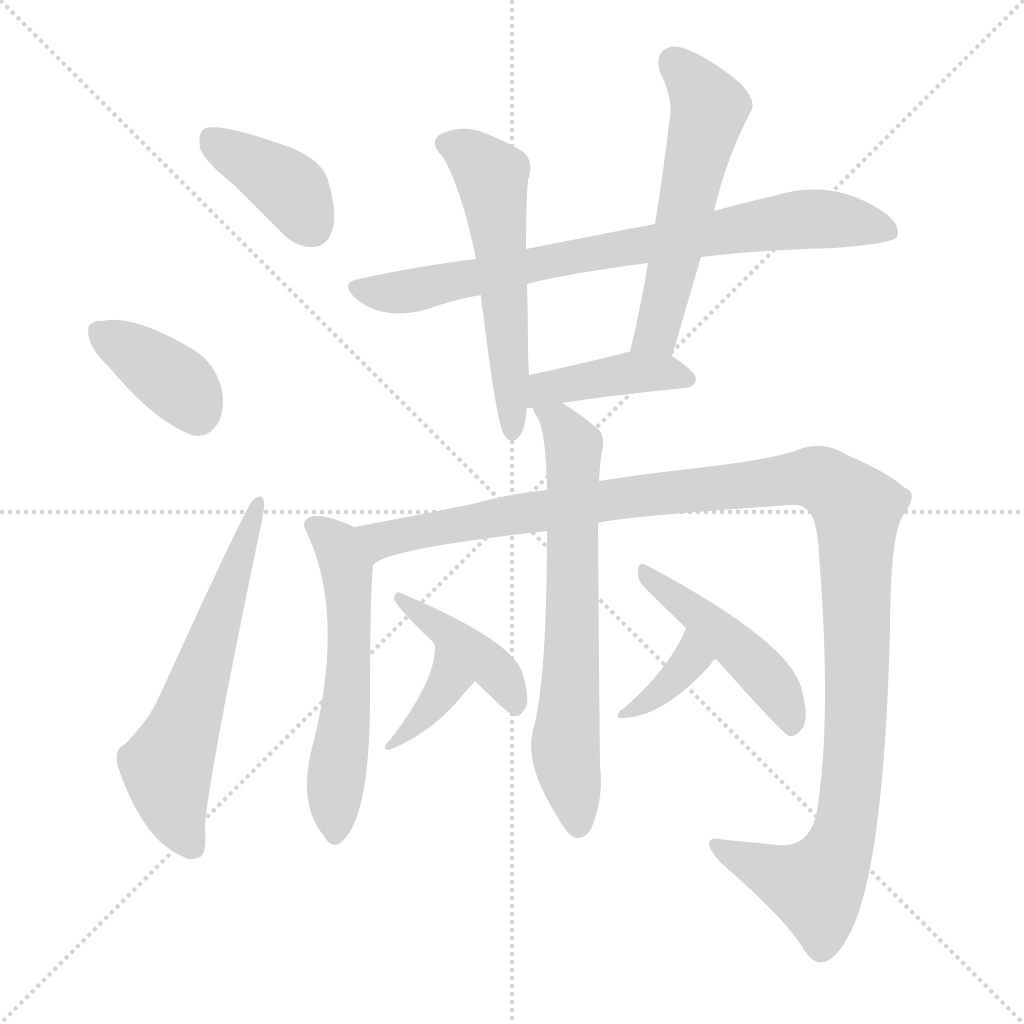
Pronounced mǎn.
Shuowen Jiezi (Explanation of Graphs and Analysis of Characters) states: To be full or overflowing.
Book of Documents (Shangshu), Chapter on the Counsels of the Great Yu: Do not be self-satisfied (man).
Commentary states: Man refers to being full and substantial.
Correct Meaning states: Man is used as a metaphor for vessels, therefore it means full and substantial.
Guanzi, Discourse on Hegemony: When territory is vast but ungoverned, it is called earth-full (tu man). When the population is numerous but unmanaged, it is called human-full (ren man). When military might is strong but does not cease, it is called martial-full (wu man).
Also a surname. During the Jin dynasty, there was a man named Man Fen.
Also pronounced mèn. The same as the term for vexed.
Shuowen Jiezi (Explanation of Graphs and Analysis of Characters): Refers to being vexed or depressed. Sometimes written in a simplified form.
Book of Han (Hanshu), Biography of Huo Guang: Worried, vexed, and unable to eat.
Also rhyming with miǎn.
Poem by Su Shi: The official from the southern capital also studies the Way, not pitying his withered intestines but boasting of his full-fed brain. Asking when you will visit Jinhua another day, you should arrive in time to travel together to the Garden of the Immortals.
Also written as a variant form.