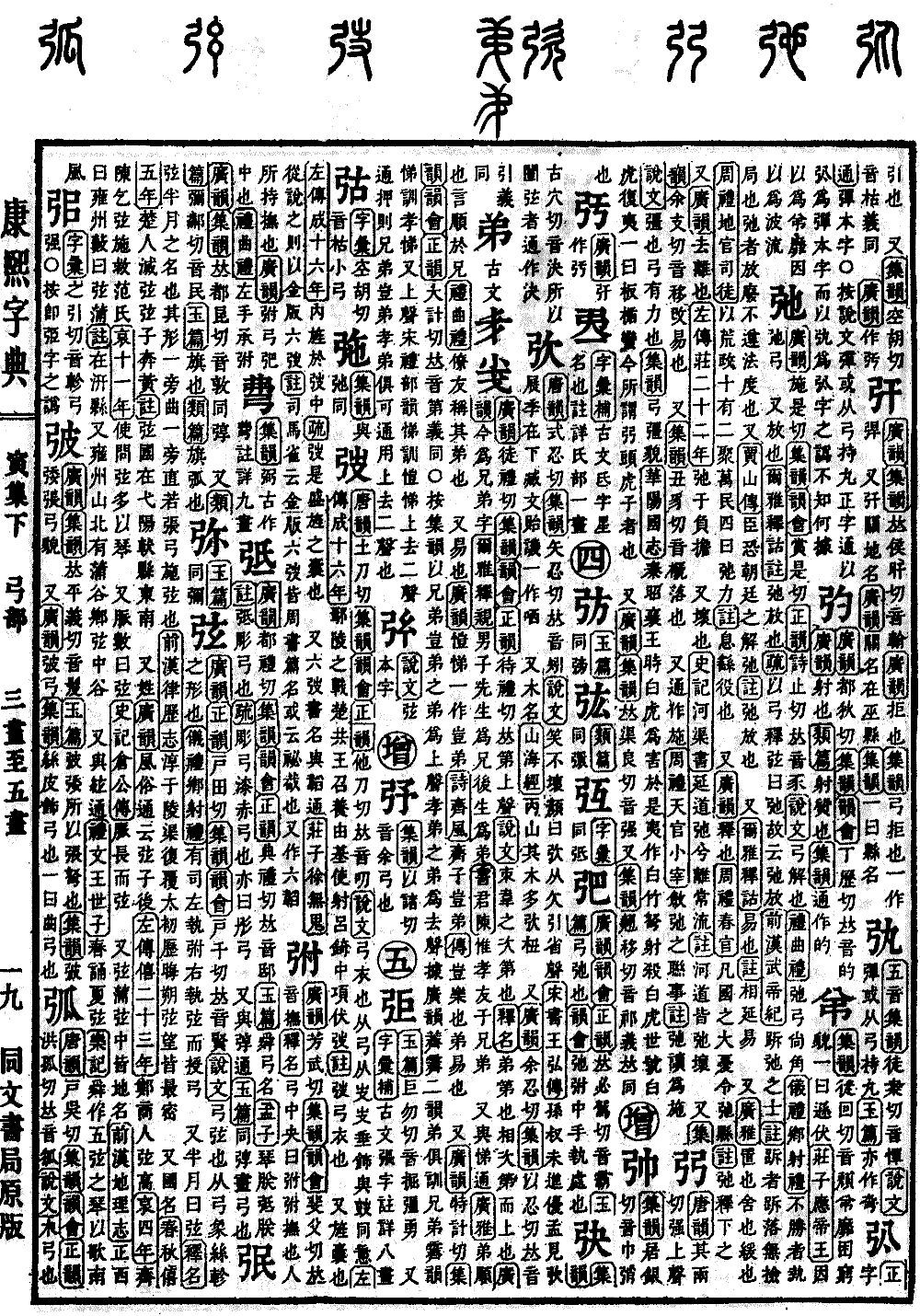
Yin Collection, Lower Volume
Radical: Bow (gōng)
Kangxi stroke count: 17
Page 357, Entry 02
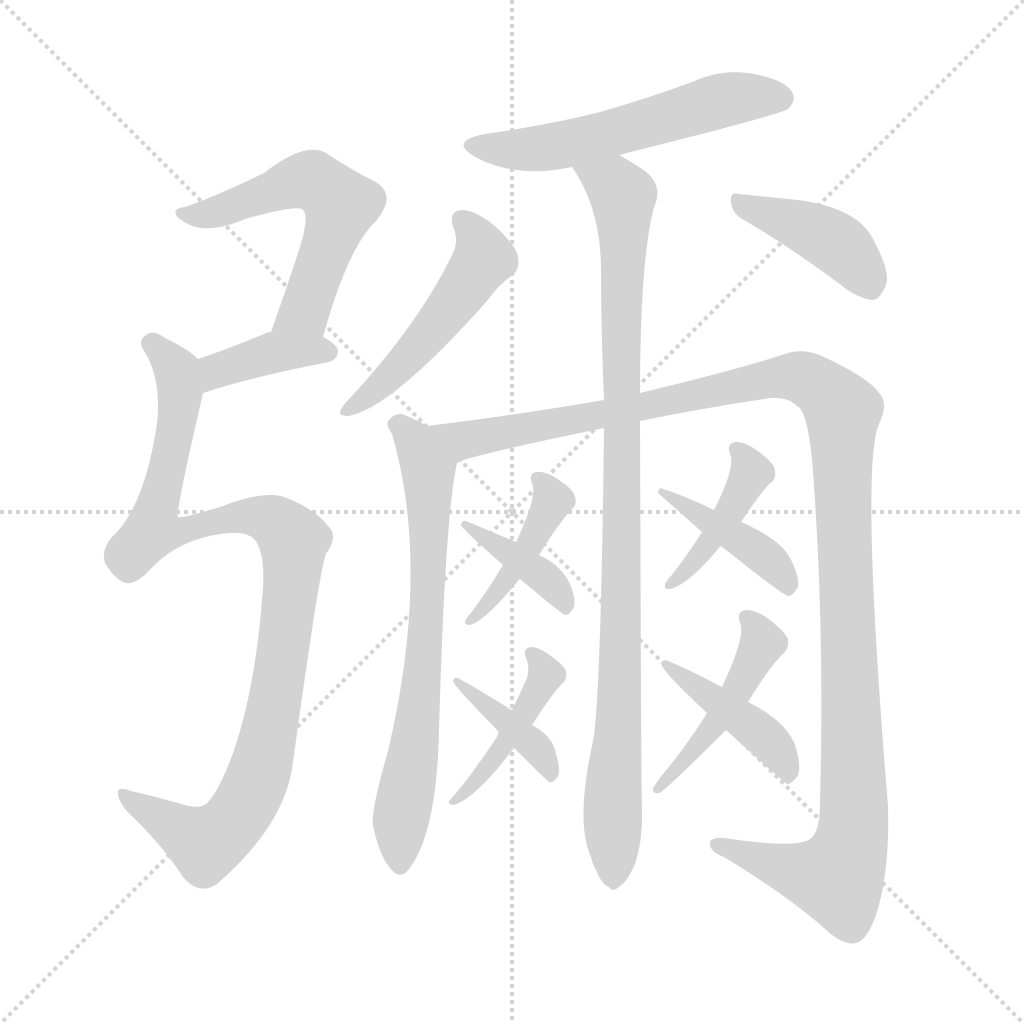
Ancient form. According to the Guangyun (Book of Rhymes), it is pronounced mi. According to the Jiyun (Collected Rhymes) and the Yunhui (Collection of Rhymes), it is pronounced mi. In the Shuowen Jiezi (Explanation of Simple and Compound Characters), it means to unstring a bow. According to the Yupian (Jade Chapters), it means to encompass or permeate. In the Book of Rites (Zhouli), specifically the Spring Officials section, it refers to a comprehensive sacrifice. The commentary states that the term implies completeness. According to the Leipian (Categorized Chapters), it means to end or complete. In the Book of Odes (Shijing), it is used to describe the completion of the months of pregnancy. The commentary states that it means to finish. According to the Guangyun, it means to increase. In the Analects (Lunyu), it is used to describe increasing height and firmness. According to the Guangyun, it means long in duration or time. It also means distant. In the Zuo Tradition (Zuozhuan), it refers to a distant relative. The commentary states that it implies distance. It also refers to a white rainbow or atmospheric phenomenon. In the Book of Rites (Zhouli), it refers to the omen of a white rainbow spanning the sky. It also refers to mending or repairing deficiencies. In the Book of Changes (Yijing), it refers to the comprehensive governance of the way of heaven and earth. The sub-commentary explains it as mending or covering a gap. In the Zuo Tradition (Zuozhuan), it refers to mending one's faults. The term mimi refers to a gradual state. In the History of the Former Han (Hanshu), it describes a gradual loss. The term milong refers to a decoration on a carriage. In the Records of the Grand Historian (Shiji), it describes a gold-decorated carriage yoke shaped like a dragon used to convey authority. Hanmi refers to the name of a kingdom. In the History of the Former Han (Hanshu), it is the Hanmi Kingdom, now known as Ningmi. It is also a surname. According to the Guangyun, the Sanfu Juelu records a person named Mi Sheng from Xinfeng. There is also a complex surname among the Qiang people, such as the Later Qin general Mije Pochu. According to the Leipian, it is pronounced mi. Yimi refers to an infant. In the Book of Rites (Liji), it describes an infant who has lost its mother on the road. The commentary notes that this is synonymous with the term for an infant. According to the Yunhui, it is pronounced mi (rising tone). According to the Leipian, it means to stop. According to the Yunhui, it means to rest. In the Book of Rites (Zhouli), it refers to stopping disasters and war. In the History of the Former Han (Hanshu), it refers to a brief moment of peace. The Yunhui notes that this is often used interchangeably with the character for to suppress.