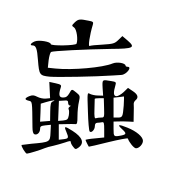
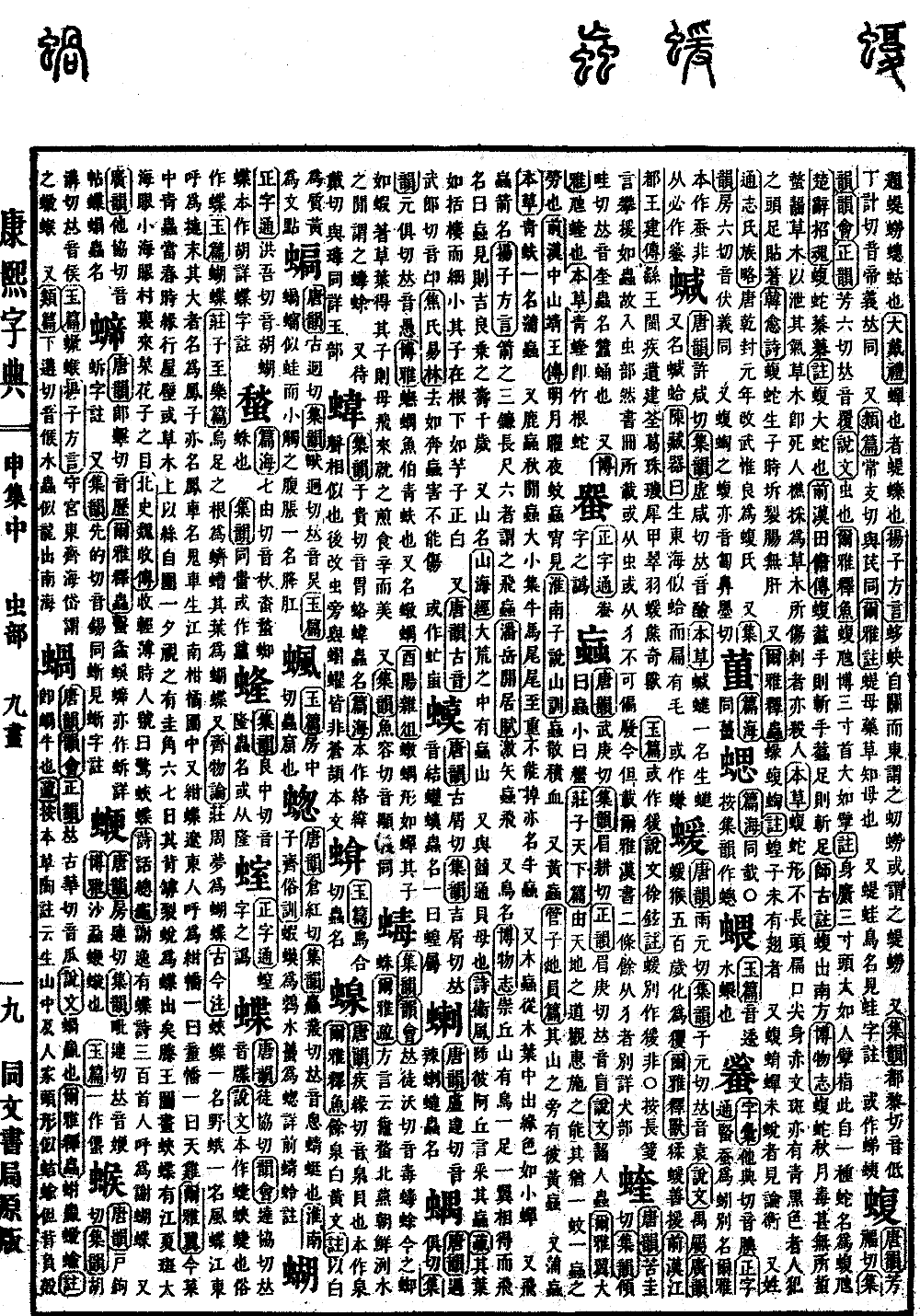
Shen Collection, Middle Volume. Radical: Insect (chóng). Kangxi strokes: 15. Page 1091, Entry 10.
Pronounced mang.
According to the Shuowen Jiezi (Explanation of Chinese Characters), it is an insect that bites. According to the Eya Yi (Supplementary Wings to the Erya), the large ones are called mang, and the small ones are called meng. In the Zhuangzi, it is written that viewing the talents of Huishi from the perspective of the Way of Heaven and Earth is like the toil of a mosquito or a biting insect. In the Biography of Prince Jing of Zhongshan from the History of the Former Han (Qian Hanshu), it is said that bright moonlight illuminates the night, while mosquitoes and biting insects appear at night. According to the Huainanzi (Instruction on Speaking of Mountains), biting insects can absorb stagnant blood.
Also known as yellow mang. In the Guanzi (Earth Components), it is mentioned that beside that mountain, there are those yellow biting insects. Also known as pu mang. According to the Bencao (Pharmacopoeia), the qingfu is also called pu mang. Also known as lu mang. In autumn, these insects gather in groups of various sizes on the tails of cattle and horses, making the tails so heavy they cannot be flicked; this is also called niu mang (ox mang).
Also known as mu mang (wood mang), which grows from tree leaves and is green, resembling a small cicada.
Also the name of an arrow. According to the Fangyan (Regional Dialects), a three-edged arrowhead measuring one foot six inches long is called fei mang (flying mang). In Pan Yue's Rhapsody on Living in Seclusion (Xianju Fu), it is said that the launched arrow flies like a biting insect.
Also the name of a bird. According to the Bowuzhi (Treatise on Miscellaneous Records), there is a bird on Chongqiu Mountain with one leg and one wing; they must pair up to fly, and it is called mang. Seeing it brings good fortune, and riding it allows one to live for a thousand years.
Also the name of a mountain. According to the Classic of Mountains and Seas (Shanhaijing), there is a Mang Mountain in the Great Wilderness.
Also interchangeable with meng, referring to the fritillaria plant. According to the Book of Odes (Shijing), in the Wei songs: Ascend that hill to gather the fritillaria. The commentary states that its leaves resemble those of the snake gourd but are thinner, and its root produces bulbs underground that are pure white like taro seeds.
Pronounced mang. According to the Jiaoshi Yilin (Master Jiao's Forest of Changes), departing like a fleeing biting insect, misfortune cannot cause harm. Sometimes written in a variant form (méng).