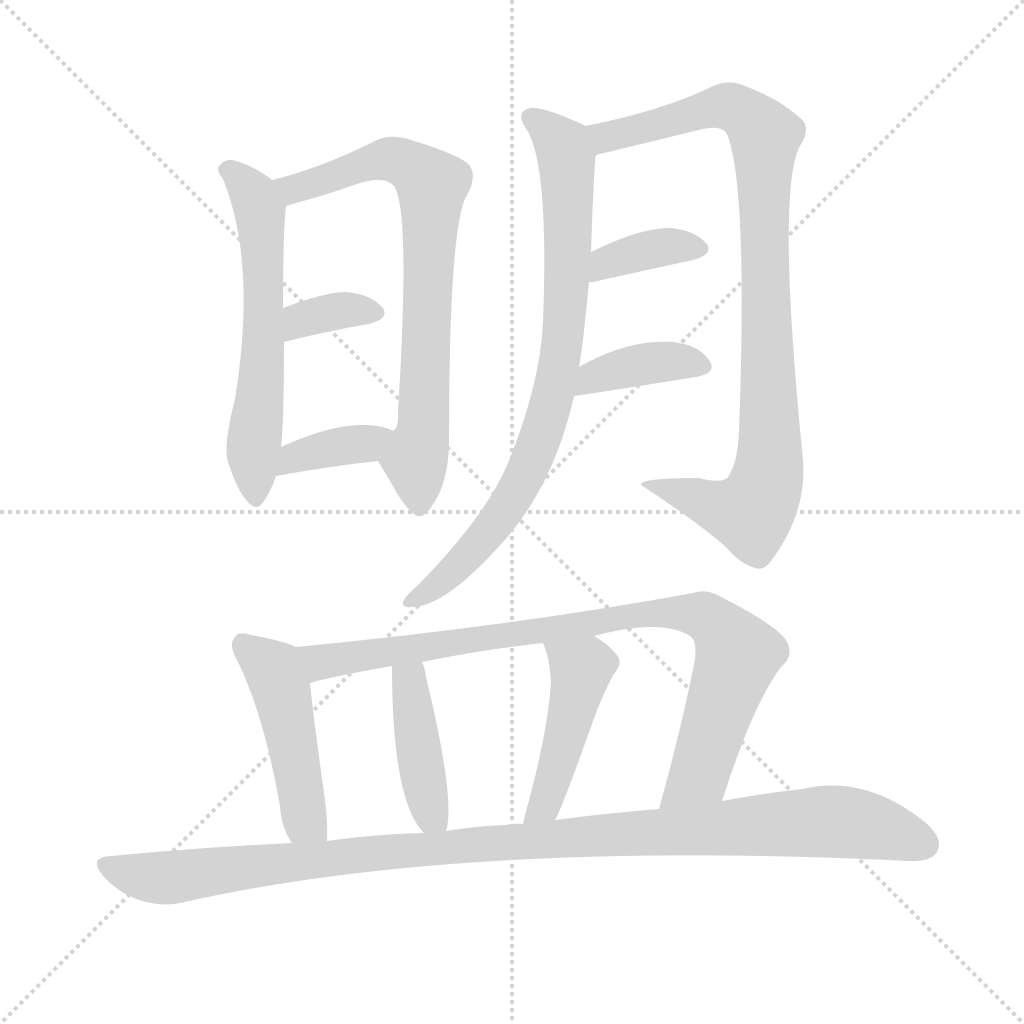
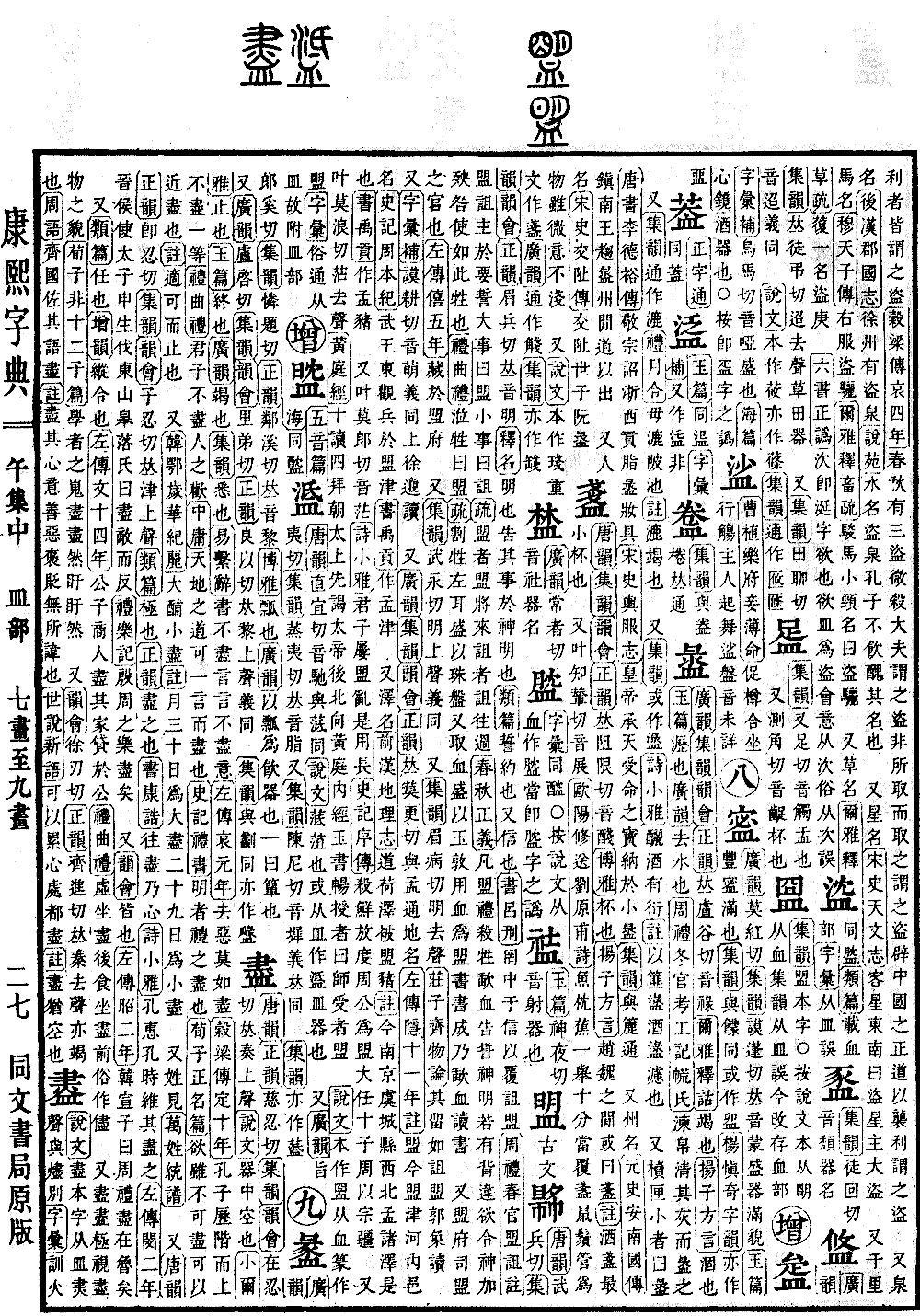
Wu Collection, Middle Volume. Radical: Vessel (mǐn). Kangxi Strokes: 13. Page 795, Entry 17.
Ancient form.
According to Tang Rhymes (Tangyun), pronounced ming (rising tone). According to Collected Rhymes (Jiyun), Rhyme Anthology (Yunhui), and Correct Rhymes (Zhengyun), pronounced ming (rising tone).
Interpretations of Names (Shiming): Meaning to manifest. To declare one's business to the gods.
Classification Compilation (Leipian): A sworn covenant. Also, trustworthiness.
Book of Documents (Shujing): Without remaining centered in trust, one brings about cursed covenants.
Rites of Zhou (Zhouli): The official in charge of covenants and curses is the Covenant Invoker. Annotation: Covenants and curses center on oaths. Major matters are called covenants; minor matters are called curses. Commentary: A covenant is a pledge for the future; a curse is an invocation regarding past offenses.
Spring and Autumn Annals (Chunqiu): Regarding the rites of covenants, one slaughters an animal, smears the blood, and swears to the gods. If one violates the oath, one invites the gods to inflict calamities, treating the violator like the slaughtered animal.
Book of Rites (Liji): Approaching the animal is called a covenant. Commentary: They cut the left ear of the animal, place it in a pearl-inlaid platter, collect the blood in a jade vessel, and use the blood for the covenant document. Once written, they smear the blood and read the text aloud.
Also, the Covenant Bureau (Mengfu), the official in charge of covenants. Zuo Tradition (Zuozhuan): Stored in the Covenant Bureau.
According to Collected Rhymes (Jiyun), pronounced ming (rising tone). Meaning is the same.
According to Collected Rhymes (Jiyun), pronounced ming (falling tone). Zhuangzi: It remains like a curse or covenant. Guo Xiang reading.
According to Supplement to the Collection of Characters (Zihui bu), pronounced meng. Meaning is the same. Xu Miao reading.
According to Broad Rhymes (Guangyun), Collected Rhymes (Jiyun), Rhyme Anthology (Yunhui), and Correct Rhymes (Zhengyun), pronounced meng. Interchangeable with the character for elder brother.
Place name. Zuo Tradition (Zuozhuan): Meng is present-day Mengjin. A city name in Henei. Records of the Grand Historian (Shiji): King Wu inspected his troops in the east at Mengjin. Book of Documents (Shujing): Written as Mengjin.
Also, the name of a marsh. Former Han History (Hanshu): Passing through Heze, covering Mengzhu. Annotation: This is the present-day Mengzhu marsh, northwest of Yucheng County in Nanjing. Book of Documents (Shujing): Written as Mengzhu.
Also, rhyming with mang. Book of Odes (Shijing): The noble man frequently makes covenants, and thus disorder grows. Records of the Grand Historian (Shiji): Killing the fresh and releasing the degree, the Duke of Zhou acted as a covenant. With ten sons of Tai Ren, Zhou established its borders.
Also, rhyming with mang (falling tone). Yellow Court Classic (Huangting jing): Read ten times and bow four times to honor the Supreme One, first visiting the Great Emperor and then facing north. The internal yellow court jade scriptures are clear, the one who gives is the teacher, the one who receives is the covenant.
Shuowen (Analytical Dictionary of Characters): Originally written with blood, derived from blood. The seal script is written as such.
Collection of Characters (Zihui): Commonly follows the vessel radical, therefore included under Radical: Vessel (mǐn).