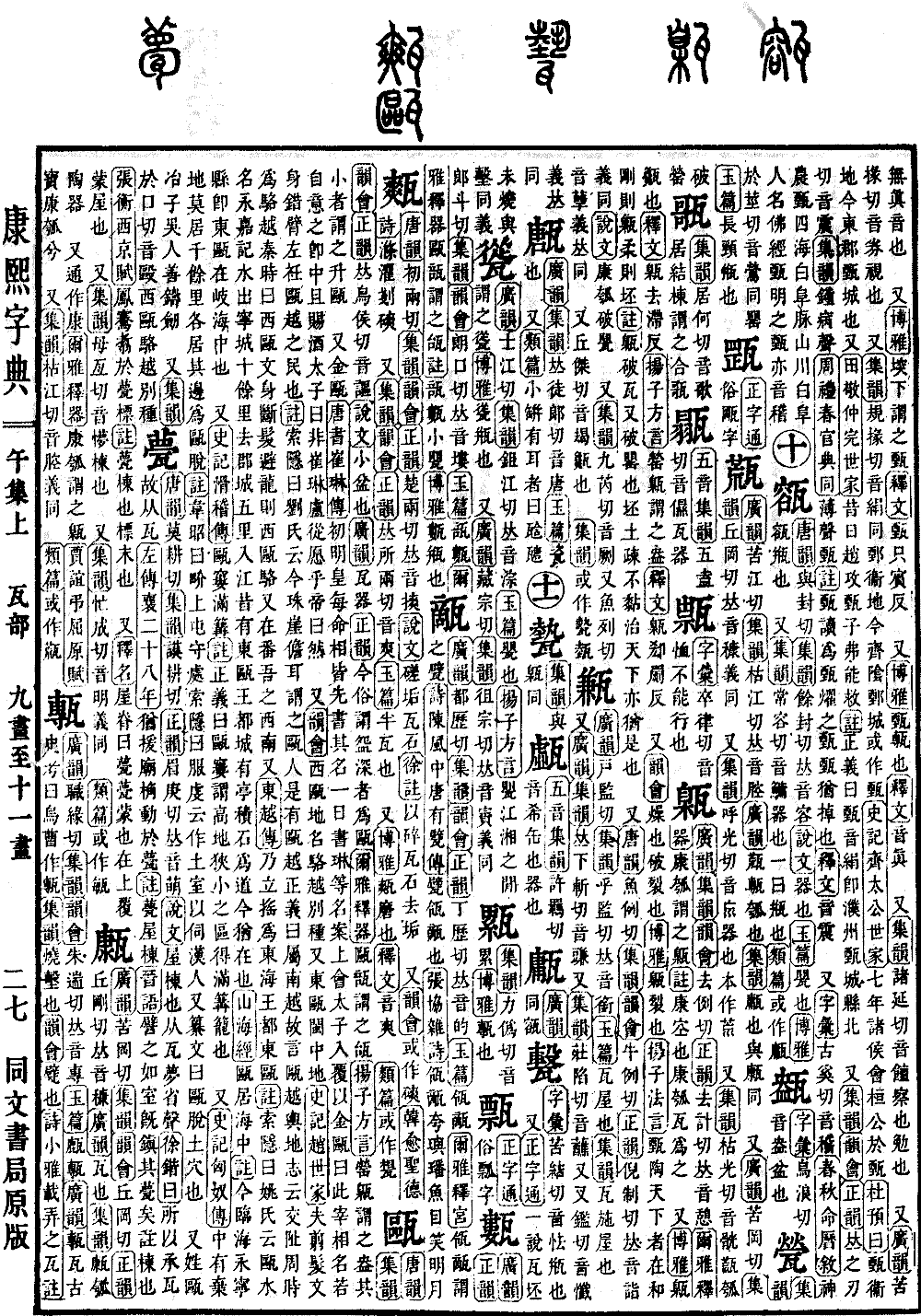
Wu Collection, Upper Volume
Radical: Tile (wǎ)
Kangxi Strokes: 16
Page 751, Entry 23
Pronounced meng.
According to the Explaining Graphs and Analyzing Characters (Shuowen Jiezi), it refers to the ridgepole of a roof. Formed by the radical for tile, with a shortened phonetic component for dream. Xu Kai states that it supports the tiles, which is why it is formed with the radical for tile.
As recorded in the Commentary on the Spring and Autumn Annals (Zuozhuan), Year 28 of Duke Xiang: Just as pulling on the rafters of the ancestral temple causes the ridgepole to shake. Commentary: The ridgepole of a roof.
In the Discourses of Jin (Jinyu): Like a house that has already had its ridgepole secured. Commentary: The ridgepole.
In the Western Capital Rhapsody (Xijing Fu) by Zhang Heng: The phoenixes fly upwards to the tip of the ridgepole. Commentary: The ridgepole is the beam, and the mark is the extremity.
Also, in the Explanation of Names (Shiming): The ridge of a roof is called a ridgepole. It means to cover, as it resides above to provide covering for the house.
Also, in the Collected Rhymes (Jiyun), pronounced meng. It means ridgepole.
Also, in the Collected Rhymes (Jiyun), pronounced ming. The meaning is the same.
In the Classified Chapters (Leipian), it is sometimes written in a variant form.