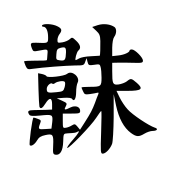
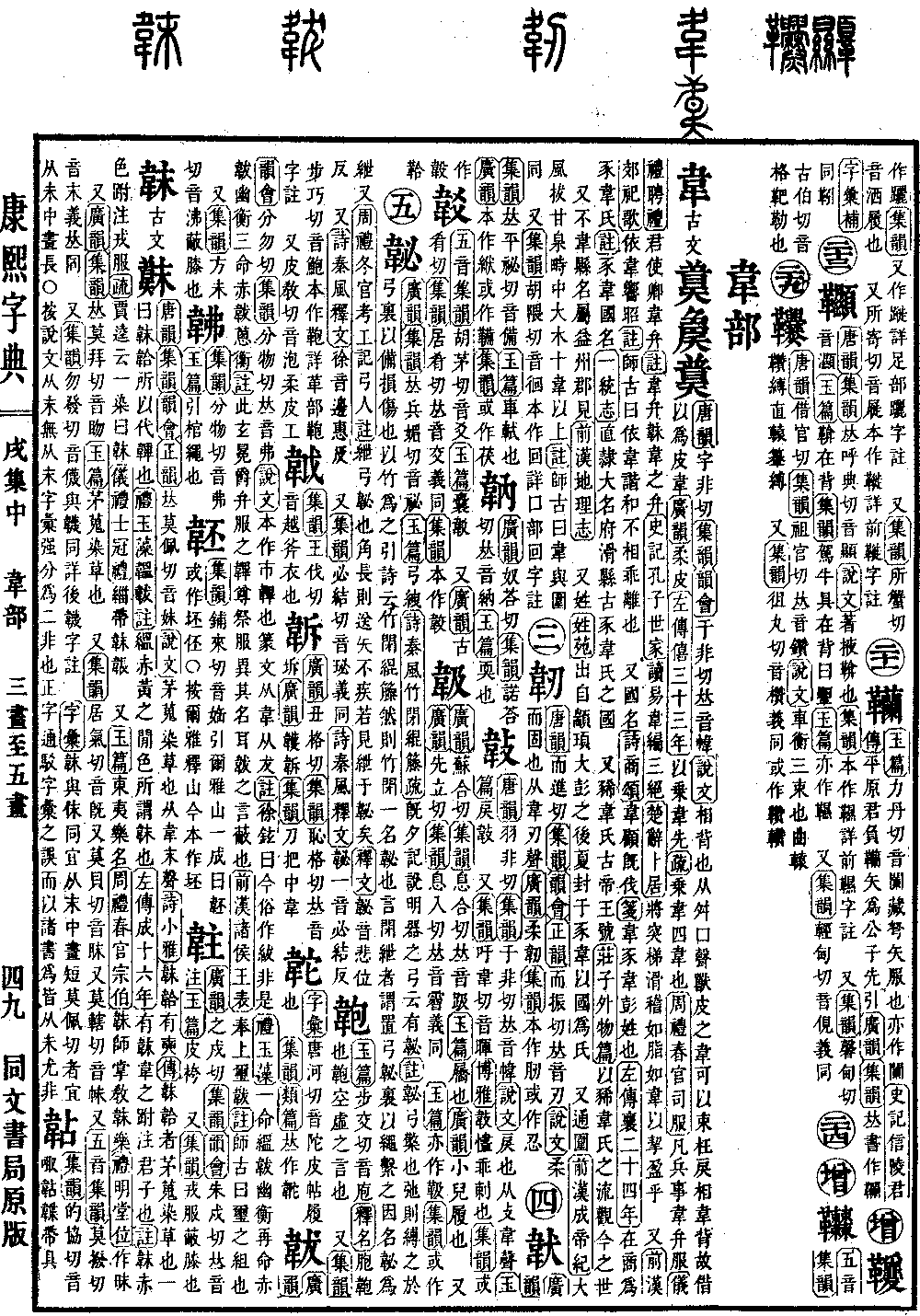
Xu Collection, Middle Volume
Radical: Leather (wéi)
Kangxi Strokes: 14
Page 1393, Entry 25
Ancient text.
According to Tang Rhymes (Tangyun), Collection of Rhymes (Jiyun), Rhyme Meetings (Yunhui), and Orthodox Rhymes (Zhengyun), pronounced mei (falling tone).
According to Explaining Graphs and Analyzing Characters (Shuowen Jiezi), it refers to leather dyed with madder root. The character structure is derived from the leather radical, with mo acting as a phonetic component.
Book of Odes (Shijing), Xiao Ya section: Contains the phrase "The leather knee-covers are bright red."
The commentary explains: A leather knee-cover is leather dyed with madder root. One account says it is a garment used to replace the knee-cover.
Book of Rites (Liji), Jade Pattern (Yuzao) commentary: States that yun is a color between red and yellow, which is known as the color mei.
Zuo Commentary (Zuo Zhuan), 16th Year of Duke Cheng: Records a person wearing leggings made of tanned leather dyed the color mei, describing him as a gentleman. The commentary notes that mei refers to a red color, and the leggings are part of military attire.
The sub-commentary quotes Jia Kui: A color achieved through a single dyeing process is called mei.
Book of Etiquette and Ceremonial (Yili), Master’s Capping Ceremony: Mentions a black belt and leather knee-covers.
Jade Articles (Yupian): Records that it is also the name of a dance of the Eastern Yi tribes.
Rites of Zhou (Zhouli), Spring Offices, Minister of Religion: Records that the Master of Mei is in charge of teaching the music of the Mei.
Book of Rites (Liji), Hall of Distinction (Mingtangwei): Written as a variant form (mei).
Also, according to Broad Rhymes (Guangyun) and Collection of Rhymes (Jiyun), pronounced mai (falling tone).
Jade Articles (Yupian): Interpreted as grass dyed with madder root.
Also, according to Collection of Rhymes (Jiyun), pronounced ji (falling tone).
Also, pronounced mei (falling tone).
Also, pronounced mo (entering tone).
Also, according to Five Sound Rhyme Collection (Wuyin Jiyun), pronounced mo (entering tone).
All the above pronunciations and meanings are the same.
Also, according to Collection of Rhymes (Jiyun), pronounced wu (entering tone). It is the same as the character for socks. See the detailed notes for the character for socks later.
Compilation of Characters (Zihui): Considers that this character and another are the same, and the character form should be derived from the component mo with a short center stroke. For the pronunciation mei (falling tone), the character form should be derived from the component wei with a long center stroke. However, according to Explaining Graphs and Analyzing Characters (Shuowen Jiezi), it is derived from mo and not from wei. The Compilation of Characters (Zihui) is incorrect in forcibly dividing these into two separate characters. The Corrected Meaning of Characters (Zhengzitong) refutes the error in the Compilation of Characters (Zihui), yet it incorrectly claims that all various texts are derived from wei.
Textual Research: In the Book of Etiquette and Ceremonial (Yili), Master’s Capping Ceremony, the text originally read "black belt and leather waist-cover." It is noted that the character for waist-cover should be corrected to the character for knee-cover.