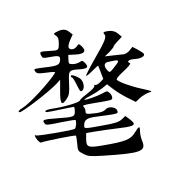
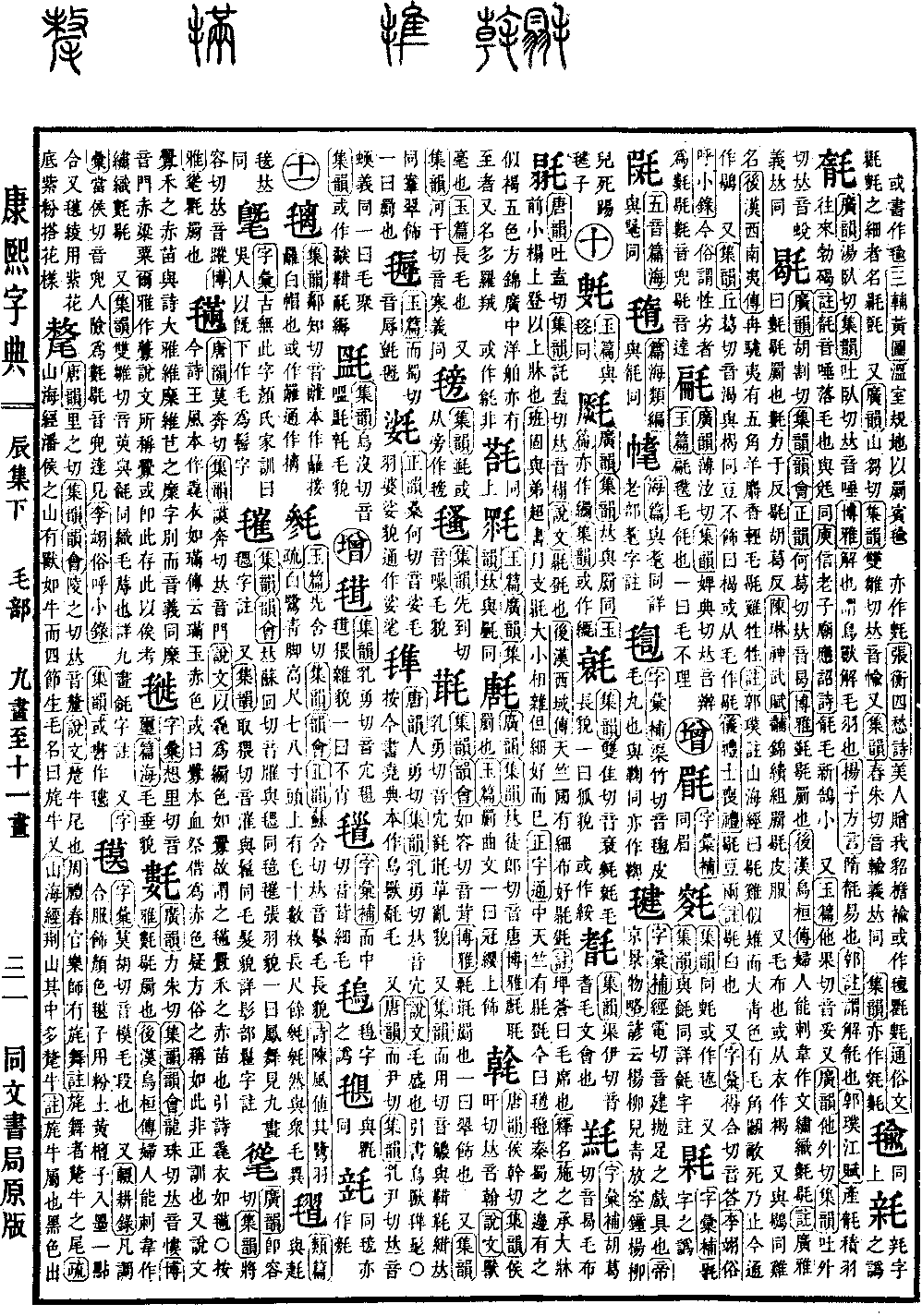
Chen Collection, Lower Volume, Radical: Hair (shān)
Page 595, Entry 46
Pronounced li (entering tone)
Also, a yak's tail.
"Yak's tail dance" — Book of Rites (Zhou Li), Official of Spring, Music Master, annotation: The yak's tail dance is the tail of the yak.
A commentary states: The "Book of Mountains and Seas" (Shanhaijing) says that on Mount Panhou, there is a beast resembling an ox, with hair growing from its four limbs, named the yak.
Also in the "Book of Mountains and Seas" (Shanhaijing): Mount Jing, which has many yaks. Annotation: Yaks are a type of bovine, black in color, found beyond the southwestern borders.
"The celestial horse, with hooves raised, follows the yak" — Poetry of Du Fu.
The tail of a horse is also called a yak.
"A horse's yak, cut like jade" — "Explaining the Mountains" (Shuoshun) in "Huainanzi". Annotation: Yak refers to a horse's tail.
Also, hair that is stiff and curved.
"Using yak hair to adorn clothing" — "History of the Former Han" (Qian Han Shu), Biography of Wang Mang. Annotation: According to Shi Gu: Hair that is stiff and curved is called yak; it is used to stuff clothing to make it stand out.
Also in the "Book of Five Elements" (Wuxing Zhi) of the "History of the Former Han" (Qian Han Shu): In the third year of Tianhan, in the eighth month, white yak hair rained from the sky.
Also in the "Minor Er Ya" (Xiao Erya): Mixed hair is called yak.
Also, long hair.
"Cen Xi was promoted to the position of Prefect of Weijun, and the people sang: 'The dog barks without alarm, and long hair grows beneath your feet.'" — Biography of Cen Peng in the "Later Han" (Hou Han Shu). Annotation: Yak refers to long hair. Since the dog does not chase and bark, long hair grows beneath your feet.
Also, felt.
"Yak is felt" — "Erya" (Shi Yan). Guo's annotation: Hair yak is used to make felt.
Xing's commentary states: It is woven from hair. It is like felt rugs today, used to adorn the horse's girth.
Also, when referring to fine things, it is called yak.
"Using yak hair to hang a louse on the window" — "Liezi" (Yin Tang).
"The bamboo fibers are separated, and the threads are divided" — "Ode to the Nine Wonders" (Jiuhua Shan Fu) by Cao Zhi.
Also interchangeable with li.
"Without cutting off fine hairs" — "Records of the Grand Historian" (Shiji), Biography of Su Qin.
"Not losing a single hair" — "Lü Li Zhi" in the "History of the Former Han" (Qian Han Shu). Annotation: Meng Kang states: Ten hairs make one yak.
Also pronounced mo (falling tone).
Pronounced mao (falling tone). The meaning is the same. Also written as 斄, 髦, 犛.
Also pronounced lai (rising tone). The meaning is the same.
Note: In the "Book of Rites" (Zhou Li), the annotation for 牦 states: pronounced mao. Liu pronounces it lai, Shen pronounces it li, some pronounce it mao, some write it 犛, and some write it 斄. According to the annotation of Guo Xiang's commentary on Zhuangzi's "Free and Easy Wandering" (Xiaoyao You), the 牦牛 is as large as the clouds that fill the sky. The annotation states: Guo's pronunciation is reversed, Xu and Li pronounce it lai, and Sima states: it is a yak. From this, it is known that although the pronunciations vary among scholars, the meaning is the same.